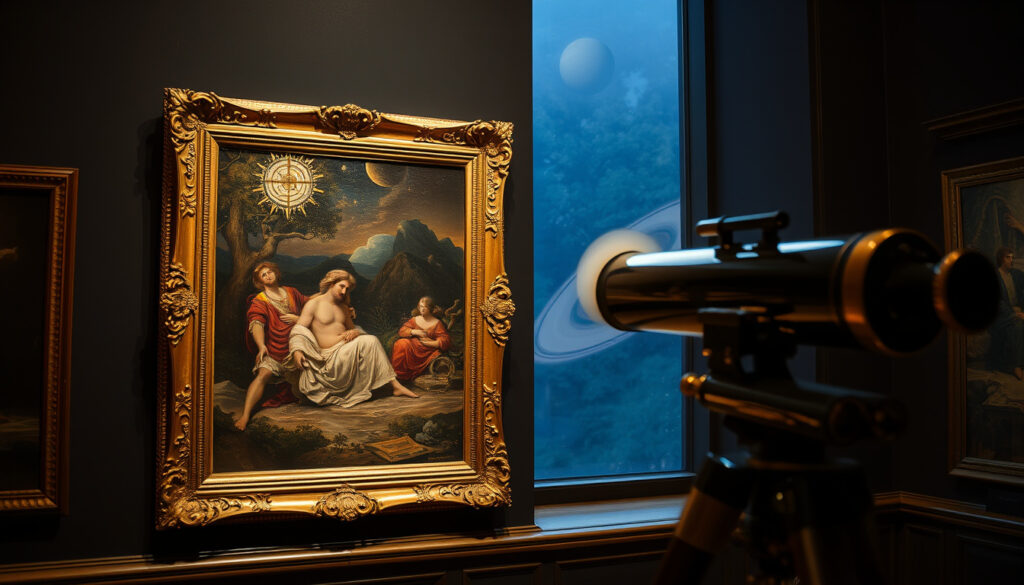
Saturn Devouring His Son: God, Painting, and Planet
Type “Saturn Devours” into a search box and three very different things answer: a blood-soaked painting by Francisco Goya, a paranoid Roman god who ate his children, and a gas giant with no solid surface at all. That collision is why the phrase trips people up — and the version that hangs in Madrid’s Museo del Prado, painted between 1819 and 1823, is the one this article untangles.
Date painted: 1819–1823 ·
Current location: Museo del Prado, Madrid ·
Black Paintings total: 14 ·
Saturn cloud-top average: About -178°C (-288°F) ·
100 lb on Earth on Saturn: About 107 lb
Quick snapshot
- Goya painted it on a wall of Quinta del Sordo, his house near Madrid, between 1819 and 1823 (Museo del Prado’s catalog entry).
- It is one of the 14 works in the Black Paintings series (Wikipedia’s Black Paintings overview).
- The cycle was transferred from plaster walls to canvas and now lives in the Museo del Prado (Khan Academy’s art history video).
- Goya’s exact symbolic intention is debated; no single reading is official (Encyclopaedia Britannica’s painting analysis).
- The child in the image is never identified. (Encyclopaedia Britannica’s painting analysis)
- Biblical name identifications with Saturn remain a matter of scholarly interpretation. (Encyclopaedia Britannica’s painting analysis)
- 1819–1823: painted on a wall of Goya’s house on the edge of Madrid, the date range in the Prado’s catalog entry.
- 1873: Baron Émile d’Erlanger bought the house and the murals were moved to canvas, as Khan Academy’s art history video recounts.
- 1889: on view at the Prado, per the museum’s provenance record.
- The painting remains on display in the Prado’s permanent collection.
- New readings keep attaching to the image, from political allegory to personal confession.
- Searching “Saturn” now splits between god, painting, and planet — this article keeps them apart.
Six fields, one pattern: the entire documented identity of this painting fits in one short table, and every value traces to the same house and the same museum.
| Field | Value |
|---|---|
| Artist | Francisco Goya |
| Date | 1819–1823 |
| Series | Black Paintings |
| Medium | Oil on wall, transferred to canvas |
| Location | Museo del Prado, Madrid |
| Subject | Roman god Saturn eating a child |
Why is Kronos eating his son?
The short answer is a prophecy. In Greek myth, Cronus — the Titan the Romans later named Saturn — swallowed his children because he had been told that one of them would overthrow him (Encyclopaedia Britannica’s Goya explainer). The myth turns a father into a lesson about power and fear, and that is the story Goya’s painting pulls from.
The family tree matters because the prophecy only works if you know who is inside the god’s belly. Cronus was the son of Uranus and Gaia, and his children were Zeus, Hera, Poseidon, Hades, Demeter, and Hestia — five of them swallowed, one saved. It is the same Cronus who drives the villain arc of the Percy Jackson series, where the prophecy logic gets a second life (Percy Jackson Books in Order).
Who is Saturn’s child?
- In the Greek myth, the children of Cronus are Zeus, Hera, Poseidon, Hades, Demeter, and Hestia.
- In the Roman version, the father is Saturn and the famous son is Jupiter, the equivalent of Zeus.
- In Goya’s painting, the child is shown mid-act and never named.
The wording trips people because “Saturn’s child” sounds like it should have one answer. The myth has six; the painting shows one; and the famous son, Zeus or Jupiter, is the one who escaped.
Who is Saturn’s wife?
- In Greek myth, Cronus’s wife is Rhea.
- She is the one who saved Zeus when the prophecy reached its crisis.
Rhea’s role is the quiet hinge of the whole story. Without her substitution, there would be no Zeus, no later overthrow, and no myth for Goya to paint.
How did Zeus escape being swallowed?
- Rhea gave Cronus a stone wrapped in cloth, and the god swallowed the stone instead of the baby.
- Zeus was raised out of reach, then forced Cronus to disgorge his swallowed siblings.
- The prophecy completed itself: a child did overthrow his father.
That is the arc Goya compresses into one frozen moment. The painting does not show the prophecy or the escape — it shows the exact act the prophecy set in motion.
The pattern: the myth is not about appetite; it is about what a ruler will destroy to keep power. Goya understood that, and his painting turns the myth’s engine — fear — into the god’s expression.
The implication: Goya’s image is not the whole myth; it is the moment the myth’s engine starts.
Where is Saturn devouring his son now?
The painting’s address is easy to remember: it has hung in the Museo del Prado in Madrid since 1889. What most people do not expect is that it began as a wall.
Where was Saturn Devouring His Son originally painted?
- Goya painted it directly on a wall of Quinta del Sordo, his house on the edge of Madrid (Museo del Prado’s provenance record).
- The room was on the ground floor, opposite Leocadia Zorrilla — the Black Painting that faces it.
- The date range usually given is 1819–1823, near the end of Goya’s life.
How was the mural transferred to canvas?
- After Goya’s death, the wall images were cut from the plaster and mounted onto canvas (Khan Academy’s art history video).
- Baron Émile d’Erlanger bought Quinta del Sordo in 1873 and oversaw the transfer.
- The canvases then passed into the Prado’s collection, where the cycle has been shown since 1889.
What is the painting’s title in the Prado collection?
- The museum’s catalog describes the subject as “Saturn devouring one of his sons” (Museo del Prado’s catalog entry).
- The common English title, Saturn Devouring His Son, is a shortened version of that description.
- The painting itself never names the child.
The title difference matters more than it looks. “One of his sons” keeps the myth’s ambiguity alive: the painting shows a single child, and the image does not say which son that is.
The implication: the painting we see in Madrid is a documented survivor. What began as private wall decoration became a museum object because the house changed hands — a transfer that saved the image but detached it from the room Goya chose for it.
What does Goya’s Saturn symbolize?
The Prado calls Saturn devouring one of his sons one of the most expressive images among the Black Paintings. The word “expressive” is doing careful work: the painting has no official meaning, only a stack of documented readings (Encyclopaedia Britannica’s painting analysis).
Why did Goya paint Saturn Devouring His Son?
- Political allegory: the Peninsular War, which tore Spain apart.
- Personal allegory: parental loss, and Goya’s own aging and illness.
- Universal allegory: old age versus youth, or Time devouring all things.
- Theological allegory: God’s wrath.
Each of those readings comes from the same source — Britannica explicitly lists them as interpretations, not facts. The honest answer to “why did Goya paint it” is that no one knows, and the painting keeps its silence.
What are the Black Paintings?
- A cycle of 14 murals now in the Prado; the roster includes Saturn Devouring His Son, The Dog, Witches’ Sabbath, Judith and Holofernes, and La Leocadia (Wikipedia’s Black Paintings overview).
- They were painted in oil directly on the walls of Quinta del Sordo.
- All of them were private images, not commissions for a church or palace.
The privacy is the part people forget. These were images for a house, not for an audience. The Black Paintings were only widely seen after the transfer to canvas, which is why the series felt shocking when it arrived in the Prado.
Why is the painting considered disturbing?
This painting became the face of the Black Paintings because it is the hardest to look at. The Guardian reported that some viewers can hardly look at it (The Guardian’s 2019 Prado bicentennial coverage), and Britannica reads the god’s wide-eyed stare as madness and paranoia (Encyclopaedia Britannica).
The violence is obvious, but the detail that stays with viewers is the stare. Goya is not painting a monster enjoying a meal; he is painting a deity trapped inside the act, wide-eyed and losing control.
- The stare is the same psychological register that makes fictional villains like Bellatrix Lestrange linger in memory — cruelty that looks human, not cartoonish (Bellatrix Lestrange: Life, Love, Death – Harry Potter Explained).
Why this matters: the ambiguity is the point. A painting that could be read as war, disease, old age, or a father’s fear keeps being rewritten by each generation — which is how a private wall decoration became a public Rorschach test.
The pattern: because the painting was private, not public, each generation has felt free to project its own fear onto it — which is exactly why it remains unavoidable.
Who is Saturn to Zeus?
The short answer: father. Saturn is the Roman name for Cronus, and Cronus is Zeus’s father. In Roman terms, the same relationship reads as Saturn and Jupiter (Encyclopaedia Britannica’s Goya explainer). One myth, two naming systems, and a lot of confusion at the search bar.
Is Saturn a god or goddess?
- Saturn is a male deity; the Latin name is Saturnus.
- He belongs to the Titan generation, not the Olympians.
The question comes up because “Saturn” is met first as a planet by most people, and planets do not have gender.
What is the Roman god name for Saturn?
- The Latin name is Saturnus — Saturn in English (Encyclopaedia Britannica’s Saturn entry).
- His son in the Roman version is Jupiter, the counterpart of Zeus.
So the Roman chain is Saturn → Jupiter, exactly parallel to the Greek chain Cronus → Zeus. Keep the two chains side by side and half the “Saturn Devours” confusion disappears.
What is the Greek equivalent of Saturn?
- Cronus (also spelled Kronos) (Wikipedia’s Cronus entry).
- The Greek Titan identified with the Roman Saturn.
Saying “the Greek equivalent of Saturn” and “the Roman name for Cronus” are two routes to the same god. The painting’s subject is that god — the Titan whose myth ends with a son taking his power.
The trade-off: learning that Cronus equals Saturn and Zeus equals Jupiter resolves half the puzzle. The other half comes from the planet, which shares the god’s name but none of his behavior.
Why is Saturn considered bad?
The bad reputation is a stack of traditions, not one source. Ancient astrology classed Saturn as a malefic planet tied to time, limitation, and hardship. The myth gave the god the same job description: a father who devoured his children to protect his throne. Then Goya added a face to the fear. The word “saturnine” — gloomy, slow, cold — still carries the old reputation.
What is Saturn called in the Bible?
- In some Bible translations, Amos 5:26 and Acts 7:43 contain names such as Chiun (or Kaiwan) and Remphan.
- Some scholars connect those names to Saturn, but the identification stays a matter of interpretation (Wikipedia’s Saturn mythology entry).
This is the spot where a search result can sound more certain than the scholarship. The biblical names exist in the text; the Saturn link is an inference, not a settled translation.
What demon is associated with Saturn?
- No single canonical demon is attached to Saturn in mainstream theology.
- Occult and astrological traditions assign different planetary spirits depending on the system.
If a claim names one specific demon as “the” demon of Saturn, treat it as tradition-specific. There is no universal answer to point to.
What is the origin of Saturn’s malefic reputation?
Three separate layers built Saturn’s dark reputation: ancient astrology’s malefic planet, the child-eating father of myth, and Goya’s paranoid portrait (Encyclopaedia Britannica). None of the layers alone defines Saturn — together they made the name feel dangerous.
The oldest layer is astronomical. Saturn moved slowly across the sky, and astrology wrote that slowness as limitation and delay. The myth layer reinforced it — a god who ate his children — and Goya’s painting gave the god a face that reads as madness. Each generation added a darker shade.
The pattern: every era wrote its own fear onto the name. Astrologers wrote limitation, mythographers wrote infanticide, Goya wrote old age and dread — and the search result today inherits all of it.
What this means: Saturn’s reputation is an accretion, not an origin — each era added a new reason to flinch at the name.
Can humans visit Saturn?
No — and the reason is more basic than distance. Saturn is a gas giant with no solid surface. There is no ground to stand on, only layers of gas that get denser and hotter with depth.
Is it hot or cold on Saturn?
Cloud-top average: about -178°C (-288°F) ·
Going deeper: pressure and temperature rise steadily
The -178°C figure refers to the cloud tops, the part telescopes see (NASA’s Saturn fact sheet). Descend far enough and the gas becomes so compressed it behaves like a liquid — which is why “landing” has no real meaning there.
Why can’t we survive on Saturn?
- There is no solid surface to set down on.
- The cloud tops are far below freezing.
- The atmosphere is mostly hydrogen and helium, with no breathable oxygen.
A probe can dive into the upper atmosphere, but there is no “arrival.” Any human near Saturn would be dealing with cold, pressure, and toxic air simultaneously.
How much would a 100 lb person weigh on Saturn?
- On Saturn, at the 1-bar pressure level, the same mass would weigh about 107 lb.
- On Jupiter, it would weigh about 253 lb.
- The Saturn figure assumes a place to stand that does not exist — it is a gravity calculation, not a practical measurement.
That last point is the one to hold onto. The 107 lb number compares gravity, not experience, because no one will ever stand on Saturn to check.
What planet are you heaviest on?
- Jupiter has the strongest gravity of the planets.
- The same 100 lb on Earth becomes about 253 lb on Jupiter.
- Jupiter also has the shortest day, about 9 hours 56 minutes.
Both records belong to Jupiter alone: it spins fastest and pulls hardest.
Which planet has 99.7% chance of life?
- No planet has an established 99.7% chance of hosting life.
- The figure circulates online without a verified source behind it.
When a number like that shows up, the honest response is skepticism. No planetary dataset in the research record supports it, and a meme is not a measurement.
The 99.7% life figure is the perfect test case: it sounds precise, it gets repeated, and it has no source behind it. For anyone fact-checking Saturn online, the move is to ask exactly that — what is the source, and where is the number from?
The takeaway: the planetary Saturn answers a different set of questions than the painting does. If you want cold, no-surface, unvisitable physics, that is the planet. If you want the face of fear, that is the god in the Prado.
The pattern: the planet, the god, and the painting have different rules of evidence — myth is argued, art is interpreted, and planetary science is measured.
Three Saturns, one name: how to tell them apart
Three Saturns, one pattern: the name keeps the myth’s dark reputation even when the subject changes entirely. That is why the same word shows up in a mythology textbook, a museum catalog, and an astronomy chart.
| Aspect | Greek Cronus | Roman Saturn | Goya’s painting |
|---|---|---|---|
| Who is it | Greek Titan, father of Zeus | Roman counterpart, father of Jupiter | Oil on a wall, later transferred to canvas |
| Famous act | Swallowed his children after a prophecy | Same myth under the name Saturnus | Shows the god tearing a child apart |
| Current home | Greek mythology texts | Roman religion and the planet’s name | Museo del Prado, Madrid |
| Signature tone | Prophecy and fear | Time, limitation, the malefic planet | Madness and paranoia |
What this means: the table is not a reduction; it is a decoder ring for a name that kept accumulating meanings.
A timeline of the myth and the painting
Four moments, one through-line: a prophecy, a private painting, a rescue, and a museum wall.
| When | What happened |
|---|---|
| Ancient Greek myth | Cronus, after a prophecy, swallows his children; Zeus escapes with Rhea’s help. |
| 1819–1823 | Goya paints Saturn Devouring His Son on a wall of Quinta del Sordo. |
| Late 19th century | The mural is transferred to canvas and enters the Prado’s collection (Khan Academy’s art history video). |
| Today | The painting is displayed at the Museo del Prado, Madrid. |
The pattern to notice: the myth has no date, the painting has a range (1819–1823), and the museum has a precise one (1889). A private image became public history in a single century.
Confirmed facts and what’s unclear
The split matters because “Saturn Devours” mixes hard documentation with speculation. The myth identity is settled by Encyclopaedia Britannica’s Goya explainer; the painting’s provenance is settled by the museum’s own record; the rest divides into known and unknown.
Confirmed facts
- Goya painted the work on a wall of Quinta del Sordo as part of the Black Paintings.
- The painting is now in the Museo del Prado, on view there since 1889.
- Saturn is the Roman name for the Greek god Cronus and is Jupiter’s father.
- Humans cannot visit Saturn because the planet has no solid surface.
What’s unclear
- Goya’s exact symbolic intention — art historians offer war, illness, old age, and Time, with no consensus.
- The identity of the child in the painting — the image never names him.
- Biblical name identifications with Saturn — a scholarly inference, not a settled fact.
- Whether the Black Paintings’ familiar titles reflect Goya’s own labels — the titles we use came later.
What this means: the painting’s documented core is small and solid — artist, house, museum, myth. Everything else, including the title, is interpretation layered on top.
What the sources say
Two voices frame the painting’s reputation better than any description: the encyclopedia that explains the myth, and the newspaper that watched people react to it.
“In the myth, Cronus swallows his children after a prophecy that one of them will overthrow him.”
Encyclopaedia Britannica — the myth context in its Goya explainer
“Some viewers can hardly look at it.”
The implication: the sources agree on the facts and disagree on the meaning. That gap is exactly where the painting lives.
The takeaway
Separating the three Saturns turns a confusing search phrase into three clear stories, and each one points somewhere concrete. The mythology student gets a prophecy-driven family drama; the astronomy-curious get a gas giant with no surface, a cloud-top average near -178°C (-288°F), and no version of “visit” that ends with someone standing on it; the traveler gets a specific painting in a specific museum. For the traveler, the decision is simple: read the myth before standing in front of Saturn Devouring His Son, because the horror will arrive either way — the myth is what makes it mean something.
en.wikipedia.org, 34st.com, news.artnet.com, artmajeur.com, britannica.com, commons.wikimedia.org, lareviewofbooks.org
Frequently asked questions
Why does “Saturn” refer to a planet, a god, and a painting?
Because three naming moments converged on one word. Roman religion called the Greek god Cronus by the Latin name Saturnus; the planet was later named after the Roman god; and Goya’s painting takes that god as its subject. The deity, the gas giant, and the artwork are separate, but the name ties them together.
How many Black Paintings did Goya paint on the walls of his villa?
The series is commonly listed as 14 works, including Saturn Devouring His Son, The Dog, Witches’ Sabbath, Judith and Holofernes, and La Leocadia (Wikipedia’s Black Paintings overview).
Is Saturn Devouring His Son a fresco?
No. Goya painted in oil directly on the plaster wall of Quinta del Sordo, and the image was later transferred to canvas (Khan Academy’s art history video). A fresco binds pigment into wet plaster; Goya’s technique was oil on a wall, which is why the plaster could be removed and remounted.
Did Goya give the Black Paintings their titles?
No. The titles used today, including Saturn Devouring His Son, came from later scholarship and curatorial practice. Goya left no documented set of names for the cycle.
Where can I see the painting online?
The Museo del Prado publishes the work in its online collection with catalog data, and Khan Academy’s art history page includes a short video discussion of the painting.
More related posts
 Bed Trundle Guide: Pros, Cons, and Adult Comfort
 Cat Hospital Near Me: Emergency, Costs & Financial Help in Ireland
 Jack Champion: Real Name, Age, Height, Net Worth & More
 Metallica James Hetfield: Sobriety, Net Worth, Wife & More
 English to Spanish Translation – Best Tools and Accuracy Guide
 Sridevi Kapoor: Cause of Death, Last Words, and Life Story
 Derren Litten: Benidorm Creator, Career and Personal Life
 Keeley Hawes: Biography, Marriage, Career & TV Roles
