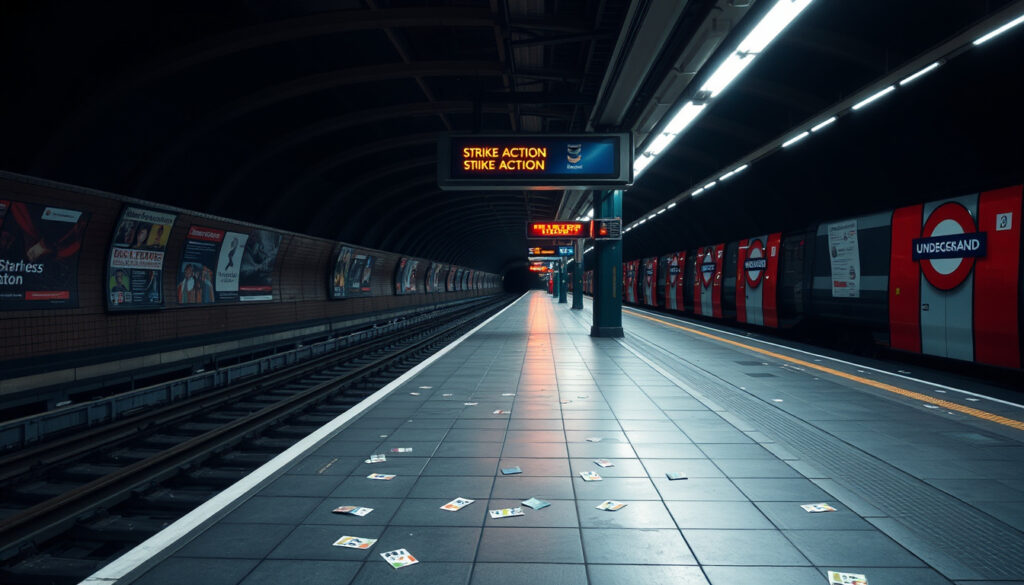
Tube Strikes This Week: Dates, Lines Affected & TfL Updates
Six 24-hour Tube strikes are scheduled across April, May, and June 2026, with the first window opening April 21. The entire London Underground network will be affected, though Overground lines will keep running. The RMT union is striking over TfL’s proposal for a compressed four-day working week.
Affected lines: Whole Tube network · Strike organizer: RMT union · Duration per strike: 24 hours · Number of strikes: Series of six · Reason: Compressed working week
Quick snapshot
- Strikes confirmed for April 21-22, 23-24, May 19-22, June 16-19 (Timeout London)
- RMT drivers voted for action in February 2026 (Timeout London)
- Whole Tube network affected (Nub News Richmond)
- Whether ASLEF drivers will join future action
- Exact service levels on affected lines after midday each strike day
- If strikes beyond June will be called if no agreement is reached
- March 24-27 strikes suspended after talks made progress (Timeout London)
- April 21-24: First strike window begins (Timeout London)
- TfL sources say further meetings could take place Friday or Monday (Timeout London)
- Strikes could end sooner if RMT and TfL reach agreement (Timeout London)
- Further 24-hour action scheduled for May and June (Timeout London)
- TfL remains open to discussions (Timeout London)
Key facts about the upcoming industrial action are summarised in the table below.
| Label | Value |
|---|---|
| Organizer | RMT union |
| Affected services | All Tube lines |
| Status | Confirmed to go ahead |
| TfL response | Reduced service where possible |
| RMT representation | Approximately 10,000 TfL staff |
| First strike dates | April 21-24, 2026 |
Are all tube lines affected by strike?
Impact on the whole network
Every London Underground line faces disruption during the strike windows. TfL has warned that the action affects the entire Tube network, and while some services will run reduced rather than nil, the scale of disruption will mirror the major September 2025 strikes that TfL described as the biggest bout of transport disruption in recent memory. According to Timeout London, only RMT drivers are striking this time—not ASLEF drivers or non-driver RMT members—which means the impact is expected to be less severe than the autumn 2025 action.
Reduced services expected
The pattern repeats across each strike day: normal service runs until 11:59am, then severe disruption kicks in at midday and continues until 11:59am the following day. During the April 21-24 window, TfL expects to run a reduced service on most lines, but the Piccadilly and Circle lines face complete closure. The Metropolitan line will not operate between Baker Street and Aldgate, while the Central line runs no service between White City and Liverpool Street. The Overground Lioness, Weaver, Liberty, Mildmay, and Suffragette lines will operate as usual, though they will be significantly more crowded than normal, according to Timeout London.
The Windrush line could face additional disruption on Thursday April 23 due to separate industrial action by signallers and telecom staff—not part of the RMT driver strikes. On previous Windrush action in February and March 2026, TfL ran normal service anyway.
Which lines are not affected by strike?
Lines with possible limited service
No Tube lines will escape disruption entirely, but the Overground network offers the most reliable alternative. The Lioness, Weaver, Liberty, Mildmay, and Suffragette lines will continue running their regular schedules during the April strikes, according to Timeout London. These lines will bear the brunt of displaced Underground passengers, so expect significant overcrowding—especially during peak morning and evening commute hours.
Alternatives during full closures
For journeys normally taken on the Piccadilly and Circle lines, the Overground connections and bus routes become critical. TfL has not confirmed what alternative bus provision will be in place. The Bakerloo line, while not immune to reduced services, may operate a partial service depending on driver availability. The DLR and Emirates Air Line cable car remain unaffected by RMT driver strikes, though they serve limited routes. Workers considering cycling should note that Santander Cycles will likely see unprecedented demand on strike days.
The implication is that commuters should build in extra time and consider alternative routes even for short journeys normally taken on unaffected lines, given the likely crowding spillover.
What are the dates of the Tube strikes this week?
Confirmed strike dates
Six 24-hour strike periods are confirmed across April, May, and June 2026, spanning 12 days total of industrial action. The first window opens April 21-22, running from 12pm to 11:59am on April 22. The second window is April 23-24, following the same pattern. According to Timeout London, each strike runs from midday to the following midday, meaning you get a brief morning window of normal service before disruption kicks in.
Next week schedule
After the April window closes on April 24, the next confirmed strike dates are May 19-20 and May 21-22, also running midday to midday. June brings the final two strikes on June 16-17 and June 18-19. The RMT union voted in favour of action back in February 2026, and while March strikes were suspended after progress in talks, the scheduled action for April onwards has been confirmed to go ahead. The strikes could be called off sooner if an agreement is reached between RMT and TfL before then.
Why are Tube workers striking this week?
RMT demands
At the heart of the dispute is the compressed four-day working week that TfL is proposing for tube drivers. RMT general secretary Eddie Dempsey said London Underground is trying to force through major changes to working patterns that have been rejected by members, according to Timeout London. The union’s concerns extend beyond simple scheduling: Dempsey stated that the proposals raise serious issues around fatigue, safety, and work-life balance. TfL is currently trialling the four-day week on the Bakerloo line as part of the proposal. The RMT represents approximately 10,000 TfL staff, and nearly half of all tube drivers are members of the union, according to Londonist.
Compressed working week dispute
TfL insists the four-day week is a fair proposal, though the specifics of what constitutes a “compressed” week remain disputed. The union’s concerns about shift lengths and working time arrangements centre on whether drivers would be required to work longer individual shifts to compensate for the reduced working week. TfL sources told the Standard that while no formal peace talks are currently planned, the organisation remains open to discussions, and further meetings could potentially take place on Friday or Monday. The strikes could end sooner if agreement is reached before the April window begins.
TfL’s approach to the compressed week could set a precedent for how driver working patterns are restructured for years to come. If TfL successfully implements the compressed week, similar changes may follow for other transport workers.
The pattern suggests TfL is willing to push forward with working pattern changes despite union resistance, betting that sustained disruption will eventually break resolve.
What are London Tube drivers striking for?
Salary context
While the current dispute centres on working patterns rather than pay, the salary debate lurks in the background of any conversation about Tube driver conditions. The RMT argues that changes to shift patterns effectively amount to asking drivers to do more work without proportional compensation. TfL’s position is that the four-day week improves work-life balance by giving drivers a three-day weekend—but the union counters that longer daily shifts offset any benefit.
Union goals
The RMT’s primary goal is to prevent TfL from imposing the compressed working week without agreement. Secondary goals include maintaining current shift length protections and ensuring that any changes to working time arrangements include proper fatigue risk assessments. ASLEF, the drivers’ union, is not participating in the current strikes—which means only RMT-represented drivers are taking action. The RMT represents nearly half of all Tube drivers, according to RMT transport union vs the City: more strikes expected in 2026.
How to travel during Tube strikes
With no Tube lines operating normally, your best options depend on your journey and how far you’re willing to go. Here’s what to consider:
- Plan for midday disruption: Normal service runs until 11:59am each strike day. If your journey can be completed before noon, you may avoid the worst of the disruption.
- Use Overground and DLR: These services continue operating and represent the most reliable alternative for many routes. The Lioness, Weaver, Liberty, Mildmay, and Suffragette lines will run as usual but expect heavy crowding.
- Consider Santander Cycles: Bike hire will see unprecedented demand during strikes. Download the app and book a bike in advance if you’re considering this option.
- Avoid the Piccadilly and Circle lines: These lines face complete closure with no service running at any point during the strike days.
- Check TfL Journey Planner before travelling: Real-time updates will be available closer to each strike date, and some services may run at reduced capacity even during the morning window.
The implication is that commuters who can adapt their routines will fare better than those dependent on fixed travel times.
Confirmed vs Unclear: Current Strike Status
Confirmed
- Strikes go ahead April 21-24, May 19-22, June 16-19
- RMT drivers voted in February 2026
- Whole network affected
- RMT leading action
- March strikes were suspended after progress in talks
- Only RMT drivers striking—not ASLEF
- TfL running reduced services where possible
Unclear
- Whether strikes will be called off before April 21
- Exact lines with service during midday windows
- Whether ASLEF will join future action
- Specific alternative transport provision
- Whether further strikes will be called beyond June
The pattern shows a union that has prepared for sustained action while leaving the door open for negotiation. RMT members voted overwhelmingly, and the staggered strike dates—rather than a single long action—suggest a strategy to maintain pressure while wearing down TfL’s resistance.
What experts and officials are saying
London Underground is trying to force through major changes to working patterns that have been rejected by members.
— Eddie Dempsey, RMT General Secretary (Timeout London)
The proposals raise serious concerns around fatigue, safety and work-life balance.
— Eddie Dempsey, RMT General Secretary (Timeout London)
While no formal peace talks are planned, the organisation remains open to discussions.
— TfL spokesperson (Timeout London)
The two statements from Dempsey frame the dispute as a matter of worker safety and democratic process, while TfL signals a willingness to talk without committing to concessions.
Tube strike timeline: April to June 2026
The key dates in the build-up to and during the strike period are summarised below.
| Date or Period | Event |
|---|---|
| February 2026 | RMT members voted in favour of strike action |
| March 18, 2026 | March 24-27 strikes suspended after progress in talks |
| April 21-22, 2026 | First 24-hour strike window (12pm to 11:59am) |
| April 23-24, 2026 | Second 24-hour strike window (12pm to 11:59am) |
| May 19-20, 2026 | Third 24-hour strike window |
| May 21-22, 2026 | Fourth 24-hour strike window |
| June 16-17, 2026 | Fifth 24-hour strike window |
| June 18-19, 2026 | Sixth 24-hour strike window |
What this means is that the dispute is far from resolved, with six strike windows confirmed through June and no clear resolution in sight.
Six strikes, 12 days of disruption, and no certainty beyond June. The question is whether talks resume in time to prevent the April action from going ahead—or whether this spring becomes the most disruptive period for London transport since the autumn 2025 strikes.
TfL sources indicate further meetings could take place before the April 21 strikes. Any breakthrough before Friday or Monday could still derail the first window.
Bottom line
For London commuters, the choice is stark: adapt or face severe disruption. The strikes are confirmed, the network will be hit hard, and while TfL is running reduced services where possible, the reality of complete closures on some lines means working from home or travelling before noon on strike days remains the most reliable strategy. RMT has showed it’s prepared for sustained action, and TfL has signalled openness to talks—but until an agreement is reached, the April 21 window looks certain to proceed.
Related reading: London tube and train strikes spring 2026: full list of dates and lines impacted · April 2026 tube strikes: how to get around London during next week’s RMT industrial action
timeout.com, community.ricksteves.com, tfl.gov.uk, tfl.gov.uk
RMT-led disruptions echo patterns seen in the 2025 Tube Strike details, where rolling actions hit all lines over a full week.
Frequently asked questions
Will tube strikes be called off?
The strikes could still be called off if RMT and TfL reach an agreement before April 21. TfL sources say further meetings could take place on Friday or Monday, and the organisation remains open to discussions. However, with voting completed and dates confirmed, the union has signalled it’s prepared to proceed.
What is the Tube strike update?
Six 24-hour strikes are confirmed across April, May, and June 2026. The first window begins April 21-22, followed immediately by April 23-24. TfL is running reduced services where possible but expects severe disruption across the entire Tube network during each strike period.
Is there a tube strike tomorrow?
As of the current confirmed schedule, the first strike window opens at midday on April 21, 2026. Normal service runs until 11:59am that day, so there is no strike tomorrow unless the scheduled date has arrived. Always check the TfL website for real-time updates closer to the date.
What date were the Tube strikes?
The confirmed Tube strike dates are April 21-22, April 23-24, May 19-20, May 21-22, June 16-17, and June 18-19, 2026. Each strike runs from 12pm to 11:59am the following day. March strikes (originally scheduled for March 24-27) were suspended after progress in talks.
What is the average salary of a London tube driver?
The current strike is not about pay—the dispute centres on working patterns and the compressed four-day working week. Tube driver salaries vary by grade and experience, but the RMT’s focus on working conditions suggests the union believes the proposed changes effectively require more work without proportionate compensation.
The FAQs above cover the most common queries, though commuters should monitor TfL announcements as the April window approaches.
More related posts
 Nicole Kidman: Biography, Relationships, and Latest News
 Emma Watson: Marriage, Children, Career & More
 Kieffer Moore: Salary, Transfer, Injury & Career Stats 2025
 0% Car Finance Deals Ireland 2026: Worth It or a Trap?
 Cat Burns: Biography, Music, and Personal Life Profile
 Leny Yoro: transfer fee, religion, speed, and background
 Kevin Clifton Relationships: From Strictly Marriages to Now
 Bathroom Wall Panels: Pros, Cons & Costs Comparison 2026
