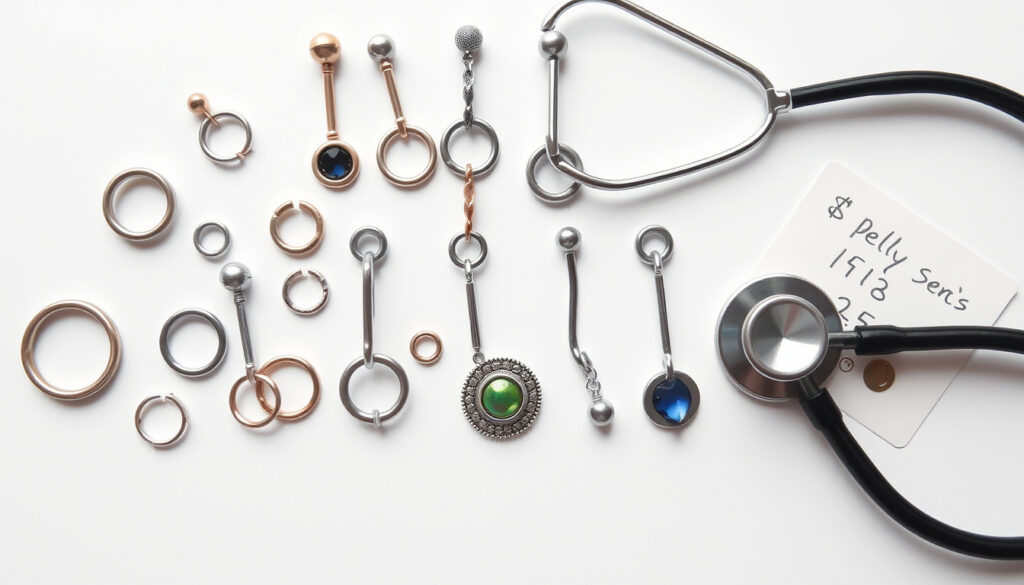
Belly Piercing: Pain, Cost, Types, and Who Should Avoid It
Anyone who has ever stood in front of a piercing studio mirror knows the real question is less “will it hurt?” than “will this heal on my body?” In the UK, a navel piercing typically takes 6–12 months to heal (Diamond & Dagger Piercing & Jewellery), and the choice between a traditional and a floating placement depends on how your navel folds when you sit, stand, and bend — so anatomy, not trends, should drive the call.
Average healing time: 6–12 months · Typical cost in the UK: £25–£50 for the procedure · Most common jewellery gauge: 14G or 12G · Pain level (subjective 1–10): 3–5
Quick snapshot
- Navel piercings take 6–12 months to heal (Diamond & Dagger Piercing & Jewellery).
- In England and Wales, piercing premises generally need local council registration (GOV.UK licensing guidance).
- Local authorities may adopt byelaws covering cleanliness and hygiene of piercing premises (UK Parliament House of Commons Library).
- Exact pain level is subjective and not clinically measured.
- Rejection rates vary widely by anatomy, jewellery type and aftercare.
- Long-term effects of specific jewellery materials are not fully documented.
- Healing runs from day one through a full 6–12 months (Diamond & Dagger, as cited above). (Crawley Borough Council)
- The Local Government Act 2003 extended council powers over cosmetic piercing (Crawley Borough Council).
- Licensing rules trace back to the Local Government (Miscellaneous Provisions) Act 1982 (UK Parliament House of Commons Library, as cited above). (Crawley Borough Council)
- Book a consultation so a piercer can assess your navel anatomy first (Diamond & Dagger, as cited above).
- Ask the studio about its needle hygiene process (UK Parliament House of Commons Library, as cited above).
- Plan around a 6–12 month healing window before you judge the final look (Diamond & Dagger, as cited above).
Belly Piercing Key Facts
Most belly piercing guides bury the practical details; these facts are the ones that actually change your decision.
| Fact | What it means |
|---|---|
| Healing time | 6–12 months for full healing (Diamond & Dagger, as cited above). |
| Average cost in the UK | £25–£50 for the procedure; £10–£30 for starter jewellery. |
| Common complications | Infection, rejection, migration, scarring. |
| Preferred jewellery materials | Surgical steel, titanium, 14K gold. |
| Most popular gauge | 14 gauge (1.6 mm). |
| England & Wales registration | Premises and practitioners generally need local council registration (GOV.UK, as cited above). |
| Greater London | Special Treatments Licence required, except in the City of London. |
| Registration fees | Vary by local council. |
| Legal basis | Local Government (Miscellaneous Provisions) Act 1982, as amended (UK Parliament House of Commons Library, as cited above). |
| Needle standard | Needles should be disposable or sterilised after each use. |
| Placement rule | Anatomy determines whether traditional or floating placement is viable. |
The pattern: the facts that get the least attention — licensing, needle hygiene, and healing time — are the facts most likely to determine whether the piercing works out.
Is belly piercing pain?
The honest answer is that the needle part is quick, and the healing part is the real test. Most people describe the pinch as a solid 3–5 out of 10 — closer to an earlobe piercing than a cartilage one.
- The initial pinch: a few seconds of sharp sting.
- The sore phase: 1–3 days of dull tenderness, worse when you bend or sit upright.
- The wildcard: your anatomy. A navel that folds can put constant pressure on the jewellery, which changes how the area feels day to day.
What is the pain level compared to other piercings?
- People who have had both usually say a navel pinch is sharper than an earlobe but easier than cartilage or nipple piercings.
- It is a surface-level sting, not a deep burning sensation.
- Because pain is subjective, no clinical scale applies; the 3–5 figure comes from client reports rather than medical measurement.
How long does the pain last after the procedure?
- The needle itself: seconds.
- Soreness: 1–3 days, easing daily.
- Ongoing tenderness: can return whenever clothes press on the area during the 6–12 month healing window.
Does the pain vary by piercing type (traditional vs floating)?
A traditional navel piercing sits through the upper rim and can rub against the fold every time you sit down. A floating navel placement is designed for bodies where that fold collapses or presses on the jewellery — which can make the healing phase less painful for those anatomies.
So the “which hurts more?” question is really a “what is your body shaped like?” question.
The pattern is consistent: the pain you feel on the day is a poor predictor of how annoying the next few months will be. Your anatomy, clothing choices, and jewellery placement decide that.
Where can I buy a belly button ring and how much is it for a belly button piercing in the UK?
You have two separate costs here: the piercing service and the jewellery. In the UK, studio fees are commonly quoted at £25–£50, and starter jewellery can add another £10–£30. The final price depends on where you are, the studio’s reputation, and whether you pick surgical steel, titanium, or 14K gold.
- High-street studios: usually carry a small range of starter jewellery and price the service separately.
- Online retailers like Astrid & Miyu and Lunifia: good for style inspiration, but you should not bring your own jewellery into a fresh piercing — studios prefer to use their own sterilised starter pieces.
- Specialist piercing studios: more likely to stock implant-grade titanium and solid 14-karat gold, and to match the piece to your anatomy.
Where to buy belly button rings (online and in-store)
- In-store: any registered piercing studio, plus some high-street jewellery counters.
- Online: retailers such as Astrid & Miyu and Lunifia have broad catalogues, but check that the material is implant-grade or solid gold before you buy.
- Marketplace listings are cheapest but carry the highest risk of mystery alloys.
What is the average cost for the piercing service in the UK?
- Typical service fee: £25–£50, studio dependent.
- Jewellery: £10–£30, more for solid 14K gold.
- Part of the reason prices vary is that local councils set different registration fees, as GOV.UK’s licensing guidance notes.
What are the common jewellery materials and price ranges?
- Surgical steel: most affordable, but not ideal for everyone.
- Implant-grade titanium: lighter and often better for sensitive skin.
- Solid 14-karat gold: a premium option and a common choice in specialist studio jewellery lists.
Cheap jewellery is where most healing problems start. A £5 ring from a fast-fashion site can contain nickel or mixed metals that inflame a fresh piercing, turning a £40 piercing into a £200 problem.
The trade-off is simple: pay a little more at a registered studio and the jewellery is likely to be better matched to your body. Save a few pounds online and you may spend more later on infection, migration, or a second piercing.
What are the key differences between a traditional navel piercing and a floating navel piercing?
This is the most important distinction in the whole belly piercing conversation because the two styles are not interchangeable.
What is a traditional navel piercing?
- Placed through the upper rim of the navel, with the bottom ball resting inside the belly button.
- Uses a curved barbell so the jewellery follows the natural angle of the skin.
- Works best when there is enough upper-rim tissue and the navel does not collapse when you sit.
The specialist studio Diamond & Dagger describes the traditional placement as commonly going through the upper rim of the navel.
What is a floating navel piercing?
- Uses a flat or low-profile top that sits flush against the skin instead of a ball pressing into the navel.
- May be placed slightly higher than a traditional piercing when there isn’t a suitable upper rim.
- Designed for navels that fold, collapse, or lack enough tissue for a standard curved barbell.
According to Diamond & Dagger’s floating navel guide, this placement is about adapting to the body, not choosing a different look.
How do anatomy and jewellery differ?
- Anatomy is the deciding factor: no reputable piercer should offer you a “choice” between the two as if they are the same piercing in two different shapes.
- The jewellery differs because the placement differs: a curved barbell for a standard navel, a flat-topped piece for a floating navel.
- A consultation should include checking how the navel changes when you stand, sit, and bend; movement and pressure affect migration risk.
The implication is that “floating” isn’t a style upgrade; it’s an anatomical solution. Picking one because it looks cute without checking your anatomy is how rejection happens.
Who should not get a belly piercing?
No one should get a belly piercing without a consultation first, and some people should probably skip it altogether.
What medical conditions are contraindications?
- Diabetes, blood clotting disorders, and a history of keloid-prone scarring are the most common red flags.
- Pregnant or breastfeeding people are usually advised to wait, because the navel changes shape and the jewellery can migrate.
- Anyone with a compromised immune system should talk to a doctor before booking.
What lifestyle factors increase risks?
- High-contact sports: a knocked piercing can tear or migrate.
- Jobs with constant bending or heavy lifting: waistbands and pressure are the main enemy.
- Swimming pools, hot tubs, and lakes: submerging a healing piercing in non-sterile water raises infection risk.
What piercing rejects the most and why navel piercings are prone to rejection?
- Surface piercings in general reject the most; navel piercings are among the more common placements to migrate or reject.
- The reason: the area moves constantly, and clothing presses on the jewellery from above and below.
- Rejection is more likely when the jewellery is too heavy, too short, or placed in anatomy that doesn’t support it.
If the jewellery starts looking longer, the holes begin to stretch, or the skin between them thins, your body is pushing the piercing out. That is rejection, and it is not something to wait out.
The catch is that most of these risks are manageable when you choose the right placement, the right jewellery, and the right timing. The people who struggle are usually the ones who skipped the anatomy check, not the ones who asked questions.
What is the hottest, most loved, and most inappropriate piercing on a girl?
Pop-culture lists and audience polls keep returning to the belly button as one of the most noticed and most liked piercings on women. But “hottest” and “most loved” are not the same as “right for you.”
What piercings do guys like on girls according to surveys?
- Belly button piercings consistently rank near the top in reader polls and celebrity-driven style lists.
- Nose studs and small hoops are also perennial favourites.
- These preferences fluctuate by decade, but the navel has had unusually long staying power.
What are considered girly piercings?
- Dainty studs, small hoops, and delicate jewellery are commonly grouped under “girly” piercing styles.
- Belly button rings fit the label because they can be ornate, colourful, or sparkly.
- Floating navel jewellery, with its flat top, is the more subtle version of the same idea.
What is a lady Diana piercing?
- Despite the name, it is not a belly piercing.
- A Lady Diana piercing is a series of surface piercings along the spine, creating a corset-like ladder.
- It gets its name from the corseted gown style associated with Princess Diana, not from being a navel placement.
The piercing others find most attractive is often the one your own anatomy will reject. The “hottest” choice and the “best” choice are frequently different piercings.
The pattern across surveys and style pages is clear: navel piercings are a visual favourite. But a piercing that migrates out in nine months stops being attractive fast — which is why anatomy should outrank social preference.
Traditional vs Floating Navel Piercing: Side-by-Side
Two types, one body, and a table that makes the difference obvious.
| Detail | Traditional navel piercing | Floating navel piercing |
|---|---|---|
| Placement | Through the upper rim of the navel | Slightly above or adapted to the navel fold |
| Jewellery style | Curved barbell with a visible bottom ball | Flat or low-profile top that sits flush |
| Best for | Prominent navel rim with enough tissue | Collapsing or folding navels, active lifestyles |
| Pressure during healing | More pressure from waistbands and sitting | Designed to reduce pressure on the navel fold |
| Rule of thumb | Anatomy decides viability; the two are not interchangeable (Diamond & Dagger, as cited above). | |
The trade-off is not “which looks better” but “which will your body keep?” A floating navel piercing is not a choice you make for fashion; it is a choice your anatomy makes for you.
Confirmed Facts vs What’s Still Unclear
Confirmed facts
- Navel piercings take 6–12 months to heal (Diamond & Dagger, as cited above).
- Traditional navel piercings are placed through the upper rim (Diamond & Dagger, as cited above).
- England and Wales require local council registration for piercing businesses (GOV.UK, as cited above).
What’s unclear
- Exact pain level is not clinically measured.
- Rejection rates vary by anatomy and jewellery quality.
- Long-term effects of specific jewellery materials are not fully documented.
- Whether a floating navel heals more comfortably than a traditional one depends on individual body mechanics.
The practical difference between these two lists is how much planning the piercing requires. The confirmed facts are easy to check; the unresolved ones are exactly what a good consultation should explore.
What Piercers and Regulators Say
“A traditional navel piercing is commonly placed through the upper rim of the navel. A floating navel placement may sit slightly above the belly button when individual anatomy does not provide a suitable conventional upper rim.”
— Diamond & Dagger Piercing & Jewellery, specialist piercing studio (floating navel guide)
“In England and Wales, cosmetic piercing practitioners and premises generally need registration with the relevant local council.”
— GOV.UK, official licensing guidance (skin piercing and tattooing licences)
“Local registration and hygiene requirements derive principally from the Local Government (Miscellaneous Provisions) Act 1982, as amended.”
— UK Parliament House of Commons Library, policy research (licensing regulation briefing)
What the sources share: anatomy and regulation matter more than aesthetics. A pretty ring cannot fix a placement that your body will push out.
What This Means for You
For anyone in the UK who wants a belly piercing, the decision process is not complicated once you separate the jewellery from the anatomy. Choose a registered studio, pay attention to the hygiene process, ask the piercer to check how your navel moves when you sit and bend, and budget for 6–12 months of healing. For anyone with a collapsing navel or an active lifestyle, the choice is clear: a floating navel piercing isn’t a trend — it’s the difference between jewellery that settles and jewellery that slowly migrates out.
ipswich.gov.uk, cornwall.gov.uk, cheshireeast.gov.uk, somerset.gov.uk
Frequently asked questions
How do I clean a new belly piercing?
Use a sterile saline spray or the aftercare product recommended by your piercer. Wash your hands before touching the area, and avoid rotating or moving the jewellery.
Can I go swimming with a healing belly piercing?
Not in pools, hot tubs, lakes, or the sea during the healing period. Bodies of water introduce bacteria that can infect a fresh piercing.
When can I change my belly button ring?
Wait until the piercing is fully healed, which usually means 6–12 months. Changing it early can irritate the channel and restart the healing process.
What are common signs of infection in a navel piercing?
Redness that spreads, warmth, yellow or green discharge, increasing pain, or a foul smell. If you see any of these, see a doctor rather than relying on home aftercare.
What type of jewellery is best for a new belly piercing?
Implant-grade titanium, solid 14-karat gold, or high-quality surgical steel. Avoid cheap mixed metals and hanging chains until the piercing is healed.
Does a floating navel piercing heal faster than a traditional one?
There is no reliable evidence that one heals faster in every body. Floating navel piercings can heal more comfortably for people whose navels fold, because there is less pressure on the piercing, but healing time still falls in the 6–12 month range.
Related reading: Photo Frames: How to Choose Sizes, Materials, and Styles · Alaskan Malamute: Breed Guide, Temperament, Lifespan & Cost
If you are still deciding, the common thread in all the FAQs is the same: your anatomy and aftercare choices will decide whether a belly piercing heals cleanly or becomes a problem.
More related posts
 Sherri Papini: Kidnapping Hoax, Custody, and Polygraph
 Keegan Bradley: Career, Net Worth, Family, Ryder Cup Captain
 Jeremy Clarkson: Health, Net Worth, Farm, Relationships
 Frances Tophill: Age, Marriage, Children, and Biography
 Geraldine Chaplin: Biography, Age, Family, and Notable Roles
 Lucy Alexander: Career, Family, and Net Worth in 2025
 Kenneth Branagh: Biography, Relationships, Religion & Family
