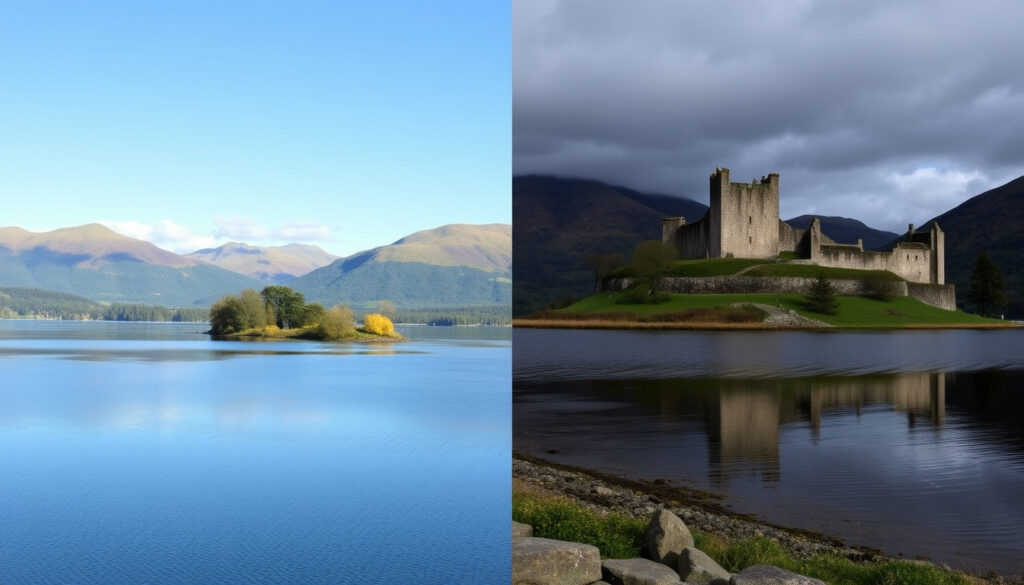
Loch Lomond vs Loch Ness: Which is the Better Scottish Trip
The classic Scottish dilemma pits the fame and monster-spotting of Loch Ness against the accessible, island-dotted drama of Loch Lomond. This guide cuts through the tourist board rhetoric with a practical, source-verified comparison focused on which loch genuinely suits your trip style.
Loch Lomond at a glance: Surface area 71 km² (largest in Britain by surface) · Maximum depth 190 m · Length 36 km · Over 60 islands · Part of Loch Lomond and The Trossachs National Park
| Feature | Loch Lomond | Loch Ness |
|---|---|---|
| Surface Area | 71 km² (largest in Britain by surface) | 56 km² (slightly smaller) |
| Maximum Depth | 190 m | 230 m (deeper, holds more water) |
| Length | 36 km (SW to NE) | 37 km (longer but narrower) |
| Key Towns/Villages | Balloch, Luss, Tarbet | Fort Augustus, Drumnadrochit, Inverness (at north end) |
| Vibe | Gateway to the Highlands, bustling, accessible, water sports | Deep, mysterious, iconic, more focused on monster legend |
| Key Draw | Islands (60+), Ben Lomond views, park facilities | Urquhart Castle, Jacobite Cruises, Clansman Centre |
| Top Visitor Numbers | Over 4 million annually | Over 1 million annually (unconfirmed, often cited) |
The pattern: Lomond leads on raw square footage and visitor infrastructure; Ness counters with depth and mythic pull.
Key Insights
- Loch Lomond: Park infrastructure and water taxi services make exploring the 71 km² area effortless, per the Loch Lomond & The Trossachs National Park Authority.
- Loch Ness: Offers cruises from Visit Inverness Loch Ness which are the primary way to see the 230 m deep waters safely.
- Loch Lomond: Kayaking and paddleboarding are huge; operators like Loch Lomond Adventures (certified by the park) are the norm, according to the Loch Lomond & The Trossachs National Park Authority.
- Loch Ness: Focus is on cycling around the Caledonian Canal (flat, easy) and guided hiking, not so much on board sports.
- Loch Lomond: Features Inchcailloch, an island with a centuries-old church and a resident community of deer, noted by See Loch Lomond.
- Loch Ness: Home to Urquhart Castle, a must-see ruin with a gruesome history and fantastic views.
- Loch Lomond: Is technically a National Park and includes the only island in Britain with a residence and a pub (Inchmurrin), per See Loch Lomond.
- Loch Ness: Contains more water (230m) than all of England and Wales’s lakes combined, making it the largest body of water by volume in the UK.
Why is Loch Lomond so famous?
Loch Lomond’s fame rests on three pillars: a folk song, its geological position, and celebrity history. The traditional song “The Bonnie Banks o’ Loch Lomond” dates to the 1700s Jacobite risings and made the loch internationally known. Geologically, the loch straddles the Highland Boundary Fault, marking the transition between Lowlands and Highlands, as documented by the British Geological Survey. On the celebrity front, singer John Lennon owned Inchconnachan island in the 1960s, and Sir Sean Connery was among other famous owners. The name “Lomond” likely derives from Scottish Gaelic meaning “beacon” or “hill.”
The VisitScotland (Scotland’s National Tourism Board) guide highlights that this isn’t just a loch but a full national park with mountains, cycle paths, and forest trails, making it a better base for a week-long stay.
Which Loch is Better for Sightseeing and Towns?
When it comes to a varied day out, Loch Lomond often feels more curated, with towns like Balloch acting as the gateway, offering a mix of local shops and easy access to the water. The national park status, designated in 2002, means the whole area is managed with visitor experience in mind. In contrast, Loch Ness has a more linear, main-road approach with Fort Augustus and Drumnadrochit acting as hubs, where you can explore the famous Caledonian Canal or visit the battlefield of Culloden nearby, though these feel more spread out.
The VisitScotland (Scotland’s National Tourism Board) guide highlights that Loch Lomond isn’t just a loch but a full national park with mountains, cycle paths, and forest trails, making it a better base for a week-long stay. Meanwhile, the shoreline of Loch Ness is more rugged and less developed, which is perfect for those who want to escape the crowds, but it means fewer in-the-moment attractions and a greater need for a car to connect the dots. If your goal is ticking off authentic Highlands towns, the Visit Inverness Loch Ness (Official Regional Tourism) board suggests that the appeal is more about the journey and the atmosphere than the individual villages.
For a mix of shopping, dining, and immediate lochside access, Balloch is a strong contender. However, for a more traditional Highland Castle experience, Urquhart Castle on Loch Ness is visually stunning and offers dramatic views that seem purpose-built for photography, whereas Lomond’s castles (like the ruins on Inchmurrin) are more hidden and require a boat or a hike to appreciate properly.
- Loch Lomond: Offers a complete resort package with villages, malls (Loch Lomond Shores), and a major rail link at Balloch.
- Loch Ness: Offers a linear, history-rich route where the journey between monuments (like the Clansman Centre or the Caledonian Canal) is part of the experience.
The trade-off is clear: Lomond provides a structured, amenity-rich visit, while Ness offers a more immersive, historic (though less convenient) Highland feel. If you can only visit one, choose based on whether you prefer an accessible vacation or a raw, historical expedition.
Is Loch Lomond worth visiting?
For most visitors, yes — but the value depends on what you want from a Scottish loch trip. Loch Lomond is Scotland’s largest loch by surface area and lies within the Loch Lomond and The Trossachs National Park. The area offers a mix of outdoor activities, scenic cruises, and village charm. Visitor numbers exceed 4 million annually, per the Loch Lomond & The Trossachs National Park Authority.
What first-time visitors say
First-time visitors consistently praise the accessibility: you can go from Glasgow city centre to lochside in under an hour by train. The downside reported is the summer crowds at popular spots like Luss and Balloch. The See Loch Lomond (Regional Tourist Information) site notes that the loch works well as a day trip, but staying overnight in towns like Luss reveals the quieter side.
Pros and cons of a visit
Upsides
- Direct rail link from Glasgow to Balloch (under 1 hour).
- Wide range of water sports: powerboating, kayaking, paddleboarding.
- National Park infrastructure with marked trails, water buses, and visitor centres.
- Island exploration with historic ruins and wildlife.
Downsides
- Peak-season crowding at main towns and car parks.
- Less remote than Loch Ness — the wild Highlands feel is diluted.
- Some beaches and paths require a boat or ferry to access.
“Loch Lomond is the destination for water sports and mountainside cycling, whereas Loch Ness is the location for boat trips and exploring the engineering marvels of the Caledonian Canal.”
How it compares to other Scottish attractions
Compared to the Isle of Skye, Loch Lomond wins on logistics — no ferry required, no single-track road anxiety. Compared to Loch Ness, Lomond wins on variety of structured activities. What Ness has is a deeper, more concentrated mythology and water volume that dwarfs all English and Welsh lakes combined, as highlighted in the Brack Tours comparison.
What is the most beautiful town in Loch Lomond?
Luss is widely regarded as the prettiest village on the loch, with stone cottages, a shingle beach, and a pier that offers classic loch views. The Loch Lomond Waterfront guide promotes village paths, the parish church, the beach, and Luss Pier as key attractions, plus the Loch Lomond Faerie Trail for families.
Balloch functions as the main tourist hub — it has the Loch Lomond Shores visitor centre, a large car park, the Sea Life aquarium, and multiple boat rental operators. The See Loch Lomond guide to Balloch calls it the gateway, highlighting cruises, Balloch Castle Country Park, Bird of Prey shows, and the Maid of the Loch.
Tarbet and Arrochar offer a quieter base with mountain backdrops and direct access to the West Highland Way. Balmaha, on the eastern shore, provides the best jumping-off point for the islands, including Inchcailloch with its ancient burial ground.
“Luss is widely regarded as the prettiest village, with stone cottages and a shingle beach.”
Activities: Water Sports vs Monster-Hunting and Cruises
The type of water you’ll be on and the activities available define the experience. At Loch Lomond, the water is warmer and the loch is shallower in parts, making it a hub for powerboating, kayaking, and paddleboarding, with several operators certified by Loch Lomond & The Trossachs National Park Authority offering rentals. The VisitScotland guide to Loch Lomond activities explicitly mentions tree-top adventures, forest trails, and mountains — so it’s not just about the water.
Loch Ness, however, is deeper and often colder. The main aquatic draws here are cruise ships, typically owned by operators like Loch Ness by Jacobite, which offer an immersive tour experience of the loch’s history and legends. While you can kayak on Loch Ness, the water conditions are less forgiving for beginners, and the current is more noticeable near the Caledonian Canal. The sheer depth (230m) and volume of water (more than all English and Welsh lakes combined) mean that the focus shifts away from casual swimming and toward observation, cruising, and visiting the Loch Ness Centre & Exhibition in Drumnadrochit to understand the natural history before you set sail.
For the active traveler, the contrast is stark. Loch Lomond is the destination for water sports and mountainside cycling, whereas Loch Ness is the location for boat trips and exploring the engineering marvels of the Caledonian Canal. Both are accessible, but the physical effort and skills required differ considerably.
The editorial upshot is that nature demands different skill levels. Lomond is a playground; Ness is a stage. Your choice should reflect your fitness and comfort on the water, not just the scenic postcard view.
Logistics, Distance, and Practicalities
Accessing both lochs is easier than you think, but the journey differs. Loch Lomond benefits from a direct rail link from Glasgow to Balloch, with the line terminating at the southern tip. From the city, you can be looking at the loch in under an hour. Loch Ness, on the other hand, is a longer ride from the central belt — roughly a three-hour drive from Glasgow to Fort Augustus, though that route is scenic. The See Loch Lomond (Regional Tourist Information) site notes that the loch is a great day trip, highlighting its close proximity to the central belt, but it also suggests staying overnight in towns like Luss to fully appreciate the evening peace.
Parking is another consideration. Loch Lomond’s main spots — like Balloch or Luss — can get extremely busy during peak tourist season, which is why the national park encourages the use of water buses and walkways. At Loch Ness, car parking is often easier to find, though the popular spots like Drumnadrochit can still fill up quickly. If you are relying on public transport, you’ll have more frequent services to the Lomond region through ScotRail, whereas bus services to Loch Ness are less frequent, making a car almost essential for exploring the northern shore.
- Distance from Glasgow: ~30 mins to Balloch (by car/train), ~3 hours to Fort Augustus.
- Public Transport: Trains run direct to Tarbet for Lomond; Ness requires a transfer via bus, often from Inverness or Stirling.
- Accommodation: Lomond offers a range of purpose-built resorts and hotels; Ness offers more affordable B&Bs in Inverness.
In conclusion, the logistics favor the day-tripper looking for a shortcut to scenery. For a quick escape, Lomond wins; for a commitment to a full Highland exploration, Ness is the more rewarding (if time-consuming) target.
Which has more range of things to do: Loch Lomond vs Loch Ness?
If we are comparing raw volume and variety of structured activities, Loch Lomond generally takes the lead, primarily because it’s a designated national park with a longer list of organized excursions. The Loch Lomond & The Trossachs National Park Authority actively markets a wider range of “attractions” that go beyond the loch itself, including forest parks like David Marshall Lodge and the scenic Inchcailloch island, which you can easily hop over to by ferry from Balmaha. This creates a more immediate sense of discovery for visitors.
Loch Ness, while having a smaller commercial footprint, offers a more concentrated “Highland” experience. The main activities often revolve around its history — the Loch Ness Centre & Exhibition dives deep into the geology and legends, while the Urquhart Castle provides a dramatic setting for photos. However, when you step outside, the number of “attractions” in the near vicinity is somewhat limited, shifting the focus to independent hiking and exploring the quieter coves to get away from it all.
Ultimately, your choice of which has more to do comes down to the mode of exploration: Lomond offers a curated buffet of activities, while Ness offers a deeper, more focused menu of a few high-quality items. Let’s break down the specifics for your planning.
What are some unusual things to do in Loch Lomond?
Beyond the standard cruises and hill walks, Loch Lomond holds a few surprises. Inchmurrin Island has a recognized naturist beach (officially tolerated but not signposted), making it one of the more unexpected draws. Several islands, including Inchconnachan, have remains of ancient chapels and castles. The Loch Lomond Distillery produces single malt whisky and offers guided tours. The lesser-known Loch Lomond Cowal Way is a hiking route with sea views that most tourists miss. The Love Loch Lomond guide identifies Luss, Conic Hill, Duncryne Hill, and Ben Lomond as key outdoor sights or hikes, confirming there are plenty of options beyond the main tourist path.
Which is easier to reach by car from Edinburgh?
Loch Lomond is generally easier. While neither is a short hop, Lomond is accessed via the M8/M80 motorway, reaching Balloch in about 1 hour 15 minutes. Loch Ness requires either a longer drive up the A9 (around 3 hours and 30 minutes directly to Inverness) or a more complex route via the A82, which is scenic but slower due to single-track sections.
Related reading: Loch Lomond Worth Visiting? Guide to Scotland’s Largest Loch
bracktours.com, must-see-scotland.com, scottishtravelcentre.com, lakebeyond.com, rome2rio.com, bracktours.com, scotlandswild.com, edinburgh-spirit.com, rome2rio.com, osmaps.com, zigzagonearth.com, rabbies.com, 10adventures.com, fodors.com, lovefromscotland.co.uk, seelochlomond.co.uk, lovelochlomond.com, seelochlomond.co.uk, scotland.org.uk, seelochlomond.co.uk, visitscotland.com, seelochlomond.co.uk, loch-lomond-waterfront.co.uk, seelochlomond.co.uk, en.wikipedia.org, nationalparks.uk, lochlomond-trossachs.org, tripadvisor.com, chasingthelongroad.com, lochness.com, visitinvernesslochness.com, swedishnomad.com, nessieland.co.uk, scotlandtourism.org, expedia.com
Frequently Asked Questions
Am I able to see both lochs in one day?
Technically yes, but it’s a long day. The direct route from Balloch to Fort Augustus via Strathyre and the A82 is roughly a 3-hour drive one-way, but with traffic in peak season, it’s not recommended. Most guides suggest picking one for a full immersion, as the VisitScotland travel time calculator and local advice highlight that you’d miss the best parts rushing between the two.
Which loch is deeper and has more water—Ness or Lomond?
Loch Ness is significantly deeper. It reaches a depth of 230 meters, which is roughly 40 meters more than Loch Lomond’s 190 meters. Because Loch Ness is deeper and longer (37 km vs 36 km), it contains more water than all of England and Wales’s lakes combined, whereas Loch Lomond is bigger by surface area (71 km²) but holds less water.
Are there any “free” natural attractions at both lochs?
Absolutely. At Loch Lomond, Conic Hill offers incredible panoramic views and is free to park and walk (though the car park charges). At Loch Ness, you can admire the 19th century Falls of Foyers or simply drive the North East shore, which is free. However, be prepared for pay-and-display parking at most lochside lay-bys in the national park.
Is Loch Lomond actually too crowded compared to Loch Ness?
It depends on the season. Loch Lomond can become very busy in July and August in the resorts like Luss and Balloch, but you can find solitude by hiring a boat. Loch Ness is also busy but the crowds are gathered at specific choke points like Urquhart Castle, so it’s easier to find a reclusive spot to camp or park a 100 meters from the road.
Which is best for a family with young children?
Loch Lomond generally wins for practical family logistics. The Loch Lomond Shores complex in Balloch has easily accessible flat paths to the loch, a live camera, and an aquarium (Sea Life), offering a guaranteed rain-proof backup. Loch Ness, while magical and more spacious, has fewer “soft play” style activities and more dangerous, steep shoreline, which requires more supervision for little ones.
How do you pronounce Loch Lomond?
The correct pronunciation is “Lokh LO-mund” — the ‘ch’ is guttural as in the Scottish word ‘loch’, and ‘Lomond’ rhymes with ‘summoned’ or ‘diamond’. The Gaelic origin likely means ‘beacon’ or ‘hill’.
Related reading
- VisitScotland (Scotland’s National Tourism Board)
- See Loch Lomond (Regional Tourist Information)
- Visit Inverness Loch Ness (Official Regional Tourism)
- Loch Lomond & The Trossachs National Park Authority (Park Governance)
More related posts
 Ashley Barnes: Age, Nationality, Burnley Career & Stats
 Ruth Gemmell: Biography, Age, Husband, and Career
 Liv Morgan Relationship Status: Who Is She Dating? (2025)
 7 Stone in kg: Exact Conversion and Step-by-Step Guide
 Michelle Ryan: EastEnders Axe, Health Rumors & Comeback
 Jesse Tyler Ferguson: Biography, Family, Net Worth, and More
 Jack Keating: Age, Job, Daughter, Parents & Love Island Return
 Loft Bed Guide: Safety, Ages, Costs & Where to Buy in Ireland
