Alaskan Malamute: Breed Guide, Temperament, Lifespan & Cost
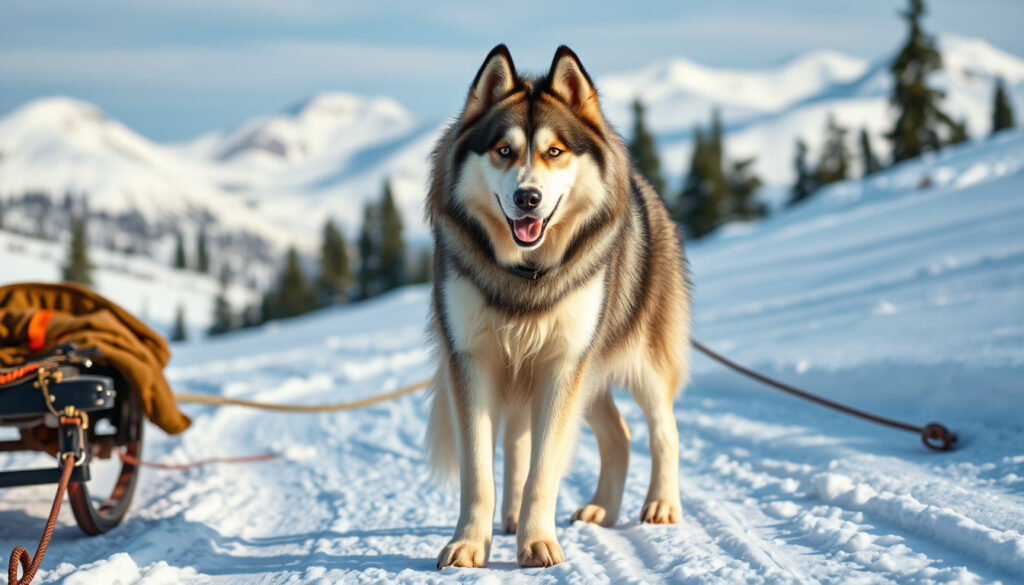
Few dogs look as wolf-like as the Alaskan Malamute, and that is exactly what pulls most people toward the breed. Beneath the striking mask is a large Arctic sled dog bred to haul heavy loads at a steady pace, according to TrustedHousesitters (pet-care community) — a working heritage that shows up in its stubborn streak and exercise needs, meaning the honest answer about whether a Malamute belongs in your home depends on space, climate, and training time.
Weight (Male): 85–100 lbs (38–45 kg) ·
Weight (Female): 75–90 lbs (34–41 kg) ·
Height: 23–25 inches at shoulder ·
Coat: Dense double coat, can withstand -60°F ·
Lifespan: 10–14 years ·
Origin: Arctic, bred by Mahlemut people
Quick snapshot
- An AKC-registered Arctic breed with centuries of history — not a wolf hybrid (AKC breed profile (U.S. kennel club))
- Lifespan: 10–14 years, per AKC breed profile (U.S. kennel club)
- Exact wolf-DNA percentage — no single authoritative figure exists (CKC USA (kennel registry))
- Published male weight ranges vary from roughly 85 lbs to 124 lbs depending on the registry (CKC USA (kennel registry))
- Aggression comparisons across breeds are anecdotal, not data-driven (CKC USA (kennel registry))
- Bred for centuries by the Mahlemut people of Alaska (AKC breed profile (U.S. kennel club))
- AKC recognition: 1935 — today a Working Group breed (AKC breed profile (U.S. kennel club))
- Start with early socialization, consistent grooming, and daily exercise (Chewy (pet-care guide))
- In warm climates, solve heat management before bringing one home (breed-guidance consensus) (Chewy (pet-care guide))
The pattern in four cards: the Malamute is a striking, ancient breed with real knowns and real unknowns — the rest of this guide fills in the gaps.
Eight rows, one pattern: nearly every number here traces back to a dog engineered for cold, heavy work — and that engineering shows up as both an asset and a limitation.
| Attribute | Value | Source |
|---|---|---|
| Origin | Alaska, bred by the Mahlemut people | AKC breed profile |
| AKC Group | Working Group | AKC breed profile |
| Weight (Male) | 85–100 lbs; registries vary up to 124 lbs | AKC / CKC USA |
| Height | 23–25 inches at the shoulder | Chewy care guide |
| Coat | Dense double coat | Chewy care guide |
| Lifespan | 10–14 years | Breed-standard data |
| Temperament | Affectionate, loyal, independent | AKC / Rover profiles |
| Energy Level | High | Chewy care guide |
Is an Alaskan Malamute a Good Family Dog?
The short answer is yes — with conditions. The AKC breed standard leads with affection and loyalty, and Adopt a Pet (adoption resource) adds the fuller picture: loyal, affectionate, intelligent, friendly, outgoing, playful, and willful.
Are Alaskan Malamutes aggressive?
- Not aggressive toward people by default — the breed standard centers on affection and loyalty, not guarding.
- Same-sex dog aggression is the more common concern, which is why early socialization is the standard recommendation.
- Size changes the risk equation: a 75–100 lb dog can knock over a small child by accident, even in play.
The realistic characterization: affectionate with family, aloof with strangers, and assertive with unfamiliar dogs. With children, the pattern is positive when the dog is raised with them, but supervision is non-negotiable because of the breed’s size. That is a manageable combination for experienced owners and a poor match for a home that wants a low-oversight dog.
Socialize a Malamute early and consistently. The willful adolescent that never learned to share space with other dogs becomes a management problem at 80 pounds — and that phase is predictable, not unlucky.
Are Malamutes cuddly?
Cuddly in Malamute language means on their terms. They bond deeply with their family, but they are not needy lapdogs — affection often shows up as a 90-pound shadow following you from room to room.
Rover (pet-care network) sums up the personality as playful, lovable, outgoing, and pack-oriented. That pack instinct is exactly why a Malamute does best in a home where someone is around — they want to be part of the group, not left alone in a yard.
The upshot: a Malamute is a family dog in the truest sense — affectionate, loyal, and always involved — but the family has to train, supervise, and exercise it in return.
The pattern: the rewards match the effort — a well-trained Malamute is a loyal companion, but the training and supervision are not optional.
Which is Better, Husky or Malamute?
“Better” is a lifestyle question, not a breed-purity question. The AKC describes both as working dogs that love being with their people — affectionate and energetic — but the two were built for different jobs, and those jobs explain most of the differences owners actually care about.
Is a Malamute bigger than a husky?
Male Malamute: ~85 lbs ·
Female Malamute: ~75 lbs ·
Male Husky: 45–60 lbs ·
Female Husky: 35–50 lbs
The AKC comparison article (national kennel registry) answers the size question directly: the Malamute is the larger and heavier breed, with males around 85 pounds and Huskies at 45–60 pounds. Chewy (pet-care guide) adds the height picture — Malamutes up to 25 inches, Huskies at 20–23.5 inches.
Is a Malamute calmer than a husky?
- Original jobs: Malamutes hauled heavy loads for long stretches at a slow pace; Huskies hauled lighter loads at speed (TrustedHousesitters (pet-care community)).
- Rover (pet-care network) notes that Huskies are intelligent and independent but get bored easily — harder to train and quicker to find their own entertainment.
- In practice, owners describe the Malamute as the more settled of the two indoors, while the Husky runs hotter — both still need serious daily exercise.
Neither breed is a couch potato. The Malamute’s calm is the calm of a working dog satisfied with its job; the Husky’s energy is the energy of a sprinter always ready to run.
Is an Alaska Malamute a husky?
All Malamutes are sled dogs, but not all sled dogs are Huskies. The AKC registers the Alaskan Malamute and the Siberian Husky as two separate breeds with different standards, histories, and original jobs.
The shared Arctic ancestry explains the similar look — upright ears, thick coats, curled tails — but the registry separation is absolute. A Malamute is not a type of Husky, and a Husky is not a small Malamute. They are parallel breeds from the same region, with distinct jobs and distinct standards.
The trade-off: the Malamute gives you a heavier, steadier dog that is usually calmer indoors; the Husky gives you a lighter, faster dog with more raw energy. Choose the engine that matches your life.
How Close is an Alaskan Malamute to a Wolf?
- Not wolf hybrids. The Malamute is an AKC-registered breed with its own standard and lineage.
- The wolf-like mask and heavy build come from selection for Arctic hauling, not from recent wolf crosses.
- Genetic studies link Arctic breeds to ancient wolf ancestors, but the breed’s exact wolf-DNA percentage has no single authoritative figure.
The resemblance is real, and it is functional. Erect ears, a dense double coat, and a powerful frame all helped a sled dog survive and work in extreme cold. Behaviorally, though, the Malamute is fully domesticated — pack-oriented with its humans, trainable within reason, and independent enough to make you work for its attention.
The implication: a wolf-like look is not a wolf-like personality. What the Malamute kept from its ancient past is endurance, independence, and a fierce pack bond — the exact combination that makes training non-negotiable.
Do Malamutes Bark a Lot? And At What Age Do They Calm Down?
Malamutes are not known for constant barking. Their default vocal habits lean toward howls, grumbles, and talking — they have plenty to say, but it rarely comes out as a non-stop alarm bark. The quiet, though, depends on exercise: an under-stimulated Malamute finds its own entertainment, often at volume.
At what age do Malamutes calm down?
- Most Malamutes show a noticeable settle between 2 and 3 years old.
- The 6-to-18-month window is the energetic peak — the stage where the willful trait in Adopt a Pet’s temperament list shows up most.
- A calm adult Malamute still needs more daily exercise than most breeds.
The settle is real but relative. Chewy’s care guidance puts the breed’s core needs simply: early socialization, consistent grooming, lots of mental stimulation, and regular exercise — the last two are what actually keep a Malamute calm.
The pattern: the so-called barking problem is nearly always an exercise problem. A tired Malamute is a quiet Malamute — if the howling is getting to you, the fix is more work, not a different dog.
What is the Lifespan of a Malamute and Do They Do Well in Hot Weather?
The commonly cited lifespan is 10–14 years, and reaching the top of that range comes down to the usual working-breed watchpoints: joint health, weight management, and regular veterinary care.
Do Malamutes do well in hot weather?
The same double coat that lets a Malamute nap outside at -60°F turns into a heat trap at 80°F. For warm-climate owners, this is not a side note — it is the central decision.
Malamutes are not heat-tolerant. Their dense double coat is spectacular in winter and a liability in summer — heatstroke risk climbs quickly with midday exertion. If you live somewhere hot, plan for air-conditioned indoor time, early-morning walks, and a strict rule against strenuous exercise in the hottest part of the day.
What this means: a Malamute in a hot climate is a year-round management project; a Malamute in a cold climate is a natural fit. Match the climate to the breed before you match the breed to your lifestyle.
Alaskan Malamute vs Siberian Husky: Side-by-Side
Five rows, one pattern: the Malamute is the heavier, steadier freight engine; the Husky is the lighter, faster sprinter.
| Attribute | Alaskan Malamute | Siberian Husky | Source |
|---|---|---|---|
| Weight (male) | ~85 lbs | 45–60 lbs | AKC comparison (above) |
| Height (shoulder) | Up to 25 inches | 20–23.5 inches | Chewy (above) |
| Original job | Heavy freight hauling — slow, steady endurance | Speed and endurance over lighter loads | TrustedHousesitters (pet-care community) |
| Energy & temperament | Affectionate, outgoing, pack-oriented | High-energy, affectionate, playful | Adopt a Pet (adoption resource) |
| Trainability | Willful, independent — needs consistency | Independent, easily bored | Rover (pet-care network) |
The takeaway is a trade-off, not a verdict: families that want a big, calm, loyal presence lean Malamute; households that want a lively, athletic, always-on companion lean Husky. Either way, you are signing up for a working dog’s exercise bill.
Alaskan Malamute Specs at a Glance
Twelve specs, one pattern: this is a working breed with a working body — every number traces back to function, not fashion.
| Attribute | Value | Source |
|---|---|---|
| Origin | Alaska, bred by the Mahlemut people | AKC breed profile |
| AKC group | Working Group | AKC breed profile |
| Height (male) | Up to 25 inches at the shoulder | Chewy (above) |
| Weight (male) | 85–100 lbs; registries vary up to 124 lbs | AKC / CKC USA |
| Coat | Dense double coat, cold-resistant | Chewy (pet-care guide) |
| Shedding | Heavy, year-round | Chewy (above) |
| Lifespan | 10–14 years | Breed-standard data |
| Temperament | Affectionate, loyal, independent | AKC breed standard |
| Energy level | High | AKC / Chewy guidance |
| Health watch | Hip dysplasia, bloat | Breed-health guidance |
| Heat tolerance | Poor — not suited to hot climates | Breed-guidance consensus |
| Best for | Active families, cold climates, experienced owners | Editorial consensus |
Read the last three rows together: joint risk, heat risk, and energy demands are the realities a prospective owner must plan around. The spec sheet is honest — the question is whether your life matches it.
Pros and Cons of Owning an Alaskan Malamute
Upsides
- Affectionate, loyal, and friendly with family (AKC breed standard)
- Built for endurance — an ideal cold-weather hiking partner (TrustedHousesitters)
- Intelligent and deeply bonded to its people (Rover)
- Striking, wolf-like appearance (breed standard)
Downsides
- Heavy shedding from a dense double coat (Chewy)
- High exercise and mental-stimulation demands (Chewy)
- Willful, independent streak that challenges first-time owners (Adopt a Pet (adoption resource))
- Poor heat tolerance — hot climates require strict heat management
- Can be dominant with other dogs; early socialization is essential
The decision framework: if shedding, exercise, and heat limits are manageable realities rather than dealbreakers, the upsides carry real weight. If any one of them makes you hesitate, trust that hesitation.
What’s Confirmed, What’s Still Unclear
Confirmed facts
- Malamutes are not wolf hybrids; they are an AKC-recognized breed.
- Male Malamutes are heavier than male Huskies — roughly 85 lbs vs 45–60 lbs.
- Lifespan is typically 10–14 years.
- The dense double coat is genuinely cold-proof, built for conditions that would harm most dogs.
What’s unclear
- The exact wolf-DNA percentage has no single authoritative figure.
- Aggression comparisons between breeds are largely anecdotal; no large controlled study shows Malamutes are more aggressive.
- Weight ranges depend on the registry — CKC USA lists male Malamutes at 85–124 lbs, a wider band than the AKC’s ~85 lb figure (CKC USA (kennel registry)).
- The age when an individual Malamute calms down varies by temperament, not just by breed.
- How much of a Malamute’s behavior is genuinely wolf-like has not been quantified breed by breed.
The pattern: breed-level facts are stable; individual-dog predictions are not. Meet the actual dog, talk to the breeder or rescue, and treat the unclear list as questions to ask rather than reasons to assume.
What Owners and Experts Say
“The Alaskan Malamute is an affectionate, friendly, and loyal companion.”
— American Kennel Club breed standard (AKC breed profile)
Given their working heritage, Malamutes tend to do well on a diet higher in protein and fat than the average house dog.
— Dr. Karen Becker, veterinarian
Together, these voices undercut the aloof-giant myth: the Malamute is affectionate and people-oriented, but it wants that bond on a working dog’s terms — active, structured, and outside.
So, Should You Get an Alaskan Malamute?
The verdict is consistent across every source reviewed: the Alaskan Malamute is a magnificent dog with non-negotiable requirements. It will bond hard to your family, test your training, shed more than you imagined, and expect a real workout every single day. For a household that can offer cold-weather exercise, firm early socialization, and space to roam, the reward is a loyal, strikingly handsome companion for 10–14 years. For the average family, the decision is clear: commit to the exercise-and-socialization contract, or let the Malamute remain a beautiful idea you admire from a distance.
akc.org, faunahub.com, worldanimalfoundation.org, caninejournal.com, petworks.com, airtasker.com, a-z-animals.com
Frequently asked questions
What is the price of an Alaskan Malamute puppy?
Prices vary widely by breeder, lineage, and region, and there is no reliable national average to quote. A responsible breeder should be able to document hip and eye screening; rescue adoption is a lower-cost alternative that skips the puppy stage.
How much exercise does an Alaskan Malamute need?
Plan for at least an hour of vigorous daily exercise plus mental stimulation. Chewy’s care guidance lists regular exercise and mental games as core needs for Malamutes and Huskies alike.
Do Alaskan Malamutes shed a lot?
Yes. The dense double coat means heavy shedding year-round, with heavier seasonal blowouts. Grooming is a constant in Malamute life, not an occasional chore.
Are Alaskan Malamutes easy to train?
No — and that is the honest answer. They are intelligent, but their willful, independent streak means consistent positive training from day one, ideally with an experienced handler.
What are common health problems in Alaskan Malamutes?
Hip dysplasia and bloat are the conditions most frequently flagged in breed-health guidance, so joint screening and weight management matter.
Can Alaskan Malamutes live in apartments?
In theory, yes, if you provide hours of daily exercise and mental stimulation. In practice, the breed’s size, energy, and vocal habits make a house with a securely fenced yard the standard recommendation.
Related reading
More related posts
 Free Bus Pass Ireland: Age & 2026 PSC Switch
 Aj Shabeel: Age, Real Name, Ethnicity, Net Worth & Beta Squad
 Rebecca Goodwin: Bio, Age, Children, Income & OnlyFans Career
 Ja Morant: Trade, Suspension, Injury & Future with Blazers
 Suge Knight in Prison 2025: Where He Is and Key Facts
 Alicia Keys Biography: Songs, Tour, Children & Activism
 Matthew Gray Gubler: Biography, Health & Career Facts
 Bebe Rexha: Ethnicity, Diagnosis, and Personal Life
