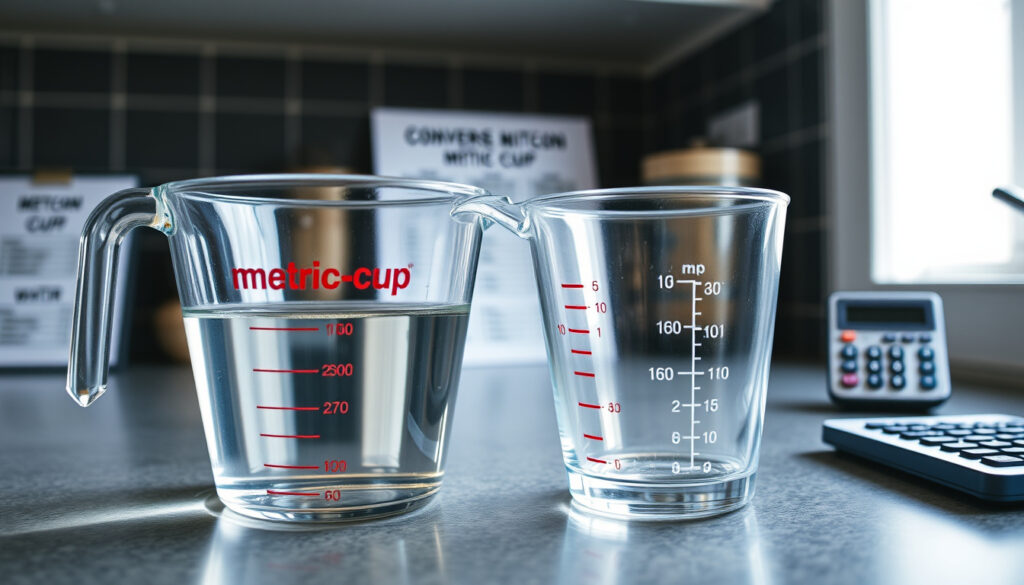
2 Cups in mL: US vs Metric Cup Conversion (Calculator & Chart)
Anyone who has tried following a recipe from a US blog while standing in a European kitchen has hit the glass ceiling of measurement confusion — the answer to “2 cups in ml” depends entirely on which cup you grabbed, and that small word can trip up an entire batch of cookies. This guide breaks down exactly how many milliliters are in 2 cups under the US customary, metric, and imperial systems, using official government and culinary reference sources.
1 US cup (standard): 236.588 mL · 2 US cups: 473.176 mL · 1 metric cup (Australia, NZ, etc.): 250 mL · 2 metric cups: 500 mL · 1 liter in US cups: 4.227 cups · 1 liter in metric cups: 4 cups
Quick snapshot
- 1 US cup = 236.588 mL (NIST Handbook 44)
- 2 US cups = 473.176 mL (The Calculator Site)
- 1 metric cup = 250 mL (The Calculator Site)
- Whether a recipe uses the US customary cup (236.588 mL) or the rounded US “legal” cup (240 mL) is often unspecified (The Calculator Site)
- Many recipe sites mix cup sizes without disclosure, as noted by The Calculator Site
- NIST adopted the rounded 240 mL cup as a household cooking equivalency, formalizing existing practice (NIST Metric Kitchen)
- Global recipe publication continues to blend US and metric units; bakers should always check cup type before measuring
The following table summarizes the key conversion facts across different cup systems.
| Measurement | Volume | Notes |
|---|---|---|
| 1 US cup (standard) | 236.588 mL | NIST official standard |
| 2 US cups | 473.176 mL | The Calculator Site |
| 1 US legal cup (FDA) | 240 mL | Rounded equivalency per Cook Like Czechs |
| 2 US legal cups | 480 mL | NIST Metric Kitchen |
| 1 metric cup (Australia, NZ, Canada) | 250 mL | The Calculator Site |
| 2 metric cups | 500 mL | International standard |
| 1 imperial cup (pre-1970s UK) | 284 mL | The Calculator Site |
| 2 imperial cups | 568 mL | Pre-metric UK recipes |
| 1 liter | 1000 mL | 4.227 US cups or 4 metric cups |
The difference between 473 mL (2 US cups) and 500 mL (2 metric cups) is just 27 mL — about 1.8 tablespoons. But when scaling a recipe to 8 or 10 cups, that tiny gap widens into a measurable error that dry ingredients like flour or sugar won’t forgive.
How Many mL is 2 Cups?
Two cups in milliliters ranges from 473 mL to 568 mL depending entirely on which cup definition the recipe uses. Five cup systems, three continents, one potential baking disaster — here is the exact breakdown.
US Customary Cup Conversion
- 1 US cup = 236.588 mL (NIST Handbook 44)
- 2 US cups = 473.176 mL (The Calculator Site)
- Many US cookbooks round to 240 mL per cup, yielding 480 mL for 2 cups (NIST Metric Kitchen)
Most US home cooks use standard measuring cups, and the National Institute of Standards and Technology (NIST) provides the official definition. The precise figure of 236.588 mL comes from the customary system’s definition of 1 US cup equaling 8 fluid ounces, with a US fluid ounce defined as exactly 29.5735295625 mL. The Exploratorium’s measurement equivalencies also confirm this conversion. (Exploratorium)
Metric Cup Conversion
- 1 metric cup = 250 mL (The Calculator Site)
- 2 metric cups = 500 mL
- Used in Australia, New Zealand, Canada, and most Commonwealth countries
Countries that use the metric system for cooking adopted a cleaner 250 mL cup. Australia officially uses the metric cup, and 2 cups there equals exactly 500 mL. Cook Like Czechs confirms that across most European countries, liquids are measured in milliliters rather than cups, but the metric cup is the standard when recipes do call for “cups.” CK-12 Foundation also provides educational resources on unit conversions. (CK-12 Foundation)
How Many Cups in 1 Liter?
- 1 liter = 4.227 US cups (The Calculator Site)
- 1 liter = 4.167 US legal cups (240 mL each)
- 1 liter = 4 metric cups exactly (250 mL each)
NIST notes that these household cooking equivalents are approximate and intended for home cooking applications, not laboratory precision.
The implication: A recipe calling for 1 liter of liquid demands 4 and ¼ standard US cups, but only 4 exact metric cups. The 0.227-cup difference is roughly 54 mL — significant enough to alter batter consistency.
When a British baker tries an American cake recipe and grabs a 250 mL measuring cup instead of the intended 236.588 mL US cup, 2 cups lands at 500 mL instead of 473 mL — a 5.7% overpour. That extra 27 mL of milk could turn a sturdy sponge into a soggy one.
Is 2 Cups 250 mL? Common Misconceptions
No, 2 cups is not 250 mL under any standard system — this confusion apparently arises because 1 metric cup is 250 mL. Here is where the math breaks down and why those neat round numbers can lead to errors.
Why 2 Cups Does Not Equal 250 mL
- 2 US cups = 473.176 mL, not 250 mL
- 2 US legal cups (FDA guideline) = 480 mL
- A single metric cup = 250 mL, so 2 metric cups = 500 mL
The 250 mL number is the volume of one metric cup, not two. According to Cook Like Czechs, the FDA guidance sets 1 US legal cup at 240 mL, which is the most common rounding used in American cookbooks. So 240 mL per cup, times two, gives 480 mL — still nowhere near 250 mL total.
Is 2 Cups 500 mL?
- Yes, if using metric cups: 2 × 250 mL = 500 mL (The Calculator Site)
- No, if using US customary cups: 2 × 236.588 mL = 473.176 mL
- Yes, approximately, if using US legal cups: 2 × 240 mL = 480 mL, close to 500 mL but not exact
The 500 mL figure is correct for Australia, New Zealand, and other metric-cup countries. For US readers, 2 cups hits 473 mL or 480 mL depending on rounding. The Calculator Site calls attention to the 20 mL gap between the metric and US rounded systems — a 4% error that accumulates in multi-cup recipes.
Is 2 Cups 1000 mL?
- No. 2 cups equals approximately 473 to 500 mL, not 1000 mL
- 4 US cups ≈ 946 mL (close to 1 liter)
- 4 metric cups = 1000 mL (exactly 1 liter)
Two cups is half a liter at most. The 1000 mL figure is 1 liter, which requires about 4¼ US cups or exactly 4 metric cups. Weekend Bakery provides a conversion table aligning 1 pint (2 cups) with 480 mL, further distancing the notion that 2 cups approaches 1000 mL. (Weekend Bakery)
The US customary cup offers precision tied to the fluid ounce definition, but that precision creates an awkward conversion number (236.588 mL). The metric cup sacrifices precision for round numbers (250 mL), making scaling dead simple. Home bakers who work across both systems must choose: accuracy or simplicity.
How Much is 2 Cups in mL in Australia?
In Australia, 2 cups equals exactly 500 mL. Australia fully adopted the metric system, including a metric cup of 250 mL. That clean number makes scaling simple, but creates a conversion gap when Australian bakers look at US recipes.
Australian Cup Size vs US
- Australian cup: 250 mL — adopted as standard via the metric system (The Calculator Site)
- US customary cup: 236.588 mL
- Difference per cup: 13.412 mL (about 2.7 teaspoons)
The gap between an Australian cup and a US cup is about 13.4 mL. For a recipe calling for 2 cups, an Australian baker using a local 250 mL cup instead of the intended US cup would use 500 mL instead of 473 mL. The Calculator Site flags this 27 mL difference across two cups as a frequent source of error in cross-border baking.
Converting Australian Recipes
- Australian recipe calls for 2 cups → use 500 mL
- To convert Australian cups to US cups: multiply by 1.057 (250 ÷ 236.588)
- To convert US cups to Australian cups: multiply by 0.946 (236.588 ÷ 250)
Cook Like Czechs points out that in most European countries, including the Czech Republic, recipes weigh dry ingredients on a kitchen scale and measure liquids in milliliters, bypassing the cup problem entirely. Weighing in grams, as European bakers typically do, eliminates the US vs metric cup ambiguity.
“The ambiguity of the word cup is a common source of baking conversion errors when recipes cross US and non-US systems.”
— The Calculator Site (cooking conversion reference)
“NIST says these household cooking equivalents are approximate and intended for home cooking applications.”
— NIST Metric Kitchen (US government measurement authority)
The pattern across all major reference sources is consistent: without knowing which “cup” a recipe author had in mind, the conversion is a guessing game. NIST treats its 240 mL guideline as an approximation for household use, while The Calculator Site and Weekend Bakery publish specific tables showing multiple valid conversion values for the same phrase.
Related reading: Air Fryer Conversion Chart · EU Shoe Size to UK: Complete Conversion & Size Charts
For a broader look at cup sizes across different systems, see our guide on how many mL are in a cup.
Frequently asked questions
How many ml is 1 cup?
1 US cup is 236.588 mL; 1 metric cup (Australia, NZ) is 250 mL; 1 US legal cup (FDA) is 240 mL. NIST provides the official US standard.
How many ml is 3 cups?
3 US cups = 709.764 mL; 3 metric cups = 750 mL; 3 US legal cups = 720 mL. (The Calculator Site)
Is 250 ml equal to 1 cup?
Yes, 250 mL equals 1 metric cup (used in Australia, NZ, Canada). But 250 mL is slightly more than 1 US customary cup (236.588 mL). The Calculator Site clarifies the regional difference.
How many cups are in 500 ml?
500 mL equals approximately 2.113 US cups, 2.083 US legal cups, or exactly 2 metric cups. (The Calculator Site)
How many ml is 1/2 cup?
1/2 US cup = 118.294 mL; 1/2 metric cup = 125 mL. NIST lists 1/2 cup as 120 mL in its household equivalencies.
What is the conversion factor from cups to ml?
Multiply US cups by 236.588 to get mL (US customary). Multiply metric cups by 250. (The Calculator Site)
For home bakers who frequently switch between US and metric recipes, the only reliable solution is to check which cup standard the recipe author used — or, better yet, buy a kitchen scale and weigh your ingredients in grams. The difference between 473 mL and 500 mL might not ruin a soup, but for a delicate sponge cake or a batch of macarons, precision is the difference between triumph and crumbs.
For the Australian baker cooking from a US blog, the choice is clear: scale every “cup” by multiplying by 0.946, or accept a consistent 5.7% overpour on every liquid ingredient.
More related posts
 Richard Blackwood: Naomi Link, Child, EastEnders Return
 Evie Templeton: Age, Eyes, Dancing & Wednesday Role
 Tony Stark: His Biography, Death, Net Worth & More
 Richard Speck: Verified Facts and Lingering Mysteries
 Ben Robson: Age, Net Worth, Wife, and Career | Biography
 Vince Vaughn: The Art of Charisma and Performance on Screen
 Jack O’Connell: Biography, Ethnicity, Movies & More
 Dame Kelly Holmes: Career, Legacy, and Current Work
