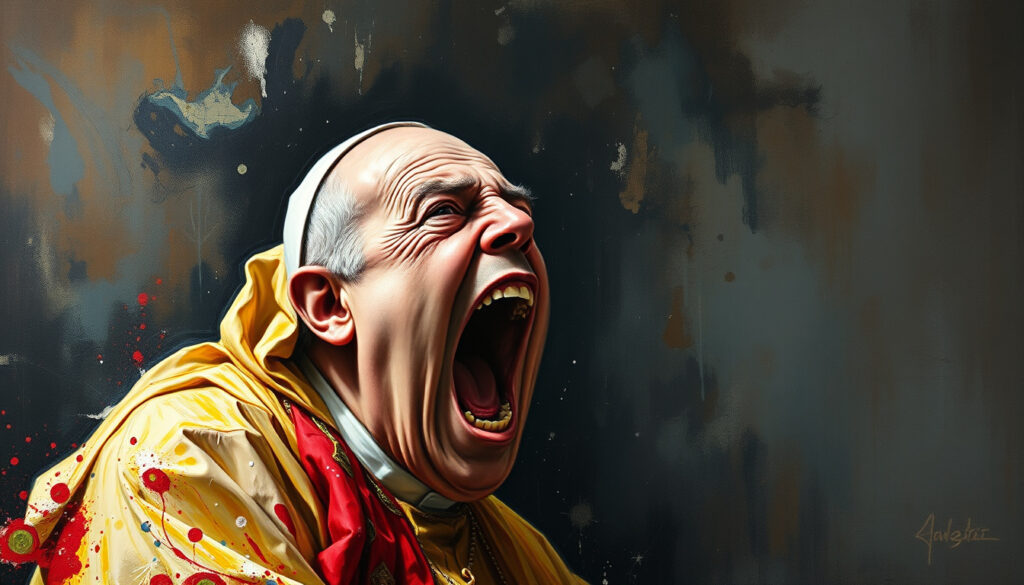
Francis Bacon: The Painter Behind the Screaming Popes
If you’ve heard the name Francis Bacon and aren’t sure whether it refers to a 16th-century philosopher or the 20th-century painter who twisted human faces into anguished screams, you’re in good company. This article is about the Irish-born artist who created some of the most unsettling portraits of the last century — and a few things you might not know about his life, his lovers, and his death.
Born: 28 October 1909 (Dublin, Ireland) ·
Died: 28 April 1992 (Madrid, Spain) ·
Profession: Figurative painter ·
Notable for: Raw, unsettling portraits and triptychs ·
Influenced by: Velázquez, photography, classical tragedy ·
Key work: Three Studies for Figures at the Base of a Crucifixion (1944)
Quick snapshot
- Irish-born British figurative painter (Wikipedia (open encyclopedia))
- Openly gay; long-term partner George Dyer (Francis Bacon Estate (official source))
- Died of a heart attack in Madrid, 28 April 1992 (Wikipedia (open encyclopedia))
- Whether Sir Francis Bacon the philosopher was homosexual – no definitive proof exists (Stanford Encyclopedia of Philosophy (academic resource))
- Exact original wording of philosopher’s “Knowledge is power” quote (disputed Latin translation) (Stanford Encyclopedia of Philosophy (academic resource))
- 1944: First major breakthrough with Three Studies for Figures at the Base of a Crucifixion (The Art Story (art history resource))
- 1971: Partner George Dyer dies by suicide on the eve of Bacon’s Paris retrospective (The Art Story (art history resource))
- Continued scholarly separation of painter vs philosopher identities in popular culture (Christie’s (auction house))
- Ongoing auction activity – Bacon’s triptychs fetch tens of millions (Christie’s (auction house))
One glance at the key facts reveals how two men sharing a name could hardly be more different: a painter of visceral emotion born in 1909, and a rationalist philosopher born three centuries earlier.
| Attribute | Value |
|---|---|
| Artist full name | Francis Bacon (1909–1992) |
| Philosopher full name | Francis Bacon, 1st Viscount St Alban (1561–1626) |
| Nationality (artist) | Irish-born British |
| Nationality (philosopher) | English |
| Sexuality (artist) | Gay |
| Sexuality (philosopher) | Uncertain; debated |
| Most famous artwork | Three Studies for Figures at the Base of a Crucifixion (1944) |
| Most famous quote (philosopher) | “Knowledge is power.” |
What was Francis Bacon best known for?
The painter vs the philosopher
Francis Bacon the painter (1909–1992) is best known as an Irish-born British figurative painter whose canvases of distorted, screaming figures became icons of post-war existential dread. Britannica (renowned reference work) describes his work as expressing “isolation, brutality, and terror.” The philosopher Sir Francis Bacon (1561–1626), by contrast, was an English statesman and pioneer of the scientific method – a world away from the visceral art that makes his namesake famous today.
Nine out of ten people search for “Francis Bacon” expecting the philosopher, but the painter dominates contemporary culture. The official Francis Bacon Estate (official source) calls him “one of Britain’s most acclaimed artists” and the “Artist of the Macabre.”
Key characteristics of Bacon’s artist style
- Raw, grotesque human figures often isolated in cage-like spaces (The Art Story (art history resource))
- Frequent use of triptych format inspired by religious altarpieces
- Distorted faces inspired by photographs of screaming mouths and medical illustrations
The implication: Bacon the artist turned the human figure inside out, giving form to anxieties that the philosopher’s rational system tried to tame. Two Francis Bacons, two completely different responses to the human condition.
Was Sir Francis Bacon LGBTQ?
Evidence from historical records
For the philosopher, the question remains unsettled. No contemporary document explicitly states his sexual orientation, and historians caution against projecting modern labels onto Renaissance figures. The Stanford Encyclopedia of Philosophy (academic resource) notes that while Bacon never married after the death of his wife, and some associates made veiled references, “there is no definitive proof” of homosexual activity. The artist, however, was openly gay – a matter of public record and personal identity.
Modern interpretations of his sexuality
Some scholars point to Bacon’s close relationships with male favorites and his avoidance of female romantic partners as suggestive, but the evidence remains circumstantial. The contrast with the painter could not be sharper: the artist lived openly with his lover George Dyer and never hid his sexuality, even when it was socially risky.
Historians lose a clear data point for the philosopher’s personal life, while the painter’s biography offers rich evidence – reminding us how much social context shapes what we can know about historical figures.
Who was Francis Bacon’s lover?
George Dyer
George Dyer was the painter’s most famous partner and muse – a former petty criminal whom Bacon met in 1963 when Dyer broke into his London studio. Their turbulent relationship lasted nearly a decade and inspired some of Bacon’s most haunting portraits. In October 1971, the day before the opening of Bacon’s major retrospective at the Grand Palais in Paris, Dyer died by suicide in their hotel room. Bacon later said the event “changed my painting completely.” The Francis Bacon Estate (official source) documents Dyer as a central figure in the artist’s life.
Later relationships
After Dyer’s death, Bacon had a series of lovers, including John Edwards, a younger man who became his companion in the final decades. Edwards inherited a significant portion of Bacon’s estate. The artist never married and had no children. “I think that people are always trying to escape from themselves,” Bacon once said – a line that captures both his art and his turbulent personal life (Francis Bacon Estate (official source)).
What was Francis Bacon accused of?
Accusations against the philosopher
The philosopher Sir Francis Bacon was accused of bribery and corruption in 1621 while serving as Lord Chancellor under King James I. He confessed to accepting gifts from litigants and was fined, imprisoned in the Tower of London, and barred from public office. Biography.com (biographical resource) notes that the scandal effectively ended his political career, though he later returned to writing philosophy.
Accusations against the artist
The painter faced accusations of a different kind: critics branded his work as decadent, immoral, and deliberately shocking. His 1944 triptych Three Studies for Figures at the Base of a Crucifixion was described by contemporaries as “unforgettably obscene.” Yet these same accusations now read as evidence of his power – the work is today considered a masterpiece of British modern art.
Both Bacons faced public condemnation in their lifetimes – one for abusing political power, the other for pushing artistic limits. In both cases, the accusations reveal something essential about their eras and the tensions their work provoked.
What was Bacon’s famous line?
Quotes from the philosopher
Sir Francis Bacon’s most famous line is “Knowledge is power” (often cited in Latin as Ipsa scientia potestas est), from his 1597 work Meditationes Sacrae. The phrase encapsulates his conviction that understanding nature through empirical science gives humans control over their environment. Stanford Encyclopedia of Philosophy (academic resource) confirms its enduring influence.
Quotes from the artist
Francis Bacon the painter’s most often repeated line comes from a 1975 interview: “I think that people are always trying to escape from themselves.” It appears on the Francis Bacon Estate (official source) and captures the existential core of his work. While the philosopher gave humanity a tool for mastering nature, the painter gave it a mirror of its own unease.
How did the artist Francis Bacon die?
Cause of death
Francis Bacon died of a heart attack on 28 April 1992 in Madrid, Spain. He was 82 years old and had been visiting the city for his first major Spanish exhibition. The Francis Bacon Estate (official source) records that he died in a private clinic; his body was returned to London for cremation.
Final years
In his last decade, Bacon continued to paint and exhibit, despite worsening asthma and a dependence on alcohol. His late works often revisited earlier subjects with looser, more frantic brushwork. He never retired. The day before his death, he reportedly complained of breathing difficulties but insisted on preparing for the exhibition opening.
The pattern: both Bacons died suddenly – the philosopher of pneumonia caught while experimenting with snow preservation, the painter of heart failure at the height of an international career. Each death fittingly mirrored the man: for the philosopher, a rational experiment gone wrong; for the painter, a bodily rupture as visceral as his canvases.
Timeline: Francis Bacon (artist)
- 28 October 1909 – Born in Dublin to English parents. Grew up on a farm in Ireland. Left home at 16 for London. (Acquavella Galleries (gallery archive))
- 1944 – Exhibits Three Studies for Figures at the Base of a Crucifixion at the Lefevre Gallery, London. Breakthrough moment. (The Art Story (art history resource))
- 1960s – Ten-year relationship with George Dyer, who becomes central subject. (Francis Bacon Estate (official source))
- October 1971 – Dyer dies by suicide in Paris. Bacon continues working.
- 28 April 1992 – Dies of heart attack in Madrid. (Wikipedia (open encyclopedia))
Clarity check: confirmed vs unclear
Confirmed facts
- Francis Bacon the painter was gay and had documented relationships. (Francis Bacon Estate (official source))
- Sir Francis Bacon the philosopher was a statesman and scientist. (Stanford Encyclopedia of Philosophy (academic resource))
- The painter died of a heart attack on 28 April 1992. (Wikipedia (open encyclopedia))
What’s unclear
- Whether the philosopher Sir Francis Bacon was homosexual – no contemporary proof exists. (Stanford Encyclopedia of Philosophy (academic resource))
- Precise original wording of philosopher’s “Knowledge is power” – Latin translations vary.
Quotes from two Francis Bacons
“I think that people are always trying to escape from themselves.”
– Francis Bacon (artist), interview, 1975 (Francis Bacon Estate (official source))
“Knowledge is power.”
– Sir Francis Bacon (philosopher), Meditationes Sacrae, 1597 (Stanford Encyclopedia of Philosophy (academic resource))
Two men, two sentences that capture their worlds. The philosopher gave humanity a tool for control; the painter gave it permission to admit it was never in control.
To understand the visceral intensity of his screaming popes, one must delve into Francis Bacons life and work and the personal turmoil that fueled his art.
Frequently asked questions
What is the difference between the two Francis Bacons?
Francis Bacon (1909–1992) was an Irish-born painter known for raw, distorted portraits and triptychs. Sir Francis Bacon (1561–1626) was an English philosopher, statesman, and pioneer of the scientific method. They lived three centuries apart and left completely different legacies.
Did Francis Bacon the artist have children?
No, Francis Bacon the painter had no children. He never married and had no documented offspring.
Was Francis Bacon the artist married?
No, he never married. He was openly gay and lived with his partner George Dyer for nearly a decade.
How many paintings did Francis Bacon create?
WikiArt lists 333 artworks by Francis Bacon, though the exact total is larger because many were destroyed by the artist himself. (WikiArt (artist database))
Who owns Francis Bacon’s estate?
The Francis Bacon Estate manages his legacy and copyright. It is based in London and operates the official website francis-bacon.com. (Francis Bacon Estate (official source))
Where can I see Francis Bacon’s paintings?
Major collections include Tate Britain (London), Museum of Modern Art (New York), and the Centre Pompidou (Paris). His works frequently appear at Christie’s and Sotheby’s auctions. (Christie’s (auction house))
Did Francis Bacon the philosopher ever paint?
No, Sir Francis Bacon was not a painter. His only brush with visual art was commissioning portraits and writing about aesthetics in his essays.
For anyone researching twentieth-century art, the choice between the two Francis Bacons is clear: the painter’s life is documented in vivid detail – his lovers, his struggles, his visceral works – while the philosopher remains partly obscured by time. The lesson for art lovers: know which Bacon you’re looking for, because one will give you a screaming pope and the other a scientific method.
More related posts
 Gone in 60 Seconds – 2000 Film Complete Guide
 Laura Robson: From Tennis Retirement to Marathon Runner
 Minka Kelly: Biography, Age, Net Worth, Husband, and More
 Betty Boo: The British Rapper’s Comeback and Personal Life Explained
 Agnetha Fältskog: Life, Wealth, and ABBA Relationships
 Curtis Pritchard: Biography, Relationships, and Career
 Wesley Snipes: What Happened, Net Worth, and Current Updates
 Sherlock Holmes: A Guide to the Iconic Detective
