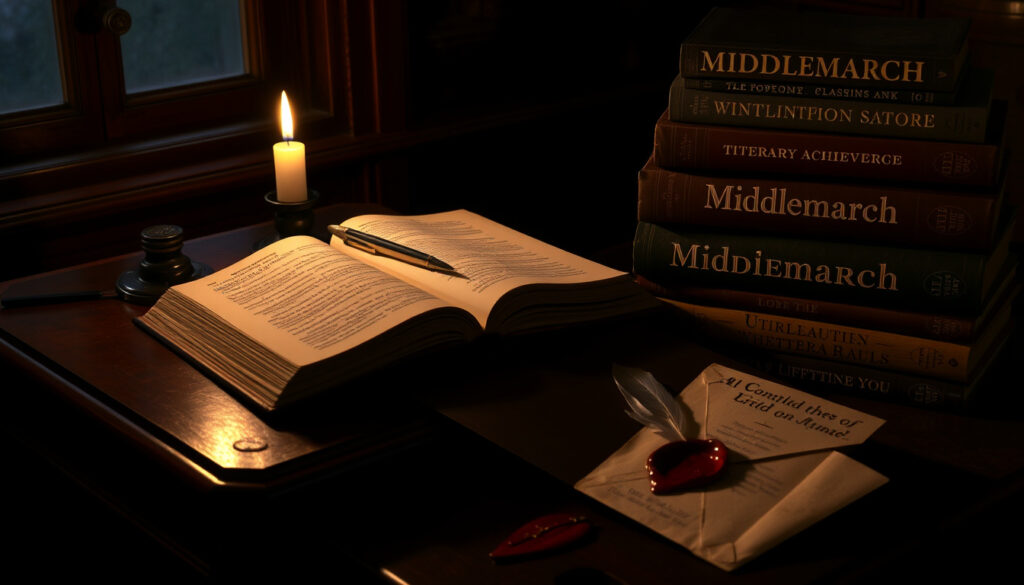
George Eliot: Biography, Books, and Controversial Life
Few novelists have left as deep a mark on English literature as George Eliot, yet behind the famous pen name was a woman whose personal choices made her a target of scandal. Born Mary Ann Evans in 1819, she lived openly with a married man, wrote under a male name, and produced novels that peered into human psychology like few before them. This article traces how her unconventional life and intellectual circle fed the psychological depth and social realism of her books — and why Middlemarch remains a landmark.
Full name: Mary Ann Evans ·
Born: 22 November 1819 ·
Died: 22 December 1880 ·
Pen name: George Eliot ·
Most famous work: Middlemarch ·
Number of novels: 7
Quick snapshot
- George Eliot was the pen name of Mary Ann Evans, a leading Victorian novelist (BBC History (UK public broadcaster))
- Born 22 November 1819 in Warwickshire (BBC History (UK public broadcaster))
- Published Adam Bede in 1859 under the pseudonym (OUPblog (academic publisher))
- Died 22 December 1880 (Wikipedia (collaborative encyclopedia))
- Exact nature of her religious conversion and later loss of faith
- Details of her early childhood education
- 1819 — born; 1854 — relationship with Lewes begins; 1871–72 — Middlemarch published
- Scholars continue to explore her relevance, especially around gender, Jewish identity, and realism (see FAQ)
Seven key facts, one pattern: every major life event — from birth to the scandalous partnership with George Henry Lewes — fed the psychological depth that made her novels enduring.
| Attribute | Value |
|---|---|
| Born | 22 November 1819, Nuneaton, England |
| Died | 22 December 1880, London, England |
| Pen name | George Eliot |
| Nationality | British |
| Notable works | Middlemarch, Adam Bede, The Mill on the Floss, Silas Marner, Daniel Deronda |
| Partner | George Henry Lewes (1854–1878) |
| Children | None (stepmother to three) |
What is George Eliot most known for?
George Eliot is renowned for novels that dissect human motive with a surgeon’s precision while painting the full canvas of provincial English life. Her real name was Mary Ann Evans (BBC History (UK public broadcaster)), adopted the male pen name to ensure her work was taken seriously, and produced seven novels that include Adam Bede, The Mill on the Floss, Silas Marner, and Daniel Deronda (Wikipedia (collaborative encyclopedia)). Above all, Middlemarch is considered her masterpiece (Britannica (reference authority)).
What was George Eliot’s real name?
Mary Ann Evans (later Marian Evans) was born on 22 November 1819 in Warwickshire (BBC History (UK public broadcaster)). She began contributing to the Westminster Review in 1850 and later became its assistant editor.
What are her most famous works?
- Adam Bede (1859) — her first novel, a rural tragedy (OUPblog (academic publisher))
- The Mill on the Floss (1860) — semi-autobiographical, explores sibling rivalry
- Silas Marner (1861) — a tale of redemption
- Middlemarch (1871–72) — widely considered her crowning achievement (Britannica (reference authority))
- Daniel Deronda (1876) — explores Jewish identity
Eliot’s early work as an editor gave her a panoramic view of Victorian intellectual life — philosophy, science, politics — which she wove into her fiction. No English novelist before her had fused so much lived social observation with such intricate interior psychology.
The implication: Eliot’s editing career was not a detour from her fiction but its laboratory — a space where she absorbed the debates she would later dramatise in novels.
Why was George Eliot controversial?
In Victorian England, a woman living openly with a married man was a scandal that could destroy a reputation. Eliot’s relationship with George Henry Lewes, who was already married to another woman, drew public criticism and social ostracism (BBC History (UK public broadcaster)). She also expressed religious skepticism in an era when piety was expected, especially from women. Together, these choices made her a magnet for controversy.
What was particularly scandalous about George Eliot’s life?
Lewes could not divorce his wife because he had condoned her adultery, a legal bar at the time. He and Eliot lived as husband and wife for more than twenty years, a public arrangement that violated nearly every social norm (OUPblog (academic publisher)). Her family cut ties, and she was excluded from many social circles.
The pattern: the same society that condemned Eliot’s choices also gave her the outsider’s vantage point that sharpened her fiction.
Who was George Eliot’s lover?
Her partner and intellectual companion was George Henry Lewes, a literary critic and philosopher. They met through London’s intellectual circles in the early 1850s, and by 1854 they were living together openly (BBC History (UK public broadcaster)). Lewes encouraged Eliot to write fiction, acting as both coach and editor.
Did George Eliot have a child?
Eliot had no biological children, but she acted as stepmother to Lewes’s three sons from his previous marriage. The household was unconventional by any standard, yet it provided the stability Eliot needed to produce her major works.
What was the cause of death of George Eliot?
Eliot died on 22 December 1880 in London (Wikipedia (collaborative encyclopedia)). The reported cause was kidney infection (nephritis), though some biographers note diagnostic uncertainty given 19th-century medical record-keeping. She had married John Walter Cross earlier that year, a union that surprised many given their age difference, but the marriage lasted only a few months before her death.
When did George Eliot die?
22 December 1880. She is buried in Highgate Cemetery in London, a resting place shared with many notable Victorians.
Why is Middlemarch so highly rated?
Virginia Woolf called Middlemarch “one of the few English novels written for grown-up people” (Hertog Foundation (educational nonprofit)). The novel’s psychological insight is unmatched in its era: Eliot takes the reader inside her characters’ minds — their ambitions, misjudgments, and small defeats — without moralizing.
What are the main themes of Middlemarch?
- Marriage and its disappointments — Dorothea Brooke’s disastrous union with Casaubon and the quieter tragedy of Lydgate’s marriage to Rosamond
- Ambition and failure — Lydgate’s scientific aspirations crushed by debt and social pressure
- Social change — the Reform Bill of 1832 as a backdrop to the town’s political shifts
- Provincial life — the novel’s subtitle “A Study of Provincial Life” signals its exhaustive social canvas (Audible (audiobook publisher))
Eliot portrays characters with such empathy that even the most foolish earn our understanding. That refusal to judge — combined with razor-sharp observation — makes Middlemarch feel more modern than most novels written a century later.
The catch: Eliot’s empathy is not softness — it is a disciplined act of attention that demands the same from her readers.
Did George Eliot have a child?
She had no biological children, but served as stepmother to Lewes’s three sons (OUPblog (academic publisher)). The role is sometimes overlooked in biographies, yet it shows a domestic side to a woman often portrayed as purely intellectual.
Timeline: George Eliot’s Life and Works
- 1819 — Born Mary Ann Evans in Nuneaton, Warwickshire (BBC History (UK public broadcaster))
- 1836 — Mother dies; leaves school to care for father
- 1849 — Father dies; moves to London
- 1851 — Becomes assistant editor of the Westminster Review
- 1854 — Begins relationship with George Henry Lewes; lives openly with him
- 1859 — Publishes first novel, Adam Bede, under pen name George Eliot (OUPblog (academic publisher))
- 1860 — The Mill on the Floss
- 1871–72 — Middlemarch published in eight parts (Britannica (reference authority))
- 1876 — Daniel Deronda
- 1878 — George Henry Lewes dies
- 1880 — Marries John Walter Cross; dies shortly after on 22 December (Wikipedia (collaborative encyclopedia))
The gap between Lewes’s death in 1878 and Eliot’s marriage in 1880 raises questions. Was she seeking companionship? Did she marry Cross as a form of social reintegration? Scholars still debate her motives.
Confirmed facts vs. what’s unclear
Confirmed facts
- Birth and death dates — 22 Nov 1819, 22 Dec 1880
- Relationship with George Henry Lewes (1854–1878)
- Publication dates of major novels
What’s unclear
- Exact nature of her religious conversion and later loss of faith
- Details of her early childhood education
- Precise cause of death — kidney infection (nephritis) is the reported cause but 19th-century diagnostics leave room for uncertainty
- Exact timeline of her religious shift from Anglican to agnostic
“If we had a keen vision and feeling of all ordinary human life, it would be like hearing the grass grow or the squirrel’s heart beat, and we should die of that roar which lies on the other side of silence.”
— George Eliot, Middlemarch
“It is the magnificent book that with all its imperfections is one of the few English novels written for grown-up people.”
— Virginia Woolf on Middlemarch
“The best way to show that a statement is false is to believe it.”
— George Eliot, Felix Holt, the Radical
Eliot’s legacy is not just a shelf of novels; it’s a challenge to every writer who follows: look closely, refuse easy judgments, and trust that ordinary lives contain extraordinary depths. For any reader curious about the human heart, the choice is clear: start with Middlemarch, or risk missing one of the few novels truly written for grown-up people.
app.thestorygraph.com, uwa.edu.au, youtube.com, facebook.com, archive.org, victorianweb.org, veranderwijs.nu
For a deeper look at the social and personal controversies surrounding her, explore the scandalous life of George Eliot in more detail.
Frequently asked questions
What was George Eliot’s religious background?
Raised in a devout Anglican family, Eliot experienced a crisis of faith in her twenties and became agnostic. She translated Strauss’s Life of Jesus, which questioned the historicity of the Gospels.
Is George Eliot considered a feminist writer?
While she did not identify as a feminist, her novels explore women’s limited choices and intellectual aspirations with deep sympathy. Many scholars read her work as proto-feminist.
How many novels did George Eliot write?
Seven: Adam Bede, The Mill on the Floss, Silas Marner, Romola, Felix Holt, the Radical, Middlemarch, and Daniel Deronda.
Where did George Eliot live?
She lived primarily in London after moving there in 1849, but also spent time in Coventry and the English countryside that inspired her fiction.
What influence did George Eliot have on modern literature?
Her psychological realism influenced Henry James, Thomas Hardy, and later modernists like Virginia Woolf. She expanded what the novel could do with interior consciousness.
Why did George Eliot choose a male pen name?
To ensure her fiction was judged on merit, not gender. In the Victorian era, women writers were often dismissed as lightweight or sentimental.
Was George Eliot ever married?
She married John Walter Cross in 1880, at age 60, but the marriage lasted only a few months before her death. She had lived with Lewes for 24 years prior.
More related posts
 Electric Scooter Laws in Ireland: Age, Speed, and Safety
 Jaden Philogene: Age, Ethnicity, Top Speed, and Current Team
 La Voix: Injury Facts, Personal Life, and Current Projects
 Percy Jackson Books in Order: Reading Guide, Age Rating, and More
 Simone Ashley: Ethnicity, F1 Movie Cut, Religion, and More
 Italian Bach: Real Name, Age, Girlfriend, and Biography
 Lisa Stansfield: Biography, Net Worth, Latest News & Songs
 Miriam Cates: Former MP, GB News Presenter and CSJ Fellow
