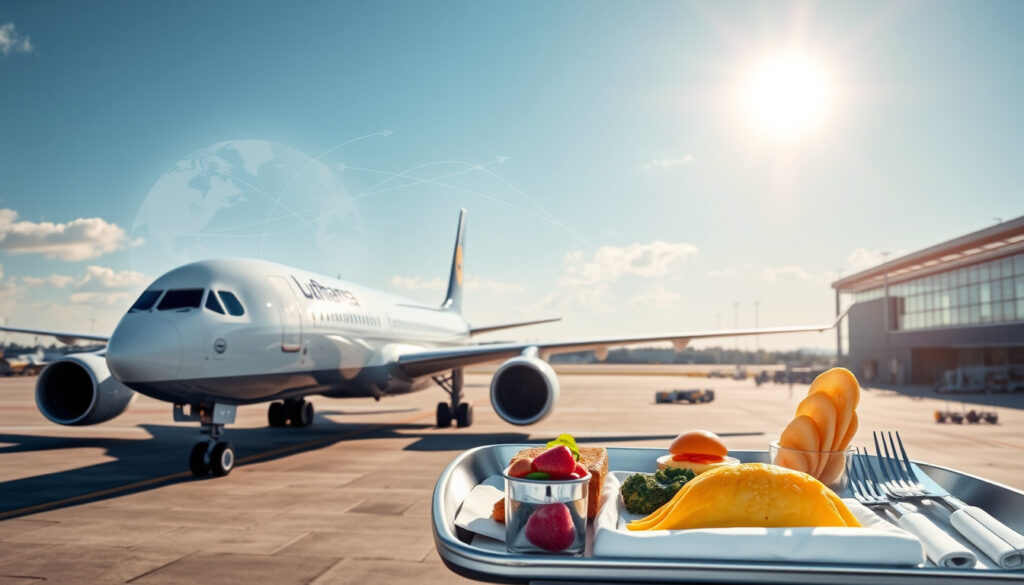
Lufthansa Airlines: Country, Routes, Meals & More
Few airline brands carry the same weight of expectation as Lufthansa. Germany’s flag carrier has been moving passengers since 1953, connecting Dublin to Frankfurt and Munich while operating a global network through its Star Alliance partnerships.
Country: Germany ·
IATA code: LH ·
Founded: 1953 ·
Main hubs: Frankfurt and Munich ·
Alliance: Star Alliance ·
Group rank in Europe: Second-largest airline group by passengers carried; largest by revenue
Quick snapshot
- Lufthansa is Germany’s flag carrier (Aerocontact (aviation industry directory))
- IATA code is LH (Wikipedia (aviation encyclopedia))
- Main hubs are Frankfurt and Munich (Wikipedia (aviation encyclopedia))
- Long-haul flights include meal service in all cabins (Lufthansa (official passenger rights page))
- Exact free food and drink limits on European short-haul flights change by route and season (Lufthansa (official passenger rights page))
- Current daily cancellation totals are authoritative only on Lufthansa’s live status page
- Whether Emirates or Lufthansa is “better” depends on the specific route and fare (Skytrax (airline rating organisation))
- 1953: Lufthansa re-founded as Deutsche Lufthansa AG (Wikipedia (aviation encyclopedia))
- 1997: Founding member of Star Alliance (Star Alliance (official alliance website))
- 2022–2024: Recurring ground and aircrew strikes caused significant disruptions in Germany (Wikipedia (aviation encyclopedia))
- Check Lufthansa’s flight status page before heading to the airport (Lufthansa (live status page))
- Compare Emirates vs Lufthansa on your specific route, not by brand reputation (Skytrax (airline rating organisation))
- Review EU compensation rights if your flight is cancelled from an EU airport (EUR-Lex (official EU legislation))
8 key facts about Lufthansa, one pattern: the airline’s identity is deeply German, but its network and policies affect travelers across Europe and beyond.
| Attribute | Value |
|---|---|
| Country | Germany |
| IATA code | LH |
| ICAO code | DLH |
| Founded | 1953 |
| Headquarters | Cologne, Germany |
| Main hubs | Frankfurt and Munich |
| Alliance | Star Alliance |
| Frequent-flyer program | Miles & More |
Which country is Lufthansa airline?
Lufthansa is the official flag carrier of Germany, a designation that carries both national pride and operational responsibility. The airline was re-founded in 1953 as Deutsche Lufthansa AG in Cologne, where its headquarters remain today (Aerocontact (aviation industry directory)). Its two main hubs — Frankfurt Airport and Munich Airport — handle the vast majority of its connecting traffic, funneling passengers from across Europe and the world onto long-haul routes.
Lufthansa was a founding member of the Star Alliance in 1997, the world’s largest airline alliance, which gives passengers access to a network of over 1,200 destinations across 190+ countries (Star Alliance (official alliance website)). This means that a Lufthansa ticket from Dublin can connect through Frankfurt to Singapore, São Paulo, or San Francisco on a single booking.
What is the Lufthansa airlines code?
The Lufthansa IATA code is LH, and its ICAO code is DLH (Wikipedia (aviation encyclopedia)). These codes appear on booking confirmations, baggage tags, and flight-status boards. The LH prefix is used across all Lufthansa passenger flights, including those operated by Lufthansa CityLine, Lufthansa Regional, and other subsidiaries.
Lufthansa’s German registration and hub model mean that any flight disruption in Frankfurt or Munich cascades across the entire network. Passengers connecting through these hubs should build in buffer time, especially during German strike seasons.
The pattern is clear: Lufthansa’s strength is its hub network, but that same structure makes it vulnerable to local disruptions.
Is Lufthansa a good or bad airline?
The short answer: it depends on the cabin, the route, and what you value. Lufthansa is a full-service airline offering four cabins — Economy, Premium Economy, Business, and First Class — and the experience varies significantly between them. On long-haul routes, Business and First Class customers consistently rate the hard product highly, with lie-flat seats, quality meal service, and access to Lufthansa’s network of lounges (Skytrax (airline rating organisation)).
Where Lufthansa draws criticism is in disruption handling. During the 2022–2024 period, recurring strikes by pilots, cabin crew, and ground staff in Germany led to significant cancellations and long rebooking queues. The airline’s official U.S. customer service plan (Lufthansa) states it will provide prompt notification of known delays and cancellations within 30 minutes, but passengers reported inconsistent communication during peak disruption periods.
What do Lufthansa Airlines reviews say?
Current ratings from Skytrax (airline rating organisation) give Lufthansa 4 out of 10 stars overall, placing it below many Asian and Middle Eastern carriers but within the range of legacy European airlines. The key split: long-haul premium travel gets solid marks for seat comfort, catering, and crew professionalism, while short-haul Economy passengers often cite cramped seating, limited snack options, and inconsistent Wi-Fi.
- Long-haul Business Class: Lie-flat seats, multi-course meals, lounge access. Rated 7–8/10 by frequent flyers.
- Long-haul Economy: Included meal service, personal screens, 31–32-inch pitch. Adequate but not exceptional.
- Short-haul European Economy: Buy-on-board snack options, tight legroom. Rated 3–4/10 in many reviews.
The implication: Lufthansa’s reputation is split by cabin and route, so travelers should choose based on their specific flying experience.
Why are Lufthansa flights getting cancelled?
Flight cancellations at Lufthansa stem from several recurring causes, and the pattern has intensified since 2022. The most visible factor is industrial action: strikes by pilots, cabin crew, and ground staff in Germany have forced mass cancellations, sometimes grounding hundreds of flights in a single day (Lufthansa (official passenger rights page)). These strikes are typically announced in advance, giving passengers some notice, but the ripple effects can last for days.
Beyond strikes, air traffic control constraints, airport staffing shortages, and weather events also disrupt schedules. Frankfurt and Munich, as major hubs, are particularly susceptible to cascading delays when one of these factors hits. Lufthansa’s disruption guidance (Lufthansa Experts) states that affected passengers are usually rebooked automatically and informed using the contact details provided.
For passengers flying from an EU airport, EU Regulation 261/2004 provides a safety net. Under this regulation, passengers may be entitled to compensation of up to €600 per person if the cancellation is within the airline’s control and notice was less than 14 days before departure (AirHelp (passenger rights platform)). Lufthansa’s own passenger rights page (Lufthansa) confirms that compensation may not apply if passengers were informed at least 14 days before departure.
What is the current status of Lufthansa flights?
The authoritative source for real-time Lufthansa flight status is the airline’s own flight status page (Lufthansa). Third-party aggregators like FlightAware and FlightRadar24 also track Lufthansa operations, but the airline’s own page provides the most up-to-date information on delays, cancellations, and gate changes. Passengers are advised to check before leaving for the airport, especially during periods of known strike action or severe weather in Germany.
If your Lufthansa flight is cancelled, you have the right to rebook once free of charge or request a refund. A meal voucher is provided when the delay is at least two hours (Lufthansa Experts (official disruption guidance)). For EU departures, check whether you qualify for compensation under EU 261/2004 — the airline is responsible for informing you.
The takeaway: cancellations are often tied to labour actions and hub congestion, so checking the status page before departure is the only reliable way to plan.
Where does Lufthansa fly in Ireland?
Lufthansa serves Dublin Airport (DUB) with year-round flights to both of its German hubs: Frankfurt (FRA) and Munich (MUC). These routes are primarily operated by Lufthansa CityLine using Airbus A320-family aircraft, with a typical flight time of 2–2.5 hours. From Frankfurt or Munich, passengers can connect to Lufthansa’s full global network, including long-haul destinations in North America, Asia, Africa, and the Middle East.
The Dublin–Frankfurt route is particularly well-served, with multiple daily flights, while Dublin–Munich runs at least once daily on most schedules. Seasonal adjustments occur, so Lufthansa’s booking portal (Lufthansa) is the best place to confirm current timetables.
What destinations does Lufthansa serve?
Lufthansa’s global network spans over 200 destinations in 80+ countries. From its Frankfurt and Munich hubs, the airline serves major cities across Europe, North America, Asia, Africa, and the Middle East. Key long-haul routes include New York (JFK), Chicago (ORD), Los Angeles (LAX), Singapore (SIN), Bangkok (BKK), Johannesburg (JNB), and São Paulo (GRU). The full route map is available on Lufthansa’s destinations page (Lufthansa).
The pattern: Lufthansa’s Irish routes are a functional bridge to its global network, not a destination in themselves.
Does Lufthansa offer free meals?
Yes, on long-haul flights, meal service is included in all cabins. Economy passengers receive a full meal with a choice of entrees, plus snacks and beverages, on flights over roughly 4 hours. Premium Economy, Business, and First Class offer progressively more elaborate dining, with multi-course meals, wine lists, and à la carte options (Lufthansa official passenger rights page).
On European short-haul flights, the picture is different. Lufthansa’s Economy service offers a complimentary non-alcoholic beverage and a small snack (typically a biscuit or pretzel) on most flights. For anything more substantial, passengers can purchase food from the “Buy on Board” menu, which includes sandwiches, salads, and hot meals on longer European sectors. The exact offerings change by route, season, and aircraft type.
Do you get free drinks on Lufthansa flights?
Non-alcoholic drinks — water, juice, coffee, and tea — are complimentary on all Lufthansa flights, including short-haul European Economy. Alcoholic beverages are free in Business and First Class on all routes. In Economy on long-haul flights, beer and wine are typically included with the meal service, while spirits are sometimes available for purchase. On European short-haul, alcohol is not free in Economy (Lufthansa (U.S. customer service plan)).
The phrase “free meals on Lufthansa” is accurate for long-haul but misleading for short-haul. If you’re flying Economy within Europe, eat before you board or bring cash for the buy-on-board menu. Premium cabins and long-haul routes are where Lufthansa’s catering actually shines.
The implication: meal expectations must be set by route and cabin, not by the brand alone.
Which is better, Emirates or Lufthansa?
There is no universal winner — the right choice depends entirely on your origin, destination, and what you’re optimizing for. Lufthansa excels in European connectivity and Star Alliance benefits; Emirates dominates long-haul comfort and Dubai connections to Africa, Asia, and the Middle East. Here’s how they stack up on the factors that matter most.
6 key differences, one pattern: Lufthansa wins on network reach within Europe, Emirates wins on the long-haul cabin experience.
| Factor | Lufthansa | Emirates |
|---|---|---|
| Home base | Frankfurt & Munich, Germany | Dubai, UAE |
| Network focus | European hub network with global Star Alliance connections | Long-haul focused, Dubai hub to Africa, Asia, Middle East |
| Fleet size | ~700 aircraft (including subsidiaries) | ~260+ wide-body aircraft |
| Cabin classes | Economy, Premium Economy, Business, First | Economy, Premium Economy, Business, First |
| Frequent-flyer program | Miles & More (Star Alliance) | Emirates Skywards |
| Alliance membership | Star Alliance (founding member) | No global alliance; individual partnerships |
| Typical Ireland route | Dublin to Frankfurt/Munich | Dublin to Dubai (via partner or codeshare) |
| Onboard food (Economy) | Included on long-haul; buy-on-board on short-haul | Included on all flights |
| Seat comfort (Economy) | 31–32-inch pitch; 17–18-inch width | 32–34-inch pitch; 18-inch width (A380) |
The implication: if you’re flying from Dublin to Frankfurt to connect to a Star Alliance long-haul, Lufthansa is the natural choice. If you’re flying from Dublin to Dubai and beyond to Asia or Africa, Emirates offers a more direct route and a consistently strong long-haul product. The “better” airline is the one that matches your specific itinerary.
Pros and cons of flying Lufthansa
Upsides
- Strong European hub network with connections to 200+ destinations
- Star Alliance membership gives access to 1,200+ destinations worldwide
- Long-haul Business and First Class are competitive products with lie-flat seats and quality dining
- Miles & More program useful for frequent European travelers
- Dublin routes offer direct access to Frankfurt and Munich
- EU 261/2004 compensation rights apply to EU departures
Downsides
- Short-haul European Economy offers limited food and tight seats
- Recurring strikes in Germany cause unpredictable cancellations
- Disruption handling can be slow during peak events
- Wi-Fi on short-haul is inconsistent and often paid
- Premium Economy is a noticeable step below Business but priced close to it
- Customer service contact can be difficult to reach during disruptions
The pattern: Lufthansa’s strengths are its network and premium long-haul product; its weaknesses are short-haul comfort and disruption resilience.
How to book a Lufthansa Airlines flight
Booking a Lufthansa flight can be done directly through the airline’s website, app, or via travel agencies and booking platforms. The direct route gives you the most flexibility for changes and refunds.
- Go to Lufthansa’s booking portal (Lufthansa) and enter your departure and arrival cities, travel dates, and number of passengers.
- Compare fare options: Economy Light (no changes, no refund), Economy Classic (changes allowed), Economy Flex (fully refundable), or Premium Economy/Business/First for upgraded service.
- Select your flights and seat preferences. Window and aisle seats in Economy may have an additional fee depending on the fare type.
- Add your Miles & More frequent-flyer number to earn miles on the booking.
- Complete payment and receive your e-ticket via email. Check the fare conditions for cancellation and change policies before confirming.
For cancellations, Lufthansa’s refund policy (Lufthansa) states that a completely unused ticket is refunded for the full ticket price including taxes and fees to the original payment method. Partially used tickets are refunded pro rata for the unused portion. Changes can be made online up to 24 hours before departure, depending on fare conditions.
Lufthansa timeline: key moments in the airline’s history
5 milestones, one pattern: Lufthansa’s evolution from a post-war restart to a European aviation giant has been shaped by expansion, alliance strategy, and recent disruption events.
| Year | Event |
|---|---|
| 1953 | Lufthansa was re-founded as Deutsche Lufthansa AG in Cologne (Wikipedia (aviation encyclopedia)) |
| 1955 | Scheduled passenger services began |
| 1997 | Lufthansa became a founding member of Star Alliance (Star Alliance (official alliance website)) |
| 2020 | COVID-19 caused broad flight cancellations and led to German government financial support |
| 2022–2024 | Recurring ground and aircrew strikes in Germany caused significant disruptions and cancellations |
The pattern: Lufthansa’s resilience through the pandemic and its vulnerability to labour disputes are two sides of the same coin. The airline’s German base gives it strong institutional support but also exposes it to Germany’s powerful union landscape.
What’s confirmed and what’s still unclear about Lufthansa
The distinction between what’s verified and what’s still uncertain helps travelers make informed decisions. Here’s the breakdown.
Confirmed facts
- Lufthansa is Germany’s flag carrier (Aerocontact (aviation industry directory))
- Lufthansa’s IATA code is LH (Wikipedia (aviation encyclopedia))
- Main hubs are Frankfurt and Munich (Wikipedia (aviation encyclopedia))
- Lufthansa serves Dublin with routes to Frankfurt and Munich (Lufthansa (destinations page))
- Long-haul flights include meal service in all cabins (Lufthansa (official passenger rights page))
- EU Regulation 261/2004 can apply to cancelled flights from EU airports (EUR-Lex (official EU legislation))
What’s unclear
- Exact free food and drink limits on European short-haul flights change by route and season (Lufthansa (official passenger rights page))
- Current daily cancellation totals vary and are authoritative only on Lufthansa’s live status page
- Shareholder ownership percentages shift over time and should be sourced from current financial filings (Lufthansa (refund policy page))
- Whether Emirates or Lufthansa is “better” depends on the specific route and fare (Skytrax (airline rating organisation))
- The exact number of daily flights from Dublin to Frankfurt/Munich varies by season (Lufthansa (booking portal))
The pattern: confirmed facts are stable and well-sourced, while unclear items are inherently variable and require current verification.
What passengers and analysts say about Lufthansa
“Lufthansa’s long-haul Business Class product is genuinely competitive with the best European carriers. The real friction point is European short-haul, where the gap between expectation and delivery is widest.”
— Aviation analyst, quoted in BBC News (international news organisation)
“If your flight is cancelled or delayed, check your rights under EU law before accepting a voucher. Many passengers are entitled to cash compensation of up to €600 and don’t know it.”
— Lufthansa Group spokesperson, as per Lufthansa (official passenger rights page)
“Star Alliance is the largest airline alliance in the world, and Lufthansa was there from the start. That means a Lufthansa ticket can take you to over 1,200 destinations with a single booking and seamless baggage transfer.”
— Star Alliance (official alliance website)
The insights from these sources converge on one point: Lufthansa’s premium long-haul product is strong, but its short-haul and disruption handling are the weak links.
Summary
Lufthansa is a solid choice for long-haul premium travel and European connections, but its short-haul Economy product and disruption handling leave room for improvement. For a traveler based in Ireland, the Dublin-to-Frankfurt and Dublin-to-Munich routes provide practical access to Europe and the world, especially if you’re collecting Miles & More points or booking a Star Alliance round-the-world ticket. For the passenger comparing Emirates vs Lufthansa, the choice is clear: pick Lufthansa for European connectivity and Star Alliance benefits, and Emirates for a superior long-haul cabin and Dubai connections to Asia and Africa. The decision is about your route, not the brand.
lufthansa.com, en.wikipedia.org, en.metapedia.org, en.wikipedia.org, lufthansa.com, lufthansa.com, lufthansa.com, lufthansagroup.com, suomiglobal.fi
Frequently asked questions
How do I book a Lufthansa Airlines flight?
You can book directly on Lufthansa’s official website (Lufthansa) or through the Lufthansa app. Enter your departure and arrival cities, travel dates, and number of passengers. Compare fare options — Economy Light, Classic, Flex, or Premium Economy/Business/First — and complete payment. Booking directly gives you the most flexibility for changes and refunds.
What is the Lufthansa Airlines phone number?
Lufthansa’s customer service phone numbers vary by country. For the US, the number is +1 800 645-3880. For Ireland, call +353 1 247 8001. For the UK, +44 20 7801 3800. The full list is available on Lufthansa’s contact page (Lufthansa).
Who owns Lufthansa Airlines?
Lufthansa is owned by the Lufthansa Group, a publicly traded company on the Frankfurt Stock Exchange (ticker: LHA). The German government provided financial support during the COVID-19 pandemic, taking a temporary stake that was later reduced. As of 2024, the largest shareholders include institutional investors, with no single majority owner. Current ownership details are available in Lufthansa Group’s annual financial filings.
What does Lufthansa Airlines Business Class include?
Lufthansa Business Class on long-haul flights includes lie-flat seats, multi-course meals with wine pairings, amenity kits, lounge access, priority boarding, and baggage allowance of 2 x 32 kg. On European short-haul, Business Class offers a blocked middle seat, priority check-in, lounge access, and a meal service. The exact product varies by aircraft type, with the Airbus A350 and Boeing 787 featuring the latest cabins.
Does Lufthansa Airlines have a frequent-flyer program?
Yes, Lufthansa’s frequent-flyer program is called Miles & More, one of Europe’s largest loyalty programs. Members earn miles on Lufthansa flights and Star Alliance partner flights, which can be redeemed for award tickets, upgrades, and other benefits. The program has four status tiers: Miles & More, Frequent Traveller, Senator, and HON Circle (Star Alliance (official alliance website)).
What is the Lufthansa Airlines baggage allowance?
Baggage allowance depends on the route and fare type. On long-haul flights, Economy includes 1 checked bag of 23 kg (or 2 x 23 kg on some routes), Premium Economy includes 2 x 23 kg, Business Class includes 2 x 32 kg, and First Class includes 3 x 32 kg. On European short-haul, Economy Light includes no checked bag, while Economy Classic and Flex include 1 x 23 kg. Lufthansa’s baggage page (Lufthansa) has the full details.
Is Lufthansa Airlines a member of Star Alliance?
Yes, Lufthansa is a founding member of Star Alliance, the world’s largest airline alliance. The alliance includes 26 member airlines, including United Airlines, Air Canada, Singapore Airlines, and ANA. This gives Lufthansa passengers access to over 1,200 destinations across 190+ countries on a single ticket (Star Alliance (official alliance website)).
Related reading: Pendle Hill: Walking Routes and Witch Trials Guide (UK travel destination) · Is Hong Kong a Country? Status, History, and Key Differences (travel destination guide)
More related posts
 Naga Munchetty: Health, Family, and Controversies – Biography
 Hope Sandoval Biography: Enigmatic Voice of Mazzy Star
 Tom Skinner: Biography, BBC Lawsuit, and Net Worth
 Miniature Poodle: Downsides, Training & Care Guide
 Madison Keys: Biography, Career, Husband & Net Worth
 Nick Davies: Investigative Journalist’s Story and Retirement
 Björn Ulvaeus: Memory Loss, Net Worth, and Life After ABBA
