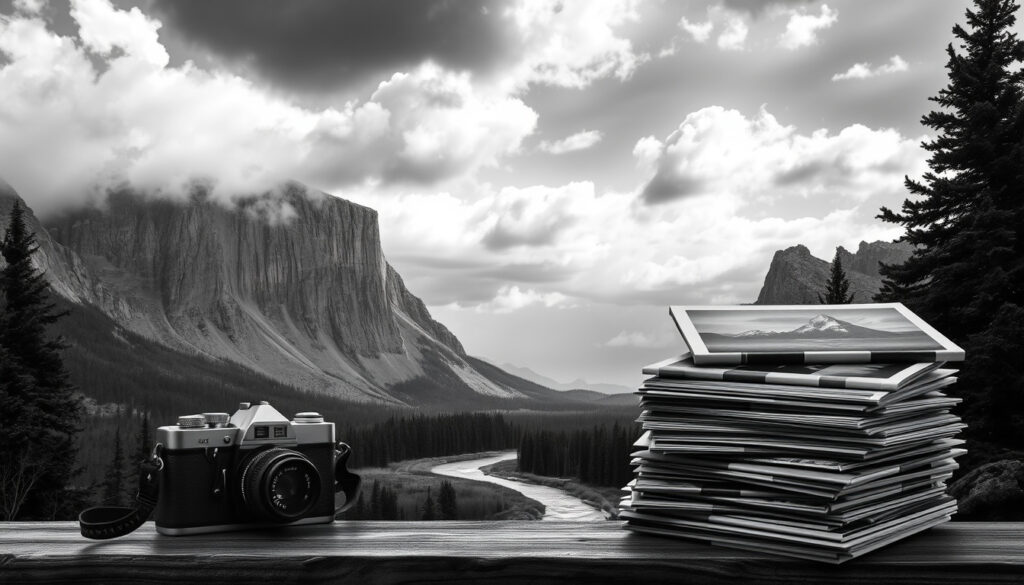
Ansel Adams Biography: Famous Photos, Criticism, Print Records
Ask a working photographer which single image made the case for the American West, and Ansel Adams’ name lands before the light changes. He built that reputation with black-and-white pictures of Yosemite and the Sierra, and the market still rewards it: a Sotheby’s auction report logged a 2024 sale at $4,567,680 with 41 new records, while the biography, the most reproduced works, and the criticism of his people-free West keep the debate alive.
Born: February 20, 1902 · Died: April 22, 1984 · Known for: Black-and-white landscapes of the American West · Signature image: Moonrise, Hernandez, New Mexico (1941) · Adams auction record: $988,000 · Global photo auction record: $12.4 million (Man Ray’s Le Violon d’Ingres, 2022)
Quick snapshot
- Ansel Easton Adams was born February 20, 1902, and died April 22, 1984 (Britannica’s biography).
- A 2024 Sotheby’s sale of his photographs achieved $4,567,680 with 41 new records (Sotheby’s auction report).
- His auction record is The Grand Tetons and the Snake River at $988,000 (Masterworks’ artist analysis).
- No official body ranks a single Adams image as the most famous.
- There are no standardized records for the “most seen” or “rarest” photograph.
- Whether Adams’s unpeopled West erased human and Indigenous histories is an interpretive debate.
- 1902: born in San Francisco (Britannica’s biography). (Wikipedia’s Adams entry)
- 1932: co-founded Group f/64 (Wikipedia’s Adams entry).
- 1941: made Moonrise, Hernandez, New Mexico (Britannica’s biography). (Wikipedia’s Adams entry)
- 2020: Sotheby’s set his auction record with The Grand Tetons and the Snake River (Masterworks’ artist analysis). (Wikipedia’s Adams entry)
- Collectors continue to reward vintage Adams prints, keeping his market active.
- Museum and conservation interest keeps his work circulating in national-park discourse.
- Critics keep debating the limits of his pristine West, which keeps his legacy in motion.
One frame, four contexts: the dates, the movement, the technical tool, and the market all point to a photographer who treated nature as both subject and cause.
| Label | Value |
|---|---|
| Full name | Ansel Easton Adams |
| Born | February 20, 1902, San Francisco, California (Britannica’s biography) |
| Died | April 22, 1984, Carmel, California (Britannica’s biography) |
| Known for | Black-and-white photographs of national parks and the American West (Densho Encyclopedia) |
| Artistic movement | Straight photography / Group f/64 (Wikipedia’s Adams entry) |
| Technical contribution | Zone System for exposure and development (The Atlantic’s appraisal) |
| Auction record | $988,000 — The Grand Tetons and the Snake River, Sotheby’s, 2020 (Masterworks’ artist analysis) |
| 2024 sale total | $4,567,680 with 41 new records (Sotheby’s auction report) |
What is Ansel Adams famous for?
Adams was an American landscape photographer and environmentalist whose images turned national parks and protected lands into a visual argument for preservation.
What is Ansel Adams photography about?
- His most important work focused on untouched wilderness, especially national parks and protected areas of the American West.
- Group f/64, which he helped found in 1932, pushed for straight photography with sharp focus and full tonal range (according to Wikipedia’s Adams entry).
- His photographs made the Sierra Nevada a national visual reference point for generations of tourists and conservationists.
The second piece of his technical legacy is the Zone System: a method for controlling exposure and development so the final print holds detail in both shadow and highlight.
What are Ansel Adams’ most famous photos?
- Moonrise, Hernandez, New Mexico (1941) is the title most commonly tied to Adams in popular searches and gallery catalogs.
- Monolith, the Face of Half Dome (1927) is widely cited as the early image that announced his ambition.
- The Grand Tetons and the Snake River became his auction benchmark when a print sold for $988,000 in 2020 (Masterworks’ artist analysis).
None of those titles has an official “most famous” ranking. The trio shows what Adams’s reputation is built from: one dramatic moonrise, one early Half Dome, and one sweeping river view.
Why does Ansel Adams matter today?
- The Zone System remains a standard teaching tool in film and fine-art photography.
- His national-park advocacy connected photography to land policy, making images part of conservation arguments.
- Museums and collectors continue to treat his prints as a reference point for the American West.
The pattern: Adams turned a regional landscape into a shared national symbol. The technical system made it reproducible; the advocacy made it political.
What is Ansel Adams’ most famous image?
The image most often pointed to is Moonrise, Hernandez, New Mexico, made in 1941. It has the signature Adams elements: a vast sky, a small town, and a tonal range that seems to glow.
Is Moonrise, Hernandez, New Mexico his most famous photograph?
- Moonrise is the title that appears most often when Adams’s name is paired with “famous photograph” in search data.
- It is also the image that introduced many viewers to the idea that a landscape print could feel like theater.
- No museum or census assigns official “most famous” status, so the answer is practical rather than official.
Which other Ansel Adams images are iconic?
- Monolith, the Face of Half Dome (1927) is considered his first great statement of form.
- The Tetons and the Snake River (1942) later became his auction record at $988,000.
- The Manzanar portraits from the 1940s are not landscapes but remain part of his documentary legacy.
What makes an Ansel Adams image recognizable?
- Black-and-white film records structure, texture, and weather without the distraction of color.
- The Zone System lets the photographer pre-visualize the final tonal scale before the shutter opens.
- Large-format cameras and small apertures produce sharp detail from near foreground to far horizon.
Moonrise is the shorthand; the Zone System is the substance. Collectors pay for the print, but the system built the reputation.
The implication: Moonrise is a useful shorthand, but Adams’s reputation rests on a system, not a single negative.
What was Ansel Adams criticized for?
Adams’s West is a world without cars, roads, billboards, or crowds. That aesthetic made him famous, and it also made him a target.
Why did critics question his prints?
- East Coast critics often misunderstood Adams and panned his work for its lack of people and urban grit (The Atlantic’s appraisal).
- A related charge was that his landscapes romanticized nature by ignoring modern America’s cities and industrial blight.
- Encyclopedia.com summarizes the critique as Adams being “criticized for photographing rocks while the world was falling apart” (Encyclopedia.com’s entry).
Did Adams erase people from nature?
- His famous landscapes are nearly always unpeopled, which gave the West a sense of timeless emptiness.
- His Manzanar project put Japanese American prisoners in the frame, but critics still accused him of softening the injustice.
- Today, that unpeopled West is read by some as a silence about Indigenous presence and labor.
How did the art market respond to Adams’s print output?
- Adams reprinted his famous negatives many times, which made early, low-edition prints far more valuable than later ones.
- His current auction record is $988,000 for The Grand Tetons and the Snake River in 2020 (Masterworks’ artist analysis).
- A 2024 Sotheby’s sale of Adams works reached $4,567,680 and set 41 records (Sotheby’s auction report).
The trade-off: the same diligence that made his prints technically brilliant also made them reproducible. The market now sorts the rare early prints from the later show prints.
What photo sold for $4.3 million?
The photo behind that question is not an Ansel Adams. It is Andreas Gursky’s Rhein II, which sold at Christie’s New York in 2011 for $4,338,500.
Which photograph set the auction record?
- Rhein II, a digitally composed image of the Rhine River, sold at Christie’s in 2011 for $4,338,500.
- It set a then-record for the most expensive photograph sold at auction.
- Ansel Adams’s own prints have never sold for that amount.
What was the price of Rhein II?
- Rhein II: $4,338,500 at Christie’s, 2011.
- Man Ray’s Le Violon d’Ingres later sold for $12.4 million at Christie’s in 2022, resetting the world record.
- The Grand Tetons and the Snake River sold for $988,000 at Sotheby’s in 2020 (Masterworks’ artist analysis).
How do Ansel Adams’s auctions compare?
- Adams’s top price is about one-twelfth of the current global record.
- His market is broad, not just single-image: a 2024 sale set 41 new records across many lots.
- Comparisons matter, but the two markets measure different things: Adams prints exist in editions, while records like Rhein II are single iconic images.
“Most expensive photograph” headlines usually mean “one unique print sold once.” Adams’s market is about edition, condition, and provenance, so a single record price cannot capture it.
The takeaway: the $4.3 million question is a useful reality check. Adams is a major market, but he is not the record market.
What is the most famous photo in the world?
There is no official ranking. “Most famous,” “rarest,” and “prettiest” are not measured categories in photography.
What is the most seen photo ever?
- NASA images such as The Blue Marble and Earthrise are often described as among the most widely reproduced photographs ever made.
- There is no central counter that tracks every screen, print, and post.
What is the rarest photo ever?
- No official registry names a single rarest photograph.
- For Adams collectors, rarity is attached to print date, edition size, and provenance.
What is the prettiest picture in the world?
- That is a subjective judgment, not a market fact.
- Adams’s Moonrise and The Tetons are common sentimental favorites.
Who is the most photographed person in the world?
- Claims vary by metric, and there is no standardized count of photographs per person.
- For photography, the more productive question is who controls the meaning of the images.
What is considered the best photo in human history?
- No canon exists; museums and critics disagree.
- Adams’s work regularly appears in histories of 20th-century photography, but no single photograph wins.
What this means: superlatives are search magnets, not measurements. Adams’s value shows up where it can be measured — in collections, auction totals, teaching systems, and conservation debates.
Three auction benchmarks, one pattern: Adams’s market runs on editions, while global records run on unique images.
| Work | Auction result | What it signals |
|---|---|---|
| The Grand Tetons and the Snake River — Ansel Adams | $988,000, Sotheby’s, 2020 (Masterworks’ artist analysis) | Adams’s auction record |
| Rhein II — Andreas Gursky | $4,338,500, Christie’s, 2011 | Set the record at the time |
| Le Violon d’Ingres — Man Ray | $12.4 million, Christie’s, 2022 | Later surpassed it |
Timeline signal
- — Born in San Francisco.
- — First visited Yosemite and started photographing.
- — Co-founded Group f/64.
- — Made Moonrise, Hernandez, New Mexico.
- — Died in Carmel, California.
The signal: Adams kept returning to the same landscape for six decades, and each return deepened the market and the conservation case.
Confirmed facts
- Ansel Easton Adams was born in 1902 and died in 1984 (Encyclopedia.com’s biography).
- A 2024 Sotheby’s sale achieved $4,567,680 and set 41 new records (Sotheby’s auction report).
- The Grand Tetons and the Snake River is Adams’s auction record at $988,000 (Masterworks’ artist analysis).
What’s unclear
- No official ranking identifies the “most famous” or “rarest” photograph.
- Whether Adams should have included human histories in his landscapes is an interpretive debate.
- Whether later printings should be valued as highly as early ones is a collector judgment, not a fixed rule.
The debate in quotes
“An apologist intent on showing the success of the internment.”
— Karin Becker Ohrn, cited in Densho Encyclopedia
“Glossing over the uglier aspects of the prison camps and the injustice of incarcerating people because of Japanese ancestry.”
— Judith Fryer Davidov, cited in Densho Encyclopedia
Adams’s pictures worked because they were both precise and persuasive: the Zone System gave him control, and the national-park cause gave him purpose. The criticism around his unpeopled West does not erase that record; it sharpens it. For collectors, the choice is clear: verify the print’s date, condition, and provenance before paying for the name, or settle for a late reprint that records the image but not the history.
The result: Adams’s standing is measurable in auction totals, museum collections, and conservation debates, even when superlative rankings remain subjective.
Related reading: Ansel Adams biography · Ansel Adams at 100
sothebys.com, ukessays.com, scribd.com, davidsheff.com, urbanmixr.uk
Frequently asked questions
When was Ansel Adams born?
February 20, 1902, in San Francisco, California.
How old was Ansel Adams when he died?
He was 82 when he died on April 22, 1984.
How did Ansel Adams learn photography?
He was largely self-taught; a 1916 family trip to Yosemite started his lifelong practice.
What is the Zone System in photography?
A method for controlling exposure and development so that shadow and highlight tones fall into a predictable scale.
How much is an Ansel Adams print worth?
Prices range from a few thousand to hundreds of thousands; The Grand Tetons and the Snake River sold for $988,000 in 2020.
Where can I see Ansel Adams’s original prints?
Major museums and the Ansel Adams Archive hold originals; check institutional collection pages before visiting.
More related posts
 Hope Sandoval Biography: Enigmatic Voice of Mazzy Star
 Harry Cooksley: Football, Love Island & Net Worth (2026)
 Nick Davies: Investigative Journalist’s Story and Retirement
 Gautama Buddha: Biography, Teachings, and Common Questions
 Aj Shabeel: Age, Real Name, Ethnicity, Net Worth & Beta Squad
 Grizzly Bear: Complete Facts, Behavior, Aggression, and Senses
 Dominic Fike: Facts, Bio, Relationships & Rumors
 Fenella Fielding: Voice, Career, and Cult Legacy
