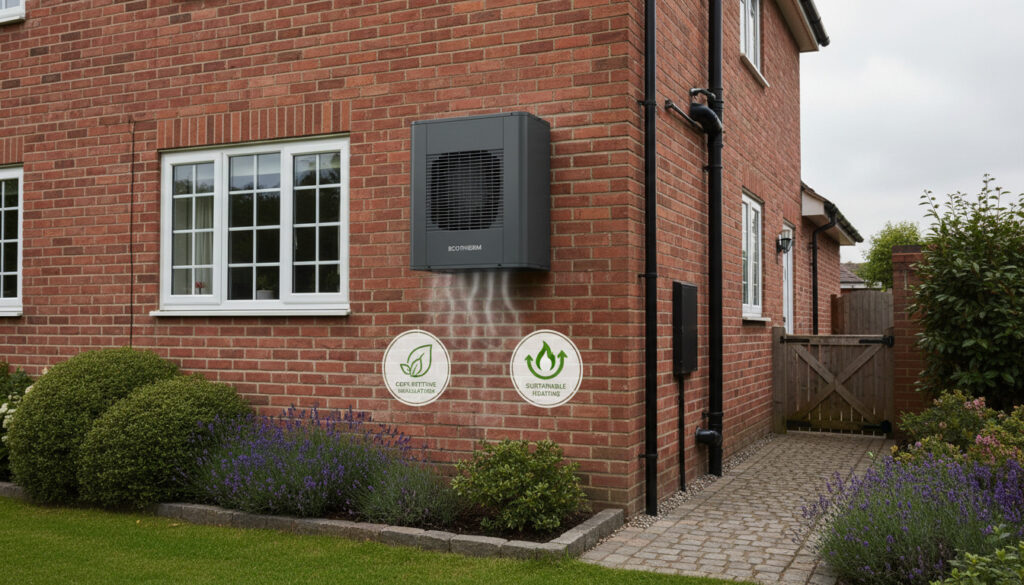
Air Source Heat Pump – UK Guide to Costs Efficiency Installation
Air source heat pumps extract warmth from outdoor air and transfer it into your home, functioning as heaters in winter and reversing to provide cooling during summer months.
These systems represent a fundamental shift in domestic heating technology, moving from combustion-based generation to energy transfer. In the UK, they operate effectively even during chilly winters, offering an alternative to traditional gas boilers.
As of 2025, regulatory changes and expanded grant schemes have positioned ASHPs at the center of the UK’s decarbonisation strategy, with installation rates accelerating across England and Wales.
What Is an Air Source Heat Pump and How Does It Work?
- Core Function: Extracts latent warmth from ambient outdoor air using refrigeration principles.
- Heat Amplification: Compressor technology raises refrigerant temperature for distribution.
- Seasonal Reversal: Cycles reverse to provide cooling during warmer months.
- Distribution Methods: Compatible with underfloor networks or appropriately sized radiator systems.
- Energy Multiplication: Systems can deliver up to four times more thermal energy than the electrical energy they consume.
- Climate Suitability: Operate effectively in UK winter conditions, including sub-zero temperatures.
- High-Temperature Variants: HTASHP models suit older homes with existing pipework limitations.
- Installation Sensitivity: Corner-cut work can reduce performance by up to 20%.
- Permitted Development: Most installations proceed without specific planning permission.
- Grant Support: The Boiler Upgrade Scheme currently offers up to £7,500 per installation.
- Solar Integration: Pairing with photovoltaic panels maximises operational efficiency.
| Attribute | Specification |
|---|---|
| Efficiency Rating | Up to 300% (COP 3–4) |
| Optimal Operating Range | Effective in sub-zero temperatures |
| Unit Lifespan | 15–20 years with maintenance |
| Noise Level | 40–60 decibels at one metre |
| Grant Support | Up to £7,500 (BUS) |
| Typical Install Cost | £11,000–£12,500 before grants |
| Net Cost After Grants | £4,000–£5,000 |
| Compatible Distributions | Underfloor heating, large radiators |
| Refrigerant Type | R290 (zero-carbon options available) |
| Regulatory Status | Permitted development (most cases) |
| Power Source | Electrical (grid or solar) |
| Suitability | Most home types, subject to survey |
Are Air Source Heat Pumps Efficient and Suitable for Cold Climates?
Efficiency Metrics and Performance Data
Coefficient of Performance (COP) figures determine ASHP efficiency. Industry data indicates these systems achieve up to 300% efficiency by moving existing heat rather than generating it through combustion.
High-temperature air source heat pumps utilise variable-speed compressors that adjust output based on demand. According to technical specifications, these units deliver flow temperatures comparable to gas boilers, enabling retrofit compatibility with older radiator systems.
Cold Weather Capabilities
Ambient air contains sufficient thermal energy even at low temperatures. Installation guidance confirms these systems function throughout British winters, though efficiency varies with external temperature extremes.
Professional commissioning is critical. Vacuum tests, pressure checks, and precise refrigerant charging must follow manufacturer protocols to achieve rated efficiency levels.
Pros, Cons, and Are They Worth It?
Key Advantages for UK Households
Operational costs decrease significantly due to superior efficiency ratios. Source documentation highlights drastically lower energy bills, reduced carbon emissions (particularly with R290 refrigerant), and dual functionality providing both heating and cooling.
Grant eligibility extends to homeowners, landlords, and self-builders replacing fossil fuel boilers. Eligibility criteria include upgrades from electric, oil, or LPG heating systems.
Practical Limitations
Initial capital requirements exceed standard boiler replacement costs. Radiator compatibility presents particular challenges, requiring assessment of existing heat emitters.
Heat pumps produce lower flow temperatures than gas boilers. Existing radiators may require upgrading to larger surface area models, or you may need to install underfloor heating, to achieve optimal thermal distribution.
Cost, Installation, and Available Grants
Financial Investment and Support Schemes
Current market data places average installation costs at £11,000–£12,500. The Boiler Upgrade Scheme provides up to £7,500 toward these expenses, reducing typical net outlay to £4,000–£5,000 for qualifying households.
Detailed cost breakdowns reveal significant regional variations depending on property size and existing infrastructure.
The Installation Process
Standard installation protocols involve four distinct phases: site survey and marking, indoor unit fit-out, commissioning tests, and user handover. MCS-approved installers conduct heat loss surveys to determine appropriate system sizing.
Regulatory Changes Effective May 2025
New permitted development rights increased maximum unit size from 0.6m³ to 1.5m³. Detached homes may now install up to two units, while the scrapped one-metre boundary rule benefits terraced and urban properties.
Conservation areas and listed buildings retain specific planning constraints. Local authority consultation remains essential before installation in these designated zones.
Air Source Heat Pump vs Gas Boiler: Key Differences
Operational and Efficiency Variations
Gas boilers generate heat through combustion, capping efficiency below 100%. ASHPs transfer existing thermal energy, achieving 300% efficiency under optimal conditions. This fundamental difference determines running costs and carbon intensity.
Distribution and Infrastructure Requirements
Gas systems operate at higher flow temperatures, allowing standard radiators. Heat pumps require lower, consistent temperatures, potentially necessitating emitter upgrades or underfloor circuits. Technical assessments confirm proper heat loss surveys determine compatibility.
How Has ASHP Technology and Policy Evolved?
- 1940s–1950s: Refrigeration-based heat pump technology first developed for residential applications.
- 2022: The Boiler Upgrade Scheme launches, initially offering £5,000–£6,000 installation support.
- October 2023: Grant values increase to £7,500 per property.
- 2024: Widespread adoption of R290 refrigerant and variable-speed compressor technology improves efficiency.
- May 2025: Regulatory amendments relax permitted development rules, allowing larger units and boundary-adjacent placement.
Established Facts Versus Remaining Uncertainties
| Established Information | Uncertain or Variable Factors |
|---|---|
| Systems achieve up to 300% efficiency under optimal conditions | Exact payback periods depend on insulation levels and electricity tariffs |
| Function effectively in UK winter conditions | Long-term performance data for R290 refrigerants in domestic settings |
| Poor installation reduces performance by up to 20% | Precise COP ratings during extreme cold snaps without auxiliary heating |
| £7,500 grants available through BUS (subject to availability) | Future electricity price impacts on annual running costs |
| May 2025 regulations ease installation rules | Compatibility outcomes for all heritage property configurations |
The Policy Context Driving Heat Pump Adoption
The UK’s net-zero 2050 commitment necessitates decarbonising domestic heating, responsible for approximately 14% of national emissions. Phase-out dates for gas boiler installations in new builds approach, positioning heat pumps as the primary low-carbon alternative.
Electrification of heating aligns with increasing renewable electricity generation. When paired with solar PV arrays, ASHPs enable households to consume self-generated power, reducing grid dependence and operational costs.
Expert and Regulatory Perspectives
Air source heat pumps extract warmth from outside air and transfer it into your home, providing heating in winter and reversing to function as coolers in summer. They operate even in chilly UK weather, making them practical for British winters.
— The Heat Pumps Hub
Combining air source heat pumps with solar PV panels can take energy efficiency to the next level. This integration allows homeowners to generate their own electricity to power the heat pump, further reducing energy costs and carbon footprint.
— Transcrew Technical Analysis
Is an Air Source Heat Pump Right for Your Home?
Suitability depends on property insulation, existing emitter compatibility, and available outdoor space for the unit. Comprehensive technical assessments by MCS-approved installers determine optimal system sizing and configuration. With current grant support and relaxed planning regulations, 2025 presents a favourable climate for transitioning to renewable heating.
Frequently Asked Questions
How long does a typical installation take?
Site survey to commissioning typically spans several days, with physical installation of indoor and outdoor units usually completed within one to two days depending on system complexity.
Do I need planning permission for an outdoor unit?
Most ASHPs fall under permitted development rights, eliminating the need for specific planning permission, though conservation areas and listed buildings retain additional restrictions.
Can I install an air source heat pump myself?
Installation requires MCS-certified professionals to qualify for the Boiler Upgrade Scheme; electrical and refrigerant work demands qualified expertise and specialist equipment.
How noisy are the outdoor units?
Outdoor units generate 40–60 decibels at one metre, comparable to a quiet conversation or domestic refrigerator, with newer models incorporating acoustic dampening.
Will my existing radiators work with a heat pump?
Existing radiators may require upgrading to larger surface area models or underfloor heating to compensate for lower flow temperatures and ensure adequate heat distribution.
How do I find a qualified installer?
Seek quotes from MCS-approved firms who conduct free home visits to assess heat loss and system sizing accurately before providing detailed quotations.
Can I use solar panels to power my heat pump?
Integration with solar PV panels allows the heat pump to run on self-generated electricity, maximising efficiency and reducing grid dependence during daylight hours.
What maintenance does an ASHP require?
Annual servicing by qualified technicians includes filter cleaning, refrigerant checks, and system diagnostics to maintain optimal performance and validate warranties.
More related posts
 Mark Ruffalo’s Health Scare, Marriage, and Political Views
 Mena Suvari Biography: Ethnicity, Children, and Net Worth
 Donnie Wahlberg: Net Worth, Brother Mark, and Blue Bloods
 Max Branning Return 2025: What Happened and Latest News
 Frank Spencer: Catchphrase, Actor & Show Facts
 Matthew Gray Gubler: Biography, Health & Career Facts
 Steve Madden: Luxury or Mass-Market? Scandal & Quality
 A Cure for Wellness – Plot, Twist & Eels Explained
