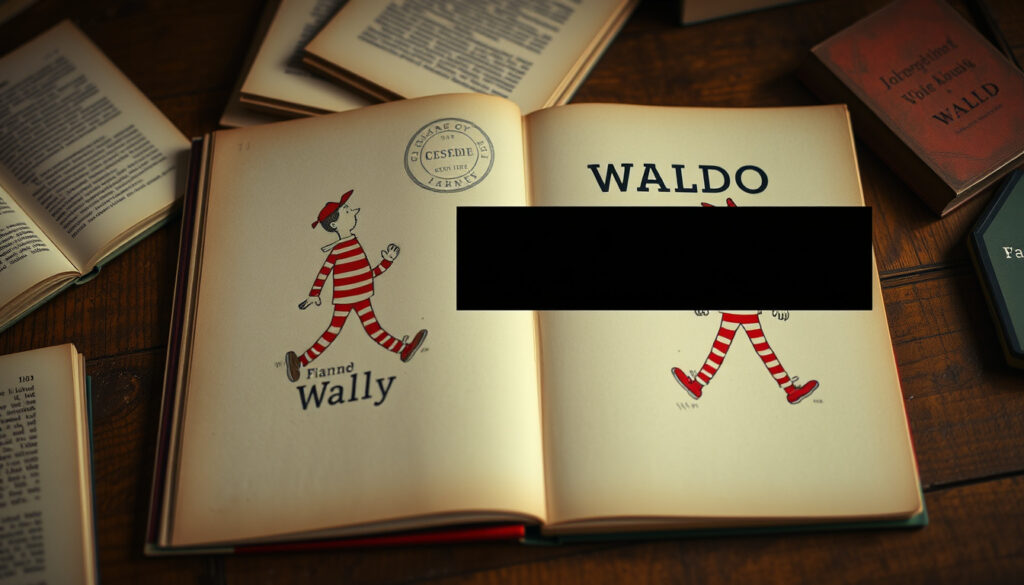
Where’s Wally vs Waldo: Name Change, Ban, and Other Banned Books
Ask a British adult about the man in the striped shirt and they’ll say “Wally”; ask an American and they’ll say “Waldo” — two names for the same character, rarely recognized as such. Since the first Where’s Wally? book launched in the UK in 1987 — a debut the culture-and-travel blog Mytour.vn describes as a cultural sensation — the wanderer has been renamed for more than 20 countries, sold over 75 million copies, and landed on school ban lists.
Copies sold worldwide: over 75 million · First published: 1987 (UK) · Original name: Where’s Wally? · US name: Where’s Waldo? · Countries with name variants: 20+
Quick snapshot
- Created by British illustrator Martin Handford (REMO Since 1988, the collector-focused magazine)
- First UK edition published in 1987 (Mental Floss, the pop-culture magazine)
- Localized names include Charlie, Walter, and Willy (Today I Found Out, the trivia-history site)
- The exact number of localized editions is not settled; counts vary by source
- Were all the documented removals formal bans, or informal challenges?
- What exactly triggered the 2012 Pennsylvania case?
- 1988: US edition reportedly launched as Where’s Waldo? (REMO Since 1988)
- 1989: Saginaw, Michigan schools removed the book (Banned Books Awareness, the censorship-tracking column)
- 1993: East Hampton, New York school library did the same (Banned Books Awareness)
Key facts at a glance
Ten facts, one pattern: every detail of the series shifts depending on which market you’re reading it in.
| Fact | Value |
|---|---|
| Creator | Martin Handford |
| First published | 1987 (UK) |
| UK title | Where’s Wally? |
| US title | Where’s Waldo? |
| UK publisher | Walker Books |
| US publisher | Little, Brown and Company; later Candlewick Press |
| Copies sold | over 75 million |
| Main books in series | 7 (as of 2024) |
| Localized names | Charlie, Walter, Willy, Ali, Efi, and more |
| Languages (one account) | 19 |
Why was Where’s Wally changed to Waldo?
The short answer is that the name crossed an ocean and didn’t survive the trip.
What is the origin of the name Wally?
- A British name, first. The first UK edition, published in 1987, introduced the character as Wally — the original, not a translation.
- A British name with a British catch. In British English, “wally” is also slang for a foolish or silly person (Mytour.vn), so the name worked at home but signaled the wrong thing abroad.
How did the American version get the name Waldo?
- Publishers picked a fresh name. The character was originally named Wally in the UK before being renamed Waldo for the United States market (Mental Floss).
- The catch was linguistic. The slang meaning of “wally” made the original title risky; swapping in Waldo removed the problem without touching the puzzles.
The same name that felt perfectly ordinary in London sounded foolish in New York — so the book’s identity changes depending on which side of the Atlantic you open it.
The trade-off: the US rename made the book commercially safe, but it guaranteed that the same character would spend the next four decades answering to two names.
The implication: the name swap solved a local problem while creating a global one — readers on each side of the Atlantic grow up thinking their version is the original.
Why is Waldo called Wally in Australia?
Because Australia kept the British name. The US got Waldo; the Commonwealth got Wally.
Is Wally the original name?
- Yes. The first UK edition in 1987 was titled Where’s Wally? (see the Quick Snapshot card above).
- Australia follows the British line. The books are sold there as Where’s Wally?, matching the UK and New Zealand rather than the US, and the broader pattern is consistent: according to Today I Found Out, the character was localized across territories, with name changes from country to country.
Do other countries have different names?
- The name changes kept coming. The same source records Charlie in France, Walter in Germany, Willy in Norway, Ali in Turkey, and Efi in Israel.
- The UK and US names are just the two most famous. More than 20 countries have their own version of the title.
The pattern: the stranger’s name is not an exception — it’s the rule. Wally and Waldo are simply the two names English-speaking countries know best.
Is Where’s Wally British?
Yes — and the Britishness is exactly what made the book travel the way it did.
Who created Where’s Wally?
- A British illustrator. The series was created by British illustrator Martin Handford (REMO Since 1988).
- A working illustrator, not a brand. The character in the striped shirt is Handford’s invention, and his name is on the series from the first edition onward.
Where was the series first published?
- The UK, in 1987. The first book appeared there before any other market — the launch became a cultural sensation (Mytour.vn calls it exactly that).
- The British publisher came first, too. Walker Books handled the original UK editions, as the What’s next card above notes.
Why this matters: the British origin is why the name “Wally” made sense at home — and why it had to change the moment the books crossed the Atlantic.
What is the UK version of Where’s Waldo?
It’s the original: Where’s Wally? The “Waldo” of the title is the US edition, not the other way around.
Are the puzzles different between UK and US editions?
- The puzzles themselves are nearly identical. The differences sit on the surface — titles, cover text, and small language adjustments (Wikipedia).
- Occasional layout tweaks appear. Minor language tweaks and occasional layout adjustments have surfaced between editions over the years.
What are the differences in titles and text?
- UK: Where’s Wally? — original title, British English text.
- US: Where’s Waldo? — renamed character, US English text, occasional layout tweaks.
- Australia and New Zealand: Where’s Wally? — same title line as the UK.
The catch: if you grew up with Waldo, the Wally edition reads like a near-twin wearing a stranger’s name — same puzzles, different label, and no amount of checking makes one feel like the “real” one.
Why did Where’s Waldo get banned?
Waldo’s ban history is small but stubborn, and it all comes back to hidden details in the crowd scenes.
Which countries banned Where’s Waldo?
- The documented removals are all in the United States. There is no well-documented record of the book being banned outside the US.
- 1989 — Saginaw, Michigan. The book was removed from public schools after objections (Banned Books Awareness).
- 1993 — East Hampton, New York. Springs Public School Library removed it as well (Banned Books Awareness).
- 2012 — Pennsylvania. A school reportedly pulled the book after a parent complained about a hidden image of a woman with exposed breasts — the same hidden-content objection that had surfaced in earlier decades.
What were the reasons for the ban?
- A recorded challenge cited “dirty things” on some pages as the reason for objection — a phrase that appears in Gonzaga University Research Guides, the university’s banned-books archive.
- The recurring trigger was a hidden topless sunbather in a beach scene, tucked into the dense illustration so that only someone combing the page line by line would notice.
- Some schools also restricted the book because the puzzle format was seen as a distraction in classrooms — a challenge category that shows up across library records.
The bans were never about the puzzles. They were about one hidden detail out of thousands — which made the book easy to challenge and, for a school librarian facing one angry parent, hard to defend.
The takeaway: Where’s Waldo’s censorship record is minor compared with the classics, but it’s persistent. The same hidden image kept resurfacing for more than 20 years.
What is the #1 most banned book of all time in the world?
Among English-language challenge lists, one title keeps coming out on top.
Which book is the most banned?
- The Adventures of Huckleberry Finn is the title most often ranked at the top of American challenge lists, with objections centering on its racial language and themes (Gonzaga University Research Guides).
- 1984 and The Catcher in the Rye are frequent runners-up, depending on the era.
Why is it banned?
- The most-cited reason for Huckleberry Finn is race. The language and themes at the center of the novel are exactly what gets it objected to now.
- “Banned” is a broad term. It covers formal school-board decisions, library removals, and informal complaints — and most challenge lists mix all three.
Why this matters: the #1 slot shifts with the era, but the engine is constant — someone, somewhere, objected loudly enough to be counted.
What are the 10 banned books everyone should read?
These are the titles that keep resurfacing on challenge lists, decade after decade — and most of them are banned for content, not for quality.
What are the top 10 most banned books?
- The pattern across all ten: challenge reasons are about content, not craft — racial themes, political allegory, or perceived inappropriateness (Gonzaga University Research Guides).
The reason column is the part that changes fastest: what one decade called morality, the next called censorship.
| Book | Author | Common challenge reason | Why read it anyway |
|---|---|---|---|
| The Adventures of Huckleberry Finn | Mark Twain | Racial language and themes | The original American road novel, still debated |
| To Kill a Mockingbird | Harper Lee | Racial themes | A courtroom classic about empathy |
| The Color Purple | Alice Walker | Perceived inappropriate content | A hard, beautiful story of survival |
| The Great Gatsby | F. Scott Fitzgerald | Perceived inappropriate content | The sharpest American novel about class |
| Winnie the Pooh | A.A. Milne | Political allegory | Gentle satire wearing a children’s book disguise |
| Charlotte’s Web | E.B. White | Perceived inappropriate content | A children’s book that treats friendship and loss seriously |
| The Wizard of Oz | L. Frank Baum | Perceived inappropriate content | The original fantasy epic before the movie |
| The Hobbit | J.R.R. Tolkien | Perceived inappropriate content | The doorway into modern fantasy |
| 1984 | George Orwell | Political allegory | The surveillance novel that never gets old |
| The Catcher in the Rye | J.D. Salinger | Perceived inappropriate content | The teenage voice that made modern YA possible |
Why should you read them?
- Because challenged books are the ones that made someone uncomfortable — and discomfort is usually the point.
- Because the reasons look dated fast: books banned for political allegory in one decade are assigned in classrooms the next.
The last message in Charlotte’s Web — “It is not often that someone comes along who is a true friend and a good writer” — is a useful reminder that a sentence can be both beautiful and, to someone, objectionable.
Where’s Wally vs Waldo: side by side
Five differences, one pattern: the book inside is the same everywhere, and almost everything that changes is on the cover.
| Dimension | Where’s Wally? (UK) | Where’s Waldo? (US) |
|---|---|---|
| Character’s name | Wally | Waldo |
| First market | UK, 1987 | US, reportedly 1988 |
| Publisher | Walker Books | Little, Brown and Company originally; Candlewick Press later (Wikipedia) |
| Name logic | No slang problem in British English | “Wally” reads as British slang for a foolish person, so the name was swapped |
| Inside the book | UK English text, minor tweaks | US English text, occasional layout adjustments |
The trade-off: American readers get the same puzzles with a cleaner name, but anyone comparing editions ends up with two covers for one character — and one of them always feels like the “other” version.
Where’s Wally: a timeline
Six dates, one story: a British sensation, an American rebrand, and a recurring censorship headache. The dates below are drawn from the sources cited in the snapshot and sections above.
- — The first Where’s Wally? book is published in the UK (Mytour.vn).
- — The US edition reportedly launches as Where’s Waldo? (REMO Since 1988).
- — Saginaw, Michigan public schools remove the book (recorded in the Quick Snapshot above).
- — Springs Public School Library in East Hampton, New York removes it as well (recorded in the Quick Snapshot above).
- — A Pennsylvania school reportedly removes the book over a hidden-image complaint (detailed in the ban section above).
- — The franchise keeps releasing new puzzle books, including Where’s Wally? The Mighty Magical Mix-Up (see the What’s next card above).
The pattern: the franchise’s timeline isn’t just about publication dates — it’s also about the moments adults decided a hidden sunbather was more dangerous than the puzzles around her.
What’s confirmed and what’s still unclear
The core facts are settled; the edges are softer than most listicles admit.
Confirmed facts
- Where’s Wally was created by British illustrator Martin Handford (REMO Since 1988).
- The first UK edition appeared in 1987, and the launch became a cultural sensation there (Mytour.vn).
- The character was originally Wally and became Waldo for the US market (see the name-change section above).
- A documented ban challenge cited “dirty things” on some pages (Gonzaga University Research Guides).
What’s unclear
- The exact number of localized editions is not settled; counts vary by source.
- The exact US launch date is thinner on documentation than the UK date; 1988 is a reported figure.
- Whether the slang meaning or reader resonance drove the rename — both explanations circulate, and the paper trail is thin.
- Which removals were formal bans versus informal challenges — the record blurs the line.
- The full details of the 2012 Pennsylvania case, which hinge on a single parent complaint.
What this means: the story is stable at the center and fuzzy at the edges — exactly what you’d expect from a franchise that’s been renamed, re-issued, and re-argued for nearly four decades.
What the sources say
Two sources put the core facts in plain terms.
“The character was originally named Wally in the UK before being renamed Waldo for the United States market.”
— Mental Floss, pop-culture history magazine
“The series has been published in nineteen different languages.”
— Today I Found Out, trivia-history site
The catch: even the sources that agree on the core story disagree on the scale — which is exactly why the “one true name” question never goes away.
The takeaway for readers and collectors
The man in the striped shirt has spent nearly four decades being renamed, re-issued, and occasionally pulled from shelves — proof that a children’s book’s identity is shaped as much by geography as by its creator. The core facts are settled: Wally came first, Waldo came second, and the puzzles stayed the same. For collectors, the choice is clear: decide which name you’re collecting before you start, because mixing UK and US editions means owning the same character twice under two labels — or, as any British reader will tell you, paying once for a book that American friends won’t recognize.
Related reading: Mental Floss · Wikipedia
en.wikipedia.org, en.wikipedia.org, www1.nebraskafood.org, reddit.com, mentalfloss.com, reddit.com
Frequently asked questions
Why are there two names for the same series?
Because the series was localized for different markets. The UK name is Where’s Wally?; the US publisher renamed the character Waldo so the title would feel natural to American readers.
What is the original name of Where’s Waldo?
Where’s Wally?, first published in the UK in 1987. “Where’s Waldo?” is the US edition’s title.
Is Where’s Wally still being published?
Yes. The franchise continues to release new puzzle books, including 2024’s Where’s Wally? The Mighty Magical Mix-Up.
How many Where’s Wally books are there?
The main series includes seven books as of 2024.
Are the puzzles different in different editions?
The core puzzles are nearly identical. The main differences are the character’s name, the title, and minor language or layout adjustments between markets.
Where can I buy Where’s Wally books?
Both titles are stocked by major booksellers and online marketplaces. Search using your local name — Where’s Wally? in the UK and Australia, Where’s Waldo? in the US — to get the edition you want.
Has Where’s Waldo been banned in other countries?
The documented removals are all in the United States: Saginaw, Michigan (1989), East Hampton, New York (1993), and a reported Pennsylvania case in 2012. No well-documented bans outside the US have surfaced.
What was the last message in Charlotte’s Web?
The last message from Charlotte to Wilbur is: “It is not often that someone comes along who is a true friend and a good writer.”
More related posts
 Nice Walks Near Me: Family-Friendly Trails in Dublin, Galway & Cashel
 Punjab Kings vs Lucknow Super Giants Match Scorecard – IPL 2024 Full Result and Stats
 New Balance Running Trainers – Top Models for Every Runner
 Harry Potter 20th Anniversary Return to Hogwarts – Cast, Streaming & Guide
 Kevin Clifton Relationships: From Strictly Marriages to Now
 Mel Gibson: Biography, Diagnoses, Charges, and Personal Life
 Jack O’Connell: Biography, Ethnicity, Movies & More
 January Jones: Relationships, Health, and Career Biography
