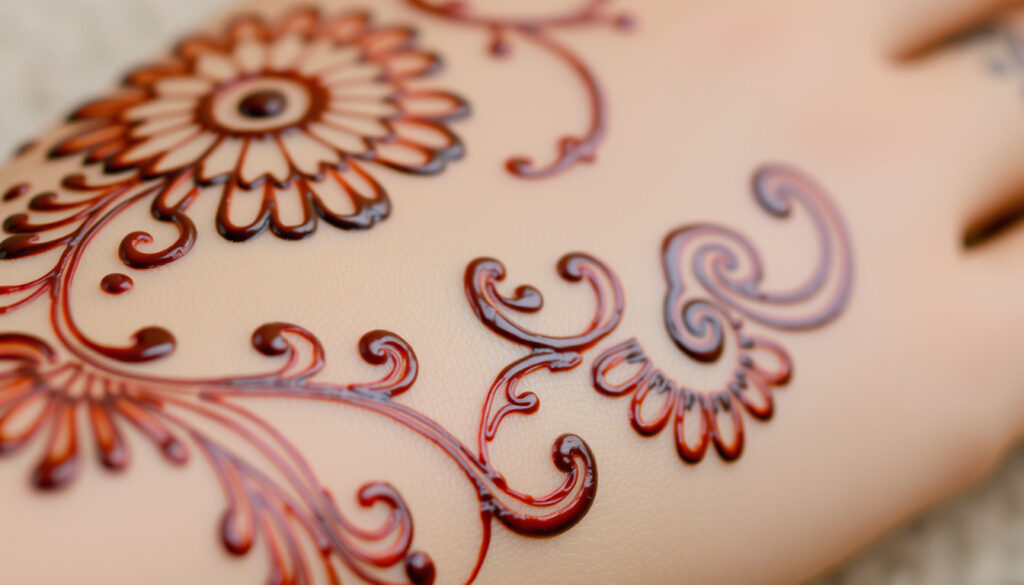
Henna Designs: Guide to Styles, Trends, and Cultural Significance
Few body-art traditions have traveled as far as henna. A single pattern can carry wedding blessings in one culture and a festival look in another, while the same plant stain appears from North Africa through South Asia.
Origin region: Wikipedia (open encyclopedia) documents a path from North Africa to South Asia · Average stain: Cleveland Clinic (academic medical center) puts it at about two weeks · Documented countries: AramcoWorld (cultural heritage magazine) counts 13+ · Typical color: orange-brown to brown
Quick snapshot
- Natural henna is a plant-based dye made from Lawsonia leaves (FDA (federal cosmetics regulator))
- The FDA has approved henna for hair dye, not direct application to skin (FDA (federal cosmetics regulator)) (FDA (federal cosmetics regulator))
- The earliest origin is debated, though documented use spans North Africa to India (Wikipedia (open encyclopedia))
- White and glitter “henna” products are not traditional henna in the plant-dye sense (Cleveland Clinic (academic medical center))
- Henna traditions span North Africa, the Middle East, the Arabian Peninsula, West Asia, and the Indian subcontinent (Wikipedia (open encyclopedia))
- Documented countries include 13 nations from Afghanistan to Tunisia (AramcoWorld (cultural heritage magazine))
- Regional styles such as Moroccan geometry, Gulf precision, and Indo-Pakistani florals are moving into global mainstream coverage (AramcoWorld (cultural heritage magazine))
- The safer direction is a natural brown stain, not a chemical black one (FDA (federal cosmetics regulator))
Six facts cover the basics; they draw on Wikipedia (open encyclopedia), AramcoWorld (cultural heritage magazine), Cleveland Clinic (academic medical center), FDA (federal cosmetics regulator), and Cosmopolitan UK (beauty and culture magazine).
| Topic | Quick answer |
|---|---|
| Origin | Documented across North Africa, the Middle East, the Arabian Peninsula, West Asia, and India |
| Primary ingredient | Dried and powdered Lawsonia inermis leaves |
| Typical color | Orange-brown to brown |
| Common contexts | Wedding ceremonies, religious festivals, temporary body art |
| Stain duration | About two weeks, varying with preparation, body location, and aftercare |
| Safety note | Black henna can contain PPD, a chemical linked to skin reactions |
What are some good henna designs?
Start with a pattern that suits your canvas, not a design that will fight your hand. The strongest looks come from recognizable regional vocabularies.
Simple henna designs for beginners
- Geometry: Moroccan traditions use bold, symmetrical lines and geometric forms (AramcoWorld (cultural heritage magazine))
- Florals: Indo-Pakistani work layers fine flowers, paisleys, and vines (AramcoWorld (cultural heritage magazine))
- Fusion: mixing one symbolic centerpiece with open lines is an easy way to avoid dense shading
Keep the design open. If a motif gets squeezed onto a small hand, it loses the clarity that makes henna read as deliberate art.
New henna design ideas for 2025–2026
- Paisley remains a wedding staple and is widely linked with luck and fertility (Cosmopolitan UK (beauty and culture magazine))
- Flowers are read as symbols of beauty and joy in South Asian and Middle Eastern design explanations (Cosmopolitan UK (beauty and culture magazine))
- Gulf styles favor precision and controlled geometry, making them a natural fit for minimalist looks (AramcoWorld (cultural heritage magazine))
Henna designs for front hand and back hand
- Placement changes the canvas: the back of the hand offers a wider field, while the palm and wrist give you natural lines to follow
- Durability also varies by body location, so the same design may fade faster on one area than another (Cleveland Clinic (academic medical center))
Cute and easy henna designs for girls and kids
- Small flowers, dots, and simple vines are child-friendly motifs that do not require heavy shading
- For children, use natural brown-staining paste and skip black henna entirely
The pattern: a design is easier to wear when it comes from a named tradition. Without that anchor, a bridal motif can become decoration with its original meaning stripped out.
The pattern: matching the design to the wearer’s intent matters more than following a trend.
How long do henna designs last?
Natural henna is not a permanent tattoo. It stains the outermost skin layer, so the color fades as that layer renews itself.
Factors affecting stain longevity
- Natural henna stains typically fade over about two weeks (Cleveland Clinic (academic medical center))
- Durability varies with preparation, body location, and aftercare (Cleveland Clinic (academic medical center))
- A deeper color usually means the paste interacted well with your skin chemistry, not that the product was stronger
Tips to extend henna life on skin
- Leave the paste on for several hours so the dye can bond with the skin
- Keep the area dry while the stain develops, especially during the first day
- A lemon-sugar wrap is a popular aftercare step, but the real rule is patience: let the orange-brown tone settle instead of scrubbing it
The trade-off: longer-lasting is not always better, because the same keratin bond that creates the stain also keeps it from washing off quickly.
What this means: patience during the first two days determines the quality of the final stain.
Is doing henna racist?
Henna itself is not racist. It is a shared practice with deep roots in multiple cultures, and the debate usually appears when sacred or ceremonial motifs are reused without context.
Religious and cultural context of henna
- Historical henna use is associated with North Africa, the Middle East, the Arabian Peninsula, West Asia, and the Indian subcontinent (Wikipedia (open encyclopedia))
- Traditions are documented in Afghanistan, Algeria, Bangladesh, Egypt, India, Iran, Malaysia, Morocco, Nigeria, Pakistan, Somalia, Sudan, and Tunisia (AramcoWorld (cultural heritage magazine))
- Designs often carry meanings linked to weddings, festivals, and celebration (Cosmopolitan UK (beauty and culture magazine))
Can Muslims wear mehndi?
- Henna traditions are documented across many Muslim-majority countries, from North Africa through South Asia (AramcoWorld (cultural heritage magazine))
- The dye itself is plant-based, not an intoxicant (FDA (federal cosmetics regulator))
Why do girls wear mehndi?
- For weddings and festivals: paisleys are widely linked with luck and fertility, especially in bridal contexts (Cosmopolitan UK (beauty and culture magazine))
- For beauty and joy: flowers are commonly presented as symbols of beauty and joy in design explanations (Cosmopolitan UK (beauty and culture magazine))
- For meaning: moons can reference Ramadan and other festivals, plus guidance, protection, and luck depending on context (Cosmopolitan UK (beauty and culture magazine))
Henna is a cross-cultural practice with deep roots. The problem is not wearing it; it is lifting a sacred wedding motif and rebranding it as a novelty without naming where it came from.
The pattern: henna is a shared inheritance, not a costume. The line between appreciation and appropriation is drawn by context, credit, and whether sacred motifs keep their meaning.
The implication: awareness of a motif’s original context turns appreciation into respect.
What is Arabic mehndi design?
What many modern tutorials call Arabic mehndi overlaps with Gulf styles: clean lines, precise geometry, and a less crowded look than dense South Asian bridal work.
Characteristics of Arabic mehndi
- Saudi and broader Gulf styles often emphasize precision and controlled geometry (AramcoWorld (cultural heritage magazine))
- Stained fingertips and hand tips are a recognizable signature of Gulf-style designs (AramcoWorld (cultural heritage magazine))
- The overall effect tends to be airier than dense Indo-Pakistani ornament
Differences between Arabic and Indian henna designs
- Arabic/Gulf styles lean geometric and precise; Indo-Pakistani styles lean floral and dense (AramcoWorld (cultural heritage magazine))
- Moroccan styles offer a third path: bold symmetry and substantial pattern coverage (AramcoWorld (cultural heritage magazine))
Three regional styles, one key contrast: density.
| Style | Dominant motifs | Density |
|---|---|---|
| Arabic / Gulf | Precision geometry, stained fingertips | Controlled, open |
| Indo-Pakistani | Florals, paisleys, vines, fine latticework | Dense ornamental detail |
| Moroccan | Bold symmetry, geometric forms | Substantial coverage |
The implication: “Arabic henna” is really a family of regional languages. Get comfortable with that variety and the design choice gets easier.
The catch: the term ‘Arabic mehndi’ is a broad label that ignores many distinct regional sub-styles.
What are the mehndi trends for 2026?
Trend lists for 2026 should be read as a weather report, not a rulebook. The strongest signals are coming from regional styles that are finally getting global attention.
Emerging patterns and styles
- Moroccan geometry and bold symmetry keep gaining visibility (AramcoWorld (cultural heritage magazine))
- Gulf-style precision fits the minimalist mood without losing cultural character (AramcoWorld (cultural heritage magazine))
- Bridal motifs such as paisleys, flowers, and vines remain the emotional anchors of henna design (Cosmopolitan UK (beauty and culture magazine))
Color innovations and application techniques
- Natural henna produces an orange-brown to brown stain, so the healthiest trend stays within that color range (Cleveland Clinic (academic medical center))
- Coal-black stains are a red flag: they often point to black henna and added chemicals rather than traditional plant paste (Cleveland Clinic (academic medical center))
Anyone chasing a jet-black stain is the most exposed actor here. Natural henna reads brown-orange; black henna can contain PPD, and dermatologists have documented blistering, pigment loss, and scarring from reactions.
The trade-off: trend chasers who want a black or metallic finish may get a faster “wow” but a bigger safety bill.
The pattern: the strongest trend is a return to authentic, plant-based traditions rather than synthetic shortcuts.
Where is mehndi most popular?
Popularity is easier to map by tradition than by social media hashtags. Henna has documented roots across three broad regions.
Countries with strong mehndi traditions
- Afghanistan, Algeria, Bangladesh, Egypt, India, Iran, Malaysia, Morocco, Nigeria, Pakistan, Somalia, Sudan, and Tunisia all have documented henna traditions (AramcoWorld (cultural heritage magazine))
- The heaviest concentration is in South Asia, North Africa, and the Middle East, where henna is part of wedding and festival culture
The English name for the color mehendi
- In English, “henna” usually names the plant, the dye, and the color it leaves on skin
- “Mehndi” is the more precise term for the decorative skin application in South Asian contexts (FDA (federal cosmetics regulator))
Why this matters: global popularity has not turned henna into one unified style. The more the art spreads, the more regional vocabulary becomes visible.
The implication: understanding the specific regional roots of a design prevents flattening a rich tradition.
What’s confirmed and what’s still unclear
Confirmed
- Natural henna is a plant-based dye made from Lawsonia leaves (FDA (federal cosmetics regulator))
- The natural stain is orange-brown to brown, and reactions to black henna can include blistering and scarring (Cleveland Clinic (academic medical center))
- Henna traditions are documented across more than a dozen countries (AramcoWorld (cultural heritage magazine))
Still unclear
- Which civilization used henna first remains a historical debate
- Whether white and glitter “henna” products should be called traditional henna is still a labeling question
- Which 2026 trend lists reflect lasting practice rather than social media virality
What this means: the field is well-researched for safety and geography, but the earliest origins and modern product definitions remain open questions.
Perspectives from the research
Henna is a plant-based dye made from Lawsonia leaves and is traditionally used for hair, skin, and nails; mehndi refers especially to decorative skin application.
— U.S. Food and Drug Administration (federal cosmetics regulator)
Natural henna generally produces an orange-brown to brown stain rather than a coal-black stain. Reported reactions to black henna can include redness, blistering, pigment loss, and scarring.
— Cleveland Clinic (academic medical center)
Regional styles are distinct: Moroccan designs lean bold and geometric, Gulf styles favor precision, and Indo-Pakistani work builds dense floral detail.
— AramcoWorld (cultural heritage magazine)
Henna keeps expanding because it lets people carry art on their own skin. A design will probably mix more than one tradition, and that is fine if you name the tradition instead of flattening it. For a first-time wearer, the decision is clear: choose natural henna, respect the wedding and festival meanings behind the motifs, and let the stain do its slow orange-brown work. For anyone tempted by a jet-black shortcut, the alternative is a chemical gamble that can cost more than a perfect photo.
Frequently asked questions
How do I remove henna quickly?
Because natural henna binds to the outer layer of skin, the stain lightens as skin cells shed. A warm shower and gentle exfoliation can speed that up, but patience is safer than aggressive scrubbing.
Is henna safe for children?
Natural henna paste is plant-based, but any product applied to a child’s skin should be patch-tested first. Avoid black henna completely, since the chemical risks are not worth a temporary design.
What is the difference between mehndi and henna?
In everyday English, henna can mean the plant, the paste, or the stain. Mehndi usually refers to the art of decorating the skin with that dye.
Can I apply henna on my hair?
Yes. The FDA has approved henna for use as a hair dye in the U.S., so hair-specific henna products are the appropriate category (FDA (federal cosmetics regulator)).
Does black henna contain chemicals?
So-called black henna commonly contains PPD, a substance not permitted in cosmetics meant for direct skin application in the U.S. (FDA (federal cosmetics regulator)).
More related posts
 Dwight Yorke: Relationship with Katie Price and Son Harvey
 Lynx Lower Body Spray: Uses, Safety, How to Apply
 Professor Green: Mental Health, Music, and Relationships
 Jude Riordan: Age, Dad, and Coronation Street Role Explained
 Neville Longbottom: Hidden Hero’s Journey
 Will Inbetweeners: Character, Actor, Virginity, Memes & Net Worth
 Richard Blackwood: Naomi Link, Child, EastEnders Return
 Luke Donald: Career, Net Worth, Wife, and Ryder Cup Captain
