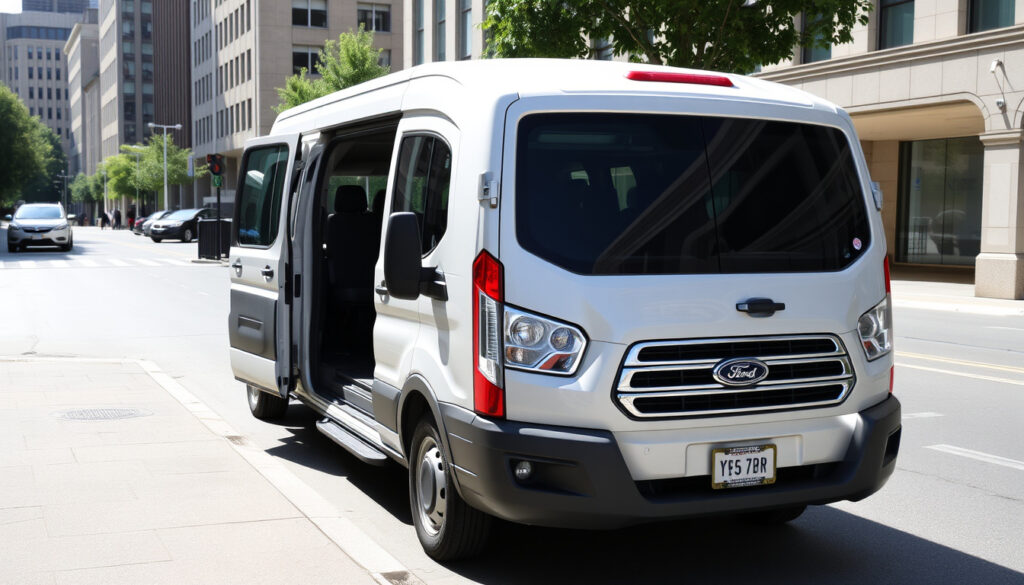
Ford Tourneo: Licence, Seating & Van Classification
Ask ten drivers what a Ford Tourneo is and you’ll get ten different answers: some call it a van, others an MPV, and a few just point at the blue oval and shrug. The confusion is fair, because Ford built the Tourneo family to sit right on the line between commercial vehicle and people carrier.
Seating options: 5, 7, or 9 seats depending on variant · Length (Tourneo Custom): 5,050 mm (long wheelbase) · Electric range (Tourneo Custom EV): 325 miles (WLTP) · Driving licence required: Category B (standard car licence) for most variants under 3.5 tonnes · Gross vehicle weight (typical): 2,800–3,100 kg · Top speed (diesel): Approx 110 mph
Quick snapshot
- Eight-seat Tourneo Custom versions are homologated as M1 passenger vehicles in dealer listings (Lookers — Ford dealer listing).
- Lease listings describe eight-seat versions as “classed as cars” for Vehicle Excise Duty rather than vans (Jurni Leasing — van leasing specialist).
- Ford’s own guidance separates M1 passenger vehicles from N1 goods vehicles at the 3,500 kg line (Ford UK — official classification guide).
- Whether future electric Tourneo derivatives will stay under the 3,500 kg GVW threshold.
- Exact payload and towing figures for each trim — the VIN plate is the final authority.
- The Tourneo Custom EV arrives with up to 325 miles of WLTP range, pushing the people carrier firmly into electric territory (Ford UK — official product page).
- Eight-seat versions keep the M1 passenger label across model years — a 2024 used listing still shows M1 and car-for-VED treatment (Lookers — Ford dealer listing).
- The Tourneo Custom 320 L2 eight-seat version also appears as a car for VED in lease records, so the tax treatment holds across body lengths (Jurni Leasing — van leasing specialist).
- Buyers should confirm the VIN’s homologation before purchase — that one letter decides speed limits and tax class. (Jurni Leasing — van leasing specialist)
One pattern runs through the whole Tourneo family: the registration document decides whether a car or a van sits on the driveway, and the figures below set the boundaries.
| Attribute | Details |
|---|---|
| Manufacturer | Ford Motor Company |
| Body styles | 5-door MPV / people carrier |
| Seats | 5, 7, 8, or 9 depending on model |
| Fuel types | Petrol, diesel, plug-in hybrid, pure electric |
| Max electric range (Custom EV) | 325 miles (WLTP) |
| Typical GVW | 2,800–3,100 kg |
| Standard licence | Category B (car) for models under 3.5 tonnes |
Are Ford Tourneo any good?
Overall owner satisfaction
- Practicality and comfort lead the reviews: the van-derived body delivers space, sliding doors, and a high seating position.
- Ford markets the Tourneo Custom as a passenger model in its own right, not a Transit with windows.
- The Custom EV’s WLTP range of up to 325 miles puts it far ahead of most van-based people carriers (Ford UK — official product page).
The family spans three characters. The Courier is a five-seat compact MPV for urban families; the Connect is a mid-size van-derived people carrier with five or seven seats; the Custom is the full-size touring model with eight or nine seats. For buyers weighing a normal estate against a Tourneo, the trade is simple: you give up some car-like handling and gain a cabin that swallows people and luggage without argument.
The diesel EcoBlue versions are the default choice for high-mileage drivers, and the plug-in and electric options exist for anyone who wants the space without the fuel bill.
Pros and cons of Ford Tourneo models
- Pros: huge cabins, sliding doors on the Custom, flexible seating, and strong diesel economy on longer runs.
- Cons: a firm ride on many versions, dated infotainment on older models, and payload figures that vary between trims.
- The sweet spot for most families is the seven-seat Connect — a genuine seven-seater on a van platform that parks like a car.
Common praise and criticism
- Praise clusters around space, seat flexibility, and the high seating position.
- Criticism typically targets the infotainment system on older models and the firm rear ride when unladen.
Style and handling are not the Tourneo’s reason to exist. Every Ford decision — van platform, tall roof, upright seats — trades a little car-like polish for space a normal estate cannot match.
Is a Ford Tourneo a 7 seater?
Seating configurations across variants
- Tourneo Courier: 5 seats in two rows.
- Tourneo Connect: 5 or 7 seats — the only Tourneo with a genuine seven-seat layout.
- Tourneo Custom: 8 or 9 seats — no seven-seat option; it jumps from eight to nine.
Ford positions the Custom as the large passenger carrier, and eight-seat examples in dealer stock are homologated as M1 — the passenger-vehicle class for up to eight passenger seats. A 2024 used listing for the eight-seat Tourneo Custom 2.0 EcoBlue shows the same M1 homologue and describes the vehicle as classed as a car for Vehicle Excise Duty purposes (Lookers — Ford dealer listing).
Lease records point the same way: the passenger Custom versions are eight-seaters, which keeps them inside the M1 passenger-seat threshold rather than tipping into minibus territory (Jurni Leasing — van leasing specialist).
Ford Tourneo Courier (5 seats)
- A compact five-door MPV, not a van with windows.
- Five seats in two rows, with a proper boot behind the rear seats.
- The easiest Tourneo to park and insure, but no sliding rear doors.
Ford Tourneo Connect (5 or 7 seats)
- A van-derived body with car-like equipment levels.
- The seven-seat Connect is the family sweet spot: a usable third row behind two proper rear seats.
- The direct rival for the VW Caddy in footprint and purpose.
Ford Tourneo Custom (8 or 9 seats)
- A full-size people carrier with three seat rows.
- Eight-seat versions are M1 passenger vehicles in dealer records; nine-seat versions stay safe only while the passenger-seat count remains eight or fewer.
- No seven-seat Custom exists — buyers choose eight or nine, not seven.
Seat count is a legal threshold, not a marketing detail. Passenger vehicles with more than eight passenger seats move out of the M1 car class into M2 territory, where Ford’s own guide points to Category D1 licences.
What’s the difference between Ford Transit and Tourneo?
Ford Transit vs Ford Tourneo: design and purpose
- Transit is Ford’s commercial-van nameplate; Tourneo is the passenger-oriented version.
- The Transit Custom and Tourneo Custom share a platform and body shell — the Tourneo adds passenger windows, rear seats, and car-style trim.
- Ford’s classification guide lists Courier, Connect, Custom and Transit as derivatives that can be registered as N1 goods vehicles, which is why the same body can end up as a van or a people carrier depending on how it is built and registered (Ford UK — official classification guide).
The short version: a Transit is built to carry loads; a Tourneo is built to carry people. Ford sells the Tourneo Custom through its car range, while the Transit line stays in the commercial aisle — two names, deliberately different buyers.
Ford Tourneo vs VW Caddy: similarities and differences
- The VW Caddy is the Tourneo Connect’s direct rival: both are van-derived MPVs with five or seven seats.
- The Caddy leans on car-like manners; the Tourneo Connect counters with van practicality and a lower entry price.
- Neither competes with the Tourneo Custom, which sits a full size class above.
If you are comparing a seven-seat Tourneo Connect with a seven-seat Caddy Maxi, the decision is about where you want the compromises — driving polish (Caddy) or outright space per pound (Tourneo).
Size comparison: Is a Ford Tourneo bigger than a Transit?
- The Tourneo Custom is the largest Tourneo, and the long-wheelbase version is quoted at 5,050 mm — enough to fill a standard UK driveway (Ford UK — official product page).
- The Tourneo Connect is noticeably shorter and narrower than a Transit Custom.
- The Courier is the smallest of the family and the only one that feels genuinely car-sized.
Can I drive a Ford Tourneo on a normal licence?
Driving licence categories for Ford Tourneo
- Category B — the standard car licence — covers vehicles up to 3,500 kg with up to eight passenger seats.
- Most Tourneo models sit under 3,500 kg GVW, so a normal car licence is enough.
- Eight-seat Tourneo Custom versions are M1 passenger vehicles, and Ford says M1 is driven on a Category B1 licence or higher.
Ford’s classification guide is the clearest statement of the rule: an M1 vehicle is a passenger vehicle with up to eight passenger seats, driven on a Category B1 licence or higher; an N1 goods vehicle up to 3,500 kg is also covered by B1 or higher (Ford UK — official classification guide).
UK buyers who passed a normal car test are legally covered for the overwhelming majority of Tourneo models — the eight-seat Custom is M1, and M1 sits within the B-class licence that every car driver already holds.
Ford’s “B1 or higher” wording covers anyone with a standard category B car licence. The licence test is not the issue — the vehicle’s maximum authorised mass is.
What does B1 mean on a driving licence?
- On licences issued before 1997, B1 allowed driving light vans up to 550 kg unladen weight.
- On post-2013 licences, B1 covers light quadricycles — not a multi-seat Tourneo.
- For a modern Tourneo, the categories that matter are B (up to 3,500 kg) and C1 (3,500–7,500 kg).
B1 is the source of endless forum confusion. People see “B1” and assume it means “van licence”, but a modern Tourneo owes nothing to it. The relevant check is always the vehicle’s maximum authorised mass.
Do I need a special licence for a 7.5 tonne van?
- Yes — vehicles from 3,500 kg to 7,500 kg need Category C1.
- C1 requires a separate medical, theory test, and practical test.
- A Tourneo is nowhere near this class: the family typically runs between 2,800 kg and 3,100 kg GVW.
Ford’s guide puts it in engineering terms: N2 vehicles exceed 3,500 kg and require Category C1 or higher (Ford UK — official classification guide). This is the rule that trips up people coming from a motorhome background, but the Tourneo stays comfortably below it.
How much does it cost to get a 7.5-tonne licence?
- Training and tests for C1 usually run to several hundred pounds, depending on the school and region.
- Budget for a medical, a theory test, and a four-day training course.
- For a Tourneo buyer, this cost is irrelevant — the family sits in the B category.
The cost question is worth knowing if you are comparing a Tourneo with a bigger minibus. A C1 licence is a real investment of time and money that most Tourneo owners simply never face.
The upshot: for the vast majority of Tourneo models, a standard Category B licence is the end of the story. The heavy-vehicle licence world — C1, medicals, theory tests — belongs to vehicles far bigger than anything Ford puts the Tourneo badge on.
The pattern is clear: the Tourneo family is designed to stay within car-licence territory.
Is a Ford Tourneo classed as a van?
Legal definition of a van in the UK
- UK law treats vehicles through their registration and homologation, not their model name.
- Ford classifies N1 as goods vehicles up to 3,500 kg and lists Courier, Connect, Custom and Transit as derivatives that can fall into that class (Ford UK — official classification guide).
- The same physical vehicle can be registered as an N1 van or an M1 passenger car depending on seats, windows, and the exact configuration.
That is the heart of the Tourneo question. The badge alone does not tell you whether it is a van for legal purposes. What matters is the M1/N1 letter on the paperwork.
In the real world, dealer and lease records show eight-seat Tourneo Custom versions coming out as M1 passenger vehicles. A Lookers listing for the eight-seat Tourneo Custom says it is classed as a car for Vehicle Excise Duty purposes (Lookers — Ford dealer listing), and Jurni Leasing’s eight-seat Custom listings use the blunt phrase “classed as cars for VED purposes rather than vans” (Jurni Leasing — van leasing specialist).
Speed limits for vans and how they apply to Tourneo
- Passenger cars and M1 people carriers follow car limits: 70 mph on motorways and dual carriageways, 60 mph on single carriageways.
- Goods vehicles over 3.5 tonnes are capped at 60 mph on motorways and dual carriageways, and 50 mph on single carriageways.
- A Tourneo registered as an M1 passenger vehicle keeps the car limits.
The moment a Tourneo is re-registered as N1 goods, the lower goods-vehicle limits apply, and a 70 mph motorway run becomes 60 mph. That is the practical difference between the car and van labels.
Can a van go 70 mph on a motorway?
- Yes, if it is a car-derived van under 2 tonnes — a class that includes small delivery versions of ordinary cars.
- No, if it is a full-size goods van: the cap is 60 mph on motorways and dual carriageways.
- An M1 Tourneo is treated as a car, so the 70 mph limit applies.
Is it illegal to drive for 12 hours in Britain?
- GB domestic driving-hours rules apply to goods vehicles and cap daily driving at 10 hours.
- Private car drivers are outside those rules, so an M1 Tourneo used as a family car is not covered.
- If a Tourneo is registered as an N1 goods vehicle and used commercially, the rules change.
The “12-hour driving” question comes from the haulage world. The M1 passenger Tourneo, driven privately, follows normal road rules and not the drivers’-hours regime — but convert it to N1 goods and use it for business, and the situation changes.
A re-registered or converted Tourneo can slide from M1 passenger to N1 goods — and with it the speed limit drops, the VED class changes, and the driving-hours rulebook applies.
The pattern: the same physical Tourneo can be a car or a van for legal purposes. The badge says Tourneo; the V5 says M1 or N1. That letter decides your speed limit, your tax class, and whether the driving-hours rules apply.
The registration document remains the final authority on classification.
Ford Tourneo family: how the three models compare
Three Tourneo families, one pattern: each derivative is a passenger take on a Ford van, and the legal label follows the seats and mass, not the styling.
| Attribute | Tourneo Courier | Tourneo Connect | Tourneo Custom |
|---|---|---|---|
| Seats | 5 | 5 or 7 | 8 or 9 |
| Body style | Compact MPV | Van-derived MPV | Full-size people carrier |
| Legal class (typical) | M1 or N1 by build | M1 or N1 by build | M1 for eight-seat passenger versions |
| VED treatment | Car or van by registration | Car or van by registration | Car for eight-seat versions |
| Licence required | B | B | B under 3.5 tonnes GVW |
The table shows the range, but the specific VIN decides the legal category.
Ford Tourneo specifications at a glance
Nine numbers capture the family, and one matters more than the rest: under 3,500 kg keeps you on a car licence.
| Specification | Ford Tourneo |
|---|---|
| Manufacturer | Ford Motor Company |
| Body styles | 5-door MPV / people carrier |
| Seats | 5, 7, 8, or 9 depending on model |
| Fuel types | Petrol, diesel, plug-in hybrid, pure electric |
| Max electric range (Custom EV) | 325 miles (WLTP) (Ford UK — official product page) |
| Typical GVW | 2,800–3,100 kg |
| Standard licence | Category B (car) for models under 3.5 tonnes |
| Length (Custom, long wheelbase) | 5,050 mm |
| Top speed (diesel) | Approx 110 mph |
These figures apply across the range, but the exact number on your vehicle’s V5C is what matters.
Ford Tourneo pros and cons
The Tourneo family wins on space and loses on polish. Below is the honest trade for UK buyers.
Upsides
- Five to nine seats across the family, with the seven-seat Connect the sweet spot for big families.
- Eight-seat Custom versions homologated as M1 passenger vehicles — car licence, car speed limits, car VED.
- Electric Custom offers up to 325 miles of WLTP range.
- Van-derived practicality: sliding doors, tall roof, square boot.
Downsides
- Firm ride and older infotainment on many used examples.
- Classification depends on the specific VIN — the same body can be M1 or N1.
- Payload and towing figures vary between trims; choose on paperwork, not looks.
- No seven-seat option in the larger Custom — it jumps from eight to nine.
The upsides and downsides are consistent across the family, though each model tailors the balance.
What’s confirmed and what’s still unclear
On a topic where forum answers disagree, the paperwork settles the argument. These are the points the records confirm, and the points they do not.
Confirmed facts
- Eight-seat Tourneo Custom versions are homologated as M1 passenger vehicles in multiple dealer listings (Lookers — Ford dealer listing).
- The same versions are treated as cars for Vehicle Excise Duty in lease records (Jurni Leasing — van leasing specialist).
- Ford’s own guide says M1 passenger vehicles with up to eight passenger seats can be driven on a Category B1 licence or higher (Ford UK — official classification guide).
What’s unclear
- Whether future Tourneo electric models will stay under the 3,500 kg GVW threshold that keeps them on a car licence.
- Exact payload and towing limits for every trim — official pricelists are the only reliable answer.
- How quickly the used market will price the shift from diesel to electric Tourneo Custom models.
- Whether any future derivative will be re-homologated as N1, as Ford has done with commercial versions of the same body.
These points are based on current listings and Ford’s own guidelines.
What the sources say
Three organisations settle the classification debate better than any forum thread.
“An M1 vehicle is a passenger vehicle with up to eight passenger seats and is driven on a Category B1 licence or higher.”
Ford UK — official classification guide
“Classed as a car for Vehicle Excise Duty purposes.”
Lookers — Ford dealer listing
“Classed as cars for VED purposes rather than vans.”
Jurni Leasing — van leasing specialist
The pattern: the manufacturer defines the categories, and the dealers confirm how the eight-seat Tourneo Custom actually lands in UK records. All three point the same direction.
The verdict
A Ford Tourneo is exactly as much of a van as its own paperwork says it is. Eight-seat passenger versions are registered as M1 passenger vehicles, treated as cars for Vehicle Excise Duty, and covered by a standard Category B licence — while the same body, configured as a goods vehicle, would face N1 rules. For UK family buyers, the decision is clear: choose the specific VIN, confirm it is M1, and you get car-licence treatment, car speed limits, and car VED — or buy on looks and accept whatever classification the previous owner registered.
Frequently asked questions
What is the payload capacity of a Ford Tourneo?
Payload depends on the variant. The Courier is a compact MPV with a modest boot, while the Connect and Custom are van-derived and can carry substantially more. Check the VIN plate of the exact vehicle — payload changes with body length, engine, trim, and battery weight.
How many miles per gallon does a Ford Tourneo diesel achieve?
Modern EcoBlue diesel Tourneo models are sold with competitive WLTP fuel-economy figures. Real-world economy depends on load, body length, driving style, and route — motorway work suits the diesel; urban running suits the plug-in or electric versions.
Is the Ford Tourneo available with four-wheel drive?
Ford has offered all-wheel drive on selected Transit Custom and Tourneo Custom derivatives in some markets and model years. The Connect and Courier are front-wheel-drive platforms. Confirm the exact drivetrain with the dealer before assuming a used example has AWD.
What is the towing capacity of a Ford Tourneo Custom?
Towing limits vary by engine, transmission, body length, tail lift, and drive type. The electric version carries different limits due to battery weight. The approved figure is listed in the vehicle’s official documentation — not in the showroom brochure.
Does the Ford Tourneo have an automatic gearbox option?
Yes. Many Tourneo Custom diesel versions use Ford’s eight-speed automatic transmission, and the electric Custom is automatic by design. Automatic options are also available on the Connect and Courier depending on year and trim.
What is the warranty on a new Ford Tourneo?
New Ford passenger models come with a standard manufacturer warranty, typically up to three years with a mileage cap, whichever comes first. Terms differ by country and model, so confirm the remaining warranty at the point of sale.
Can I fit a child seat in a Ford Tourneo?
Yes. Modern Tourneo passenger versions include ISOFIX anchor points on the outer rear seats, and the tall, square body makes fitting bulky child seats easier than in a low-slung estate car. Check the specific seat’s ISOFIX positions before buying.
Are Ford Tourneo models Euro 6 compliant?
Recent Tourneo diesel models use Ford’s EcoBlue engines, which meet Euro 6 emission standards. For older used models, verify the emissions certificate before driving into clean-air zones with stricter rules.
Related reading
More related posts
 Betty Boo: The British Rapper’s Comeback and Personal Life Explained
 Henry Thomas Now: Net Worth, Age, and Life After E.T.
 Louis Armstrong: Biography, Health, Music & Legacy | Facts
 Victor Ubogu: Biography, Family, and HSTikkyTokky Connection
 Meg Foster: Why Her Ice-Blue Eyes Were ‘Distracting’ to Hollywood
 Rugby Autumn Internationals 2025 – Complete Schedule and Guide
 Kitchen Cabinets: Cost, Trends & Colors for 2026
 TG Jones Clapham Store Closing – Timeline, Reasons and Shopper Guide
