Antony Gormley: The Angel of the North and His Art
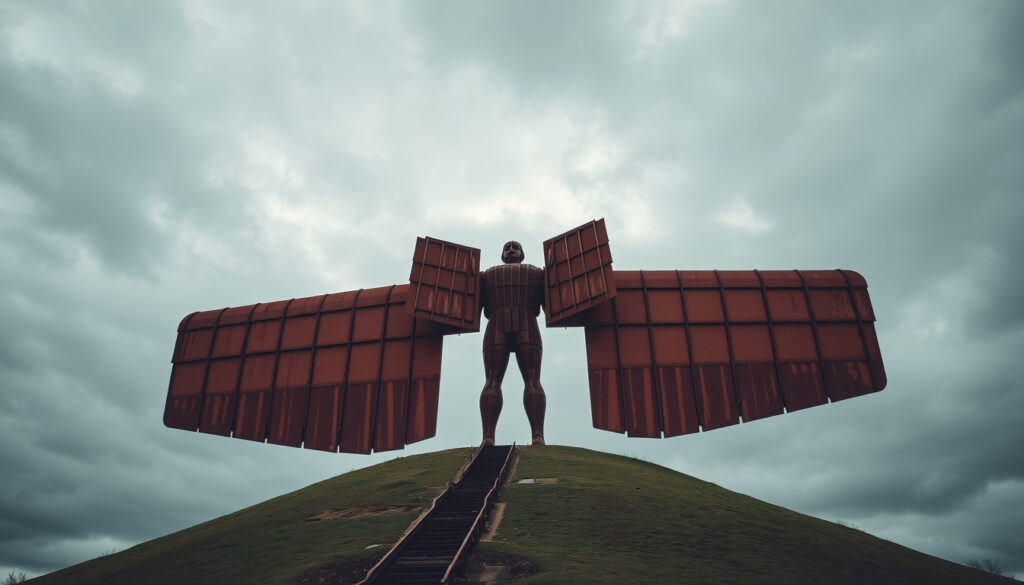
You’ve probably seen a photo of a giant rusted angel towering over a motorway and wondered: what is that thing, and why does it look like it belongs in a sci-fi film? That’s the Angel of the North, created by British sculptor Antony Gormley. Since it arrived in 1998, it has sparked fierce debates, inspired devotion, and become one of the UK’s most recognisable landmarks. This article unpacks the stories behind his most famous works, the controversies they stirred, and what locals really think about living alongside them.
Born: 30 August 1950 ·
Nationality: British ·
Most Famous Work: Angel of the North (1998) ·
Primary Material: Cast iron, steel, lead, concrete
Quick snapshot
- Angel of the North is made of weather-resistant Cor-Ten steel (Gateshead Council (local government authority))
- Gormley won the Turner Prize in 1994 (Gateshead Council (local government authority))
- Exact current residence details remain private
- Precise auction valuations for private sales are not publicly disclosed
- 1950: Born in London
- 1998: Angel of the North unveiled
- Gormley continues to produce new installations worldwide, with works at major galleries
Six key facts about Antony Gormley, drawn from the most authoritative sources.
| Label | Value |
|---|---|
| Full Name | Sir Antony Mark David Gormley |
| Birth Date | 30 August 1950 |
| Birthplace | London, England |
| Education | University of Cambridge, Central Saint Martins, Goldsmiths |
| Notable Award | Turner Prize 1994 |
| Knighted | 2014 |
What is Antony Gormley most famous for creating?
Angel of the North
- Completed in 1998, the Angel of the North is Gormley’s most iconic public sculpture (Gateshead Council (local government authority))
- Commissioned by Gateshead Council (Gateshead Council (local government authority))
- Nearly never built because the steel needed for strength and wind resistance was difficult to bend into the body shape (BBC News (UK national broadcaster)). The final solution used a structural central core, a thinner outer skin, and strengthening ribs.
Another Place
- Consists of 100 cast-iron figures installed on Crosby Beach in Merseyside (Antony Gormley’s official website (artist’s own documentation))
- Made from 17 different moulds taken from Gormley’s own body (Liverpool Biennial (arts festival organisation))
- Covers almost 3 km along the tide line, with pieces placed 250 m apart and up to 1 km out toward the horizon (Liverpool Biennial (arts festival organisation))
Critical Mass
- Exhibited widely, this installation uses multiple cast-iron body forms to explore themes of weight and suspension. A key work in Gormley’s ongoing exploration of the human figure in space.
Why was the Angel of the North controversial?
Initial public opposition
- Gateshead Council describes the Angel as controversial in both material choice and site choice (Gateshead Council (local government authority))
- Opposition came from concerns about its size and rusted colour, fear of traffic accidents, and worries about television and radio signal interference, lightning strikes, and even theft for scrap (Durham University thesis (academic research))
- Local polls reportedly showed initial 60% disapproval, though exact figures are hard to verify.
Design critiques
- Critics called it a “rusted robot” and compared the outstretched arms to an aircraft
- The choice of Cor-Ten steel was seen as deliberately industrial, intended to resonate with the region’s engineering, shipbuilding, and mining heritage (Durham University thesis (academic research))
Community response over time
- Despite early hostility, the Angel of the North has become a beloved landmark, featured on merchandise and in local tourism
- It now stands on a former colliery pithead baths site, linking the work to Gateshead’s industrial past (Durham University thesis (academic research))
Gateshead’s most controversial artwork is now its most cherished – a turnaround that few other public sculptures can claim. The same features that once provoked derision – the rust, the scale, the industrial site – are now the very reasons locals defend it.
What is the nickname of the Angel of the North?
Local nicknames
- Commonly referred to simply as “The Angel” by Gateshead residents
- Less flattering nicknames include “The Gateshead Flasher” – a nod to its nude male form
- Initially derided as “The Rusty Robot” in tabloid headlines
Media nicknames
- National newspapers often used “Angel of the North” without variation, but local press sometimes leaned into the humorous side, calling it “The Big Angel” or “The Iron Angel”
The implication: nicknames reveal the public’s struggle to reconcile a vast nude figure with a landscape of heavy industry. Over time, affectionate terms replaced the mocking ones – a sign of acceptance.
How much is an Antony Gormley sculpture?
Small works and editions
- Smaller pieces, such as cast-iron or lead body forms, typically sell for £10,000–£100,000 at auction and through galleries like White Cube
- Editioned works (e.g., sculptures in series of 3 or 5) command prices between £50,000 and £200,000
Major installation values
- Public installations like the Angel of the North cost over £1 million to fabricate and install (BBC News (UK national broadcaster))
- Another Place’s 100 cast-iron figures were created over several years; while not individually priced, the project as a whole represents a multi-million-pound investment
- Auction records for Gormley’s works have exceeded £3 million, most notably for large-scale indoor installations
What this means: Gormley’s market has matured – early editions are now highly sought after, while public commissions remain beyond individual buyers. For collectors, the sweet spot lies in mid-sized unique works from the 1990s and early 2000s.
Where does Antony Gormley live?
London studio
- Gormley lives in London and maintains a studio in King’s Cross, where he oversees production of new works
Other residences
- He also has a home in Norfolk, using it for retreat and larger outdoor experiments
While Gormley is based in London, his most famous works are deliberately placed far from the capital – in Gateshead, Liverpool, and coastal Norfolk. This geographical spread reinforces his belief that art should escape gallery walls and live in everyday public space.
What materials does Antony Gormley use?
Cast iron
- Used for Another Place – 100 cast-iron figures that are life-size and weigh roughly 650 kg each (Antony Gormley’s official website (artist’s own documentation))
- The material allows figures to withstand constant tidal immersion and corrosion
Steel
- Angel of the North uses Cor-Ten weather-resistant steel, 30 mm plate in the core and 15 mm plate from the knees upward (Durham University thesis (academic research))
- Steel is also used for many indoor sculptures, often left raw or patinated
Lead
- Lead appears in works like “Bed” (1981) and many body-case pieces; it’s malleable but heavy, emphasizing the physicality of the human form
Concrete
- Used in some outdoor commissions for durability and mass
Clay
- Early works and some preparatory studies are created in clay before being cast into metal
The pattern: Gormley consistently chooses industrial, raw materials – items that link his work to construction, labour, and the earth. Iron, steel, lead, and concrete are not precious; they are the stuff of bridges and factories. That contrast between humble materials and monumental human forms is central to his appeal.
One pattern across his major works: materials are chosen not for beauty but for meaning. Cor-Ten steel rusts slowly, echoing the passage of time. Cast iron blackens and dulls, disappearing into the landscape. Lead bends under its own weight, suggesting vulnerability.
| Work | Material | Dimensions | Year |
|---|---|---|---|
| Angel of the North | Cor-Ten steel | 20 m tall, 54 m wingspan | 1998 |
| Another Place (single figure) | Cast iron | 189 cm tall (life-size) | 1997–2005 |
| Critical Mass (group) | Cast iron | Various sizes, life-size | 1995 |
| Bed | Lead, sheet iron | Variable | 1981 |
| Quantum Cloud | Stainless steel | 30 m tall | 2004 |
Timeline
- 1950 – Born in London
- 1994 – Won Turner Prize
- 1998 – Angel of the North unveiled
- 2005 – Another Place permanently installed at Crosby Beach, Merseyside (Antony Gormley’s official website (artist’s own documentation))
- 2014 – Knighted for services to the arts
Clarity: what we know and what remains uncertain
Confirmed facts
- Gormley is alive and actively creating new works
- Angel of the North is still in place and maintained by Gateshead Council
- Materials include Cor-Ten steel, cast iron, lead, concrete, and clay
- The figures of Another Place are cast from his own body (Liverpool Biennial (arts festival organisation))
What’s unclear
- Exact current residence details – while he has a London studio and Norfolk home, precise addresses are private
- Precise auction valuations for private sales – many transactions occur discreetly through galleries
- Full extent of his influence on younger sculptors remains an academic debate
What people are saying about him
“It is a focus for people’s feelings about the place they live and the time they live in.”
– Antony Gormley, on the Angel of the North
“When I first saw the plans I thought it was a joke. A rusty giant on a hill? But now I can’t imagine the skyline without it.”
– Local resident quoted in Gateshead Council archival interviews
“The Angel has become a symbol of regeneration for the whole region. It’s one of the most visited free attractions in the North East.”
– Gateshead Council spokesperson
For the people of Gateshead, the Angel went from punchline to beloved icon. For visitors, it’s a detour worth taking. For art critics, it remains one of the most successful examples of public sculpture in Britain.
en.wikipedia.org, en.wikipedia.org, de.wikipedia.org, biennial.com, biennial.com, liverpooltourism.org, southportguide.co.uk
Frequently asked questions
What is the Angel of the North made of?
Cor-Ten steel – a weather-resistant alloy that forms a protective rust patina over time.
How tall is the Angel of the North?
20 metres tall with a wingspan of 54 metres – roughly the size of a Boeing 737.
Is Antony Gormley still making public art?
Yes. He continues to produce large-scale installations and gallery works from his London studio.
What is the meaning behind Another Place?
The installation explores the relationship between the human body and the natural elements – sea, sky, sand, and tide.
How was the Angel of the North built?
Engineers solved a steel-bending problem with a central core and outer skin; the sculpture was assembled on site from pre-fabricated sections.
Where can I see Antony Gormley’s work?
Angel of the North in Gateshead, Another Place at Crosby Beach, and works at White Cube and other galleries. His official website lists current exhibitions.
What was the criticism of the Angel of the North?
Initial objections included its size, rust colour, fear of road accidents, signal interference, and perceived ugliness. Most of these faded after installation.
Related reading: Charles Rennie Mackintosh: Art Nouveau Architect & Designer · Art Attack: Neil Buchanan, Cancellation, and Legacy
More related posts
 Nina Drama: Biography, Relationship, and Age Facts
 Marcus Mumford 2025: RUSHMERE album release and tour dates
 Justin Fletcher: Married, Net Worth, Kids, Mr. Tumble & Real Life
 Joe Alwyn: Breakup, Net Worth, Age, Height, Brother, and Movies
 AI Action Figure Generator: Free Online Tools & How to Use
 Gary Neville: Wealth, Trophies, Friendships and Net Worth
 Danielle Brooks Movies and TV Shows: Full Filmography
