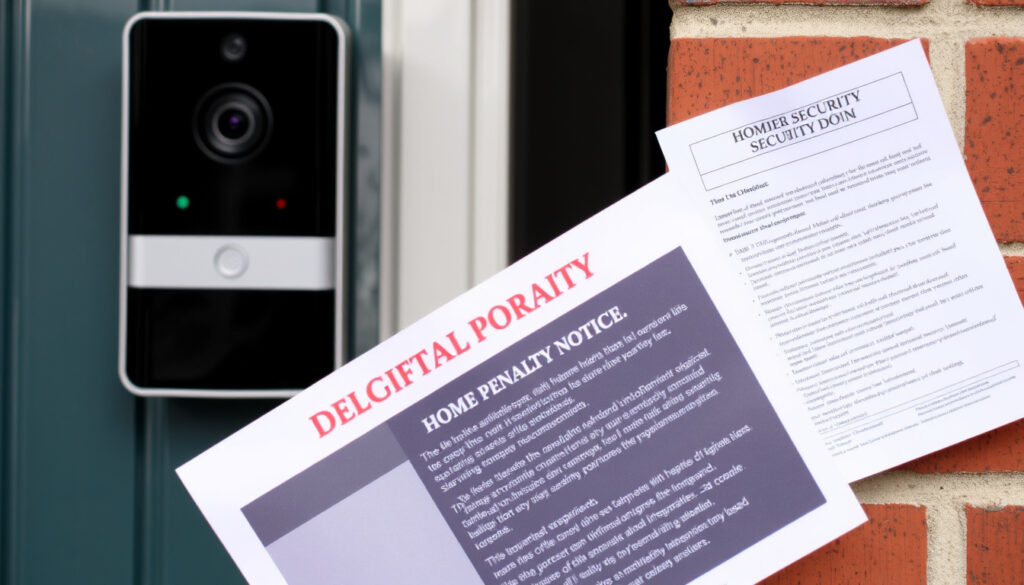
Video Doorbell Rule Fine UK: Key Fact
Video doorbells can be handy, but UK law imposes fines up to £17.5 million if they record beyond your property. This guide covers the rules, neighbour rights, and how to stay compliant.
Maximum fine under UK GDPR: £17.5 million ·
Governing body: Information Commissioner’s Office (ICO) ·
Key law: Data Protection Act 2018 / UK GDPR
Quick snapshot
- ICO can fine up to £17.5 million for serious data protection breaches (ICO (fines and penalties))
- Cameras that capture beyond your property must comply with UK data protection law (ICO domestic CCTV guidance)
- Neighbours can complain to the ICO if they feel their privacy is invaded (ICO domestic CCTV guidance) (ICO (fines and penalties))
- Exact legal definition of “private space” in camera context (ICO domestic CCTV guidance) (Curwens Solicitors (law firm))
- How often the ICO enforces fines specifically against video doorbell owners (Curwens Solicitors (law firm))
- Whether apartment bans on doorbell cameras are legally enforceable (Unique Fire & Security)
- 2014: CJEU Ryneš ruling established that home CCTV capturing public spaces is not covered by the household exemption (Court of Justice of the European Union)
- 2018: Data Protection Act 2018 came into force, incorporating GDPR principles into UK law (Legislation.gov.uk (Data Protection Act 2018))
- 2025: Legal experts warn that Ring doorbell owners could face fines of up to £100,000 (Curwens Solicitors (law firm)) (Court of Justice of the European Union)
- ICO is expected to issue more guidance on domestic smart cameras as adoption grows (ICO domestic CCTV guidance)
- Neighbour disputes increasingly lead to court cases over privacy invasion (Curwens Solicitors (law firm))
- More homeowners are choosing doorbells with local storage to avoid cloud privacy concerns (Unique Fire & Security)
The table below summarises the key regulatory figures.
| Category | Detail |
|---|---|
| Maximum fine | £17.5 million (UK GDPR) or up to £100,000 (DPA 2018 specific offences) |
| Governing body | Information Commissioner’s Office (ICO) |
| Key law | Data Protection Act 2018 / UK GDPR |
| Recording consent required | Yes, for audio – separate consent under UK law |
| ICO registration threshold | Typically needed for continuous recording of public spaces |
Can you be fined for having a Ring doorbell?
The short answer is yes — if your video doorbell captures footage beyond your own property boundary. The ICO states that domestic CCTV users must comply with data protection law when their system records images outside their boundary, including shared spaces, pavements, roads, or a neighbour’s property (ICO domestic CCTV guidance).
What is the maximum fine for breaking video doorbell rules?
- Under UK GDPR, the ICO can impose administrative fines of up to £17.5 million or 4% of annual worldwide turnover, whichever is higher (ICO (fines and penalties)).
- For less serious infringements, the maximum fine is £8.7 million or 2% of turnover (ICO (fines and penalties)).
- The ICO also has powers to issue monetary penalty notices of up to £100,000 for specific breaches of the Data Protection Act 2018, such as failing to comply with an enforcement notice (ICO enforcement guidance).
Does GDPR apply to Ring doorbells?
Yes, when the doorbell records beyond your private property. The CJEU’s Ryneš judgment (2014) established that home CCTV monitoring a public street is not covered by the household exemption (Court of Justice of the European Union). This principle was retained in UK law after Brexit through the UK GDPR and Data Protection Act 2018 (Legislation.gov.uk (Data Protection Act 2018)). The ICO advises using clear signs to tell people they are being recorded when the system is not obvious (ICO domestic CCTV guidance).
A Ring doorbell that only records your own garden is low risk. But if it captures the neighbour’s driveway or the pavement, you have entered data protection territory — and the ICO can act.
Can a neighbour complain about a Ring doorbell?
Absolutely. A neighbour can make a complaint to the ICO if they believe a video doorbell is breaching data protection law. The ICO encourages informal resolution first, but it will investigate if the issue persists (ICO domestic CCTV guidance).
How do I file a complaint about a neighbour’s Ring doorbell?
- First, try a polite conversation with your neighbour — many are unaware their camera is intrusive.
- If that fails, gather evidence: take photos of the camera angle and note when it points into your home.
- Submit a complaint to the ICO online, detailing how the camera affects your privacy (ICO domestic CCTV guidance).
- For ongoing harassment, contact your local council or consider legal advice (Curwens Solicitors (law firm)).
What can a neighbour do if they feel surveilled?
Beyond the ICO route, a neighbour may seek a court remedy if the video doorbell causes distress or invasion of privacy. According to Curwens Solicitors, the court can order the removal or repositioning of the camera (Curwens Solicitors (law firm)). Common grounds include the camera pointing into bedrooms, gardens, or other private spaces.
Can my neighbour have a camera facing my door?
It depends on what the camera captures. The ICO’s guidance is clear: cameras must not intrude on spaces where people have a reasonable expectation of privacy, such as bedrooms, bathrooms, or private gardens (ICO domestic CCTV guidance). A camera pointing at your front door may be acceptable if it only records the immediate area of the neighbour’s property, but if it regularly captures your entrance or hallway through a window, that could be a breach.
What is considered reasonable placement of a doorbell camera?
- Pointed at your own doorstep, garden, or driveway — generally allowed.
- Covering a shared path or entrance — requires careful compliance (signage, limited retention).
- Directly facing a neighbour’s window or garden — likely unreasonable (Curwens Solicitors (law firm)).
Can I ask my neighbour to move their camera?
Yes, and doing so politely is the best first step. Many disputes are resolved by simply adjusting the camera angle or enabling privacy zones that block out the neighbour’s property. The ICO suggests using signs and limiting retention of footage (ICO domestic CCTV guidance). If the neighbour refuses, you may escalate to the ICO or seek legal advice.
Your right to security ends where your neighbour’s right to privacy begins. A small angle adjustment often satisfies both.
The pattern: a minor hardware adjustment can pre-empt a major legal headache. Most doorbell cameras include privacy zone settings that should be used.
What can I do if my neighbour has a camera pointed at my house?
You have several options, and the right one depends on the severity of the intrusion. Below is a step‑by‑step approach.
- Talk to your neighbour. Send a friendly note or have a conversation. Many people are unaware their camera is pointing into your home.
- Document the intrusion. Take photos or a video showing the camera angle and how it captures your property. Note the times.
- Ask for a privacy zone. Most modern doorbell cameras (Ring, Nest, Eufy) let owners set “privacy zones” that black out certain areas. Request this adjustment.
- Complain to the ICO. If the issue persists, file a data protection complaint with the ICO online (ICO domestic CCTV guidance).
- Contact your local council. If the camera causes harassment or noise (e.g., frequent recording announcements), the council may intervene under anti‑social behaviour powers.
- Seek legal advice. For persistent invasion of privacy, a solicitor can advise on a potential court claim (Curwens Solicitors (law firm)).
What this means: you have a clear escalation path. The ICO is the primary regulator, but local councils and courts can also act.
Why are people ditching Ring doorbells?
Growing privacy concerns and subscription costs are driving some users away. Ring’s data‑sharing policies have drawn criticism, particularly around partnerships with police and third‑party analytics (Unique Fire & Security). Many homeowners are switching to brands that offer local storage, such as Eufy, to avoid cloud‑based privacy risks.
Are privacy concerns driving people away from Ring?
Yes. In 2023, Ring faced scrutiny over its Neighbors app and data sharing with law enforcement. While the company has updated its policies, many users remain uneasy about audio recording and cloud data retention. The ICO’s guidance on audio consent adds another layer: recording conversations without clear consent may breach data protection law (Unique Fire & Security).
What are the alternatives to Ring video doorbells?
- Eufy – local storage, no mandatory cloud subscription.
- Nest Hello (Google) – integrates with Google Home, but cloud‑based.
- Arlo – offers local recording on some models.
- SkyBell – privacy‑focused with customisable zones.
The catch: switching to a local‑storage device reduces but does not eliminate legal obligations – the camera’s placement still matters.
“If your camera captures more than your own property, you must comply with data protection law – including telling people they are being recorded and keeping footage only as long as necessary.”
– ICO domestic CCTV guidance, ICO
“Ring doorbell owners could face fines of up to £100,000 if they breach data protection laws, especially if they record audio without consent.”
– Legal experts cited in news reports, Curwens Solicitors (law firm)
The pattern is clear: the convenience of a video doorbell comes with real legal obligations. For UK homeowners, the choice is straightforward – either configure your camera to respect neighbours’ privacy and comply with ICO guidance, or risk a fine that could run into tens of thousands of pounds. For those on the receiving end of an intrusive doorbell, the ICO and the courts offer clear remedies. The rules are not new, but enforcement is growing.
For a detailed breakdown of how these regulations apply across the UK and Ireland, see the guide on UK video doorbell rules and fines.
Frequently asked questions
Is it against the law to have a Ring doorbell?
No, owning a Ring doorbell is not illegal. But using it in a way that records beyond your property without complying with data protection law can be a breach. The ICO provides guidance on how to use domestic CCTV lawfully (ICO domestic CCTV guidance).
Are doorbell cameras allowed in apartments?
Most apartment leases restrict modifications to common areas, and installing a camera may violate the lease. Legally, if the camera captures shared corridors or other tenants’ doors, data protection law applies. Check your tenancy agreement and seek permission from the landlord (Unique Fire & Security).
Is it legal to share Ring doorbell footage?
Sharing footage that includes identifiable individuals may breach data protection law unless you have a valid reason and have informed those recorded. The ICO advises that domestic CCTV footage should be kept only as long as necessary (ICO domestic CCTV guidance).
Do doorbell cameras record?
Most smart doorbells record video continuously or when motion is detected. Many also record audio if enabled. The ICO has stated that recording conversations requires careful consideration of consent under UK law (Unique Fire & Security).
Can my Ring camera face my neighbour’s house?
If the camera is angled in a way that regularly records your neighbour’s private space (windows, garden, entrance), it is likely unreasonable. The ICO recommends using privacy zones to block out areas that are not your property (ICO domestic CCTV guidance).
More related posts
 Vittorio Angelone: Age, Rugby, Podcast, and Comedy Career
 Chrissie Hynde: Biography, Sobriety, and Net Worth
 New Balance Running Trainers – Top Models for Every Runner
 Raheem Sterling: Children, Chelsea Exit, Feyenoord Move
 David Tennant’s Biography: Family, Health, and Career Facts
 Clair Buckley: Biography, Career, and True Crime Podcast
 Charlie Brooks: Life, Career, and Weight Loss After EastEnders
 Grace Kelly’s Death: Accident, Stroke, and Unanswered Questions
