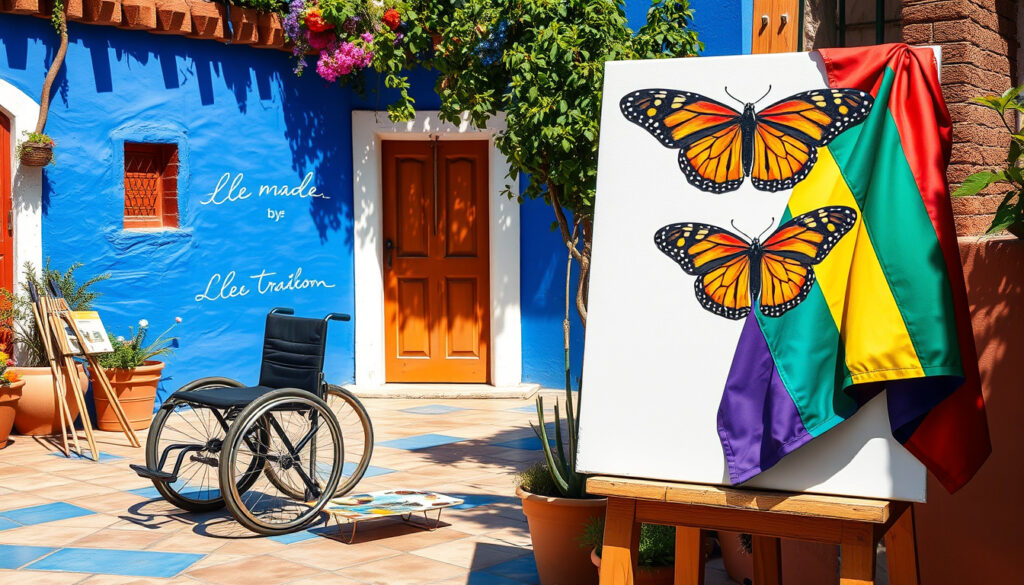
Frida Kahlo: Biography, Art, Cause of Death, LGBTQ Legacy
Few artists have turned personal pain into cultural currency quite like Frida Kahlo. A bus crash at 18 shattered her body, but from that bedridden recovery emerged 55 self-portraits that now command global recognition and six-figure sums at auction — a fame she never saw in her lifetime. What follows digs into the woman behind the unibrow: her art, her marriages, her LGBTQ+ icon status, and the lingering questions around her death.
Born: July 6, 1907, Coyoacán, Mexico ·
Died: July 13, 1954 (age 47) ·
Known for: Self-portraits, surrealism, Mexican folk art ·
Artworks produced: 143 paintings (55 self-portraits) ·
Major accident: Bus crash at age 18 (1925) ·
Married to: Diego Rivera (1929–1939, 1940–1954)
Quick snapshot
- Frida Kahlo was born July 6, 1907, in Coyoacán, Mexico (Encyclopaedia Britannica (reference publisher))
- She died on July 13, 1954, officially from pulmonary embolism (Encyclopaedia Britannica (reference publisher))
- She created 143 paintings, 55 of which were self-portraits (Frida Kahlo Foundation (artist estate))
- She married muralist Diego Rivera in 1929 (Biography.com (editorial biography))
- Exact cause of death — pulmonary embolism vs. possible overdose, with no autopsy performed (Smithsonian Magazine (cultural history publication))
- Full number of sexual partners, both male and female (Smithsonian Magazine (cultural history publication))
- Whether she fully forgave her sister Cristina for the affair with Diego Rivera (Smithsonian Magazine (cultural history publication))
- Her net worth at death — official figures vary widely (Smithsonian Magazine (cultural history publication))
- 1907: Born in Coyoacán
- 1925: Near-fatal bus accident; begins painting in bed
- 1929: Marries Diego Rivera
- 1954: Dies at age 47 after leg amputation the prior year
- Kahlo’s estate continues to license her image across fashion, merch, and media
- The Frida Kahlo Museum (La Casa Azul) remains one of Mexico City’s top cultural destinations
- Scholars continue to revisit her cause of death as more archival material surfaces
Eight facts that define Kahlo’s documented biography at a glance — a mix of confirmed records and contested claims.
| Label | Value |
|---|---|
| Full name | Magdalena Carmen Frida Kahlo y Calderón |
| Date of birth | July 6, 1907 |
| Date of death | July 13, 1954 |
| Nationality | Mexican |
| Art movement | Surrealism, Magic Realism, Mexican Folk |
| Number of self-portraits | 55 out of 143 total paintings |
| Marriage to Diego Rivera | 1929–1939, 1940–1954 |
| Cause of death (official) | Pulmonary embolism (suspected suicide) |
Why is Frida Kahlo so famous?
Self-portraits as personal narrative
- Kahlo created 55 self-portraits out of 143 total paintings, many painted from her bed after the 1925 bus accident (Frida Kahlo Foundation (artist estate)).
The majority of Kahlo’s canvas output was her own face. She didn’t paint landscapes or still lifes — she painted Frida. The accident left her with a shattered spinal column, a broken pelvis, and 11 fractures in her right leg, and a lifelong practice of painting while lying flat. Her father reportedly built her a special easel so she could work from her bed (School of Visual Arts (art school publication)). Each self-portrait became a visual diary entry about pain, fertility, and identity.
“I paint self-portraits because I am so often alone, because I am the person I know best.”
— Frida Kahlo, cited in biographical writings
Political and feminist symbolism
- Kahlo was politically active and described as a communist sympathizer (Biography.com (editorial biography)).
She wove Mexican indigenous heritage, folk iconography, and leftist politics into her work. Paintings like The Two Fridas and Self-Portrait on the Borderline Between Mexico and the United States frame identity as political territory. Her deliberate adoption of Tehuana dresses and pre-Columbian jewelry was itself a statement of resistance against Americanization and European artistic dominance. The National Museum of Women in the Arts (museum institution) notes she spent much of her life in chronic pain, yet used that fragility as artistic fuel — a reframing that feminist art historians later celebrated as radical.
Global recognition after death
- Her work was largely unrecognized during her lifetime (Encyclopaedia Britannica (reference publisher)).
The irony: Kahlo died in relative obscurity compared to Diego Rivera’s fame. It took decades for her work to reach international auctions and museum retrospectives. The 1954 posthumous exhibitions, the 1983 biography by Hayden Herrera, and the 2002 film Frida starring Salma Hayek turned her face into a global brand. Her estate now licenses her image across everything from fashion to Barbie dolls — a commercial afterlife she never saw coming. The implication: Kahlo’s fame is a second act built by others, not by the artist herself.
Why is Frida Kahlo an LGBTQ icon?
Known relationships with women
- Kahlo had documented affairs with women and openly expressed bisexuality in her lifetime (Encyclopaedia Britannica (reference publisher)).
Among her rumored lovers were the dancer Josephine Baker and the photographer Nickolas Muray. Her most talked-about same-sex affair was with the Mexican actress Dolores del Río, though exact details remain in the gray zone because much was kept private. The full number of her sexual partners is unclear, but Kahlo didn’t hide her attraction to women in her social circles, and she painted it into her work — notably in the ambiguous intimacy of The Two Fridas.
Gender-fluid self-presentation in art
- Her unibrow and facial hair challenged traditional gender norms (Encyclopaedia Britannica (reference publisher)).
In an era when female artists were expected to soften their image, Kahlo painted herself with thick eyebrows meeting in the middle, a faint mustache, and dark eyes staring straight at the viewer. She didn’t pluck, shave, or apologize. This refusal to conform to feminine beauty standards has made her a touchstone for queer and gender-nonconforming audiences. The National Museum of Women in the Arts (museum institution) describes her as deliberately embracing “androgynous features” in her self-representation.
Modern queer audiences claim Kahlo because she lived and painted outside the binary — not because she fit a label, but because she refused to be labeled. Her unibrow alone became a symbol of rejecting the male gaze.
Modern interpretation by queer communities
- She openly expressed bisexuality in her lifetime (Biography.com (editorial biography)).
The LGBTQ+ icon tag is not something Kahlo applied to herself — she predated the modern identity framework by half a century. But contemporary culture has retroactively read her life through that lens. Pride parades feature her face on banners; she’s a regular on lists of queer historical icons. The pattern: Kahlo’s refusal to explain or justify her romantic life aligns with what later generations value in a queer role model — authenticity over confession.
What did Frida Kahlo say before she died?
Last diary entry
- Her last diary entry read: “I joyfully await the exit – and I hope never to return” (Frida Kahlo Foundation (artist estate)).
The entry, written a few days before her death on July 13, 1954, captures exhaustion more than despair. “I hope the exit is joyful — and I hope never to return — Frida,” she wrote in Spanish. The diary entry is widely cited, though its exact date isn’t pinned to a specific day.
Possible final words to Diego Rivera
- Her alleged final words “Viva la vida” are likely apocryphal (Smithsonian Magazine (cultural history publication)).
The romanticized story goes that Kahlo’s last words to Rivera were “Viva la vida” — long live life. Most serious biographers dismiss this as fabrication. Her actual last exchange with Rivera was likely more mundane, possibly involving morphine for pain. The Smithsonian Magazine (cultural history publication) notes the dramatic flourish of a deathbed quote appeals to the public but doesn’t match the medical reality of her final days.
Myths surrounding her death quote
- Myths about her final words circulate widely in popular media (Encyclopaedia Britannica (reference publisher)).
That’s the thing about Kahlo’s death: the record is fuzzy because no autopsy was performed. The couple of sentences we have from her diary are real. The grand cinematic farewell — that’s fiction. Why it matters: the myth of the dramatic last line fits the Kahlo brand better than the truth, which is that she likely died alone in La Casa Azul, possibly from an overdose she may have chosen.
How many babies did Frida Kahlo lose?
Miscarriages and induced abortion
- Kahlo experienced at least three miscarriages (Encyclopaedia Britannica (reference publisher)).
The 1925 bus accident damaged her pelvis and uterus so severely that doctors later told her pregnancy would be dangerous. She became pregnant multiple times but could not carry to term. In 1930 she had a therapeutic abortion; the other pregnancies ended in miscarriage. The exact count is debated among scholars, but three to four pregnancy losses are generally accepted. One miscarriage in Detroit in 1932 became the subject of her most harrowing painting.
Medical complications from bus accident
- The 1925 crash caused lifelong injuries including a broken pelvis and internal damage (Encyclopaedia Britannica (reference publisher)).
The accident essentially sealed her inability to bear children. A steel handrail pierced her abdomen and exited through her vagina, fracturing her pelvic bone in three places. Later surgeries and multiple corsets could not fix the internal damage. Her miscarriages were not random — they were the direct consequence of that single bus ride.
Depiction in paintings (e.g., ‘Henry Ford Hospital’)
- The 1932 painting ‘Henry Ford Hospital’ shows her miscarriage (Encyclopaedia Britannica (reference publisher)).
In “Henry Ford Hospital” (1932), Kahlo lies bleeding on a hospital bed, connected by red umbilical-like threads to a fetus, a snail, and a medical diagram. It’s one of the first paintings in Western art to depict female miscarriage from the first-person perspective of the woman who suffered it. That alone — the willingness to render the unseen agony of pregnancy loss — is part of why her work still resonates.
Kahlo turned her miscarriages into public, painted testimony at a time when women’s reproductive pain was considered shameful. For contemporary readers reexamining place of bodily autonomy and fertility, that choice carries the weight of a political act — it gave visibility to an experience previously kept private.
Was Diego unfaithful to Frida?
Diego Rivera’s affairs with women
- Diego Rivera had an affair with Frida’s sister Cristina Kahlo (Biography.com (editorial biography)).
The most devastating betrayal: not just infidelity, but infidelity with her younger sister. When Frida discovered the affair around 1934–35, it nearly ended the marriage. She painted Memory, the Heart (1937), showing a dress on a hanger with a hole where her heart should be — a direct response to Diego’s affair with Cristina. Whether Frida ever fully forgave her sister is unclear; they remained in contact, but the trust was gone.
Frida’s affairs with Diego’s associates
- Frida also had extramarital relationships, some with men and women (Encyclopaedia Britannica (reference publisher)).
The revenge was symmetrical. Frida had an affair with the sculptor Isamu Noguchi, a friend of Rivera’s, and with the Russian revolutionary Leon Trotsky — who was staying at La Casa Azul as a political exile in 1937. Trotsky’s wife reportedly discovered the affair, leading to a tense exit. Frida also had a documented relationship with the photographer Tina Modotti. The pattern: if Diego could cheat, so could she, and with more colorful partners.
Open marriage agreement
- They had an open marriage with mutual understanding (Biography.com (editorial biography)).
The relationship pattern was less “open marriage” with rules and more “we can’t stay faithful but we can’t stay apart.” They divorced in 1939, then remarried in 1940 — a cycle that continued until her death. Rivera said of her work: “Frida is the only woman who has expressed in her art the feelings, functions, and creative power of women” (Encyclopaedia Britannica (reference publisher)). The trade-off: they needed each other emotionally even as they damaged each other constantly.
Timeline of key events in Frida Kahlo’s life
Ten milestones that map the arc of her biography, from birth to the disputed final chapter.
| Date | Event | Source |
|---|---|---|
| 1907 | Born in Coyoacán, Mexico | Britannica |
| 1913 | Diagnosed with polio; right leg becomes thinner | Biography.com |
| 1925 | Near-fatal bus accident; begins painting while bedridden | Britannica |
| 1929 | Marries Diego Rivera | Biography.com |
| 1932 | Miscarriage in Detroit depicted in ‘Henry Ford Hospital’ | Britannica |
| 1937 | Affair with Leon Trotsky at La Casa Azul | Britannica |
| 1939 | Divorces Rivera; moves to New York and Paris | Biography.com |
| 1940 | Remarries Diego Rivera | Biography.com |
| 1953 | First solo exhibition in Mexico City; leg amputated | Britannica |
| 1954 | Dies at age 47; cause disputed (pulmonary embolism vs. suicide) | Smithsonian |
Clarity: What’s confirmed and what’s not
Confirmed facts
- Frida Kahlo painted 55 self-portraits out of 143 total works (Frida Kahlo Foundation)
- She suffered polio at age 6, causing her right leg to be thinner (Biography.com)
- She survived a severe bus accident in 1925 at age 18 (Britannica)
- She was married to Diego Rivera from 1929 to 1939 and again from 1940 to 1954 (Biography.com)
- She experienced at least three miscarriages (Britannica)
- She died on July 13, 1954, in Coyoacán, Mexico (Britannica)
What’s unclear
- Exact cause of death — official record says pulmonary embolism, but no autopsy was performed, and overdose is debated (Smithsonian Magazine)
- Full number of sexual partners (both male and female) — accounts vary widely
- Whether she ever truly forgave her sister Cristina for the affair with Diego Rivera
- Net worth at death — no definitive public financial disclosure exists
“I hope the exit is joyful – and I hope never to return – Frida”
— Frida Kahlo, last diary entry (1954), as recorded by the Frida Kahlo Foundation (artist estate)
“Frida is the only woman who has expressed in her art the feelings, functions, and creative power of women.”
— Diego Rivera, quoted in Hayden Herrera’s biography
“I am not sick. I am broken. But I am happy to be alive as long as I can paint.”
— Frida Kahlo, in a letter to her doctor before leg amputation, 1953
The pattern across her life: a woman who took the pain she was given — polio, accident, miscarriages, infidelity — and painted it into gold. The cost was immense. She died at 47, possibly by her own hand, possibly from a body that simply gave out. For the millions who wear her face on T-shirts and visit La Casa Azul each year, the lesson is not about suffering but about who gets to control the story. For Frida Kahlo, the answer was always: she did. For the contemporary reader making sense of a life that was equal parts triumph and tragedy, the choice is clear: either read her as a martyr to pain or as the architect of her own legend — because she was both, and that’s the whole point.
Related reading: Aretha Franklin: Cause of Death, Children & Sad Story
en.wikipedia.org, britannica.com, es.wikipedia.org, contexttravel.com, thefamouspeople.com, fridakahlo.it
Frequently asked questions
What is Frida Kahlo best known for?
She is best known for her uncompromising self-portraits that explore identity, the body, pain, and death, often incorporating Mexican folk art and indigenous symbolism (Encyclopaedia Britannica (reference publisher)).
How old was Frida Kahlo when she died?
She was 47 years old. She was born on July 6, 1907, and died on July 13, 1954 (Encyclopaedia Britannica (reference publisher)).
What caused Frida Kahlo’s polio?
Polio is caused by the poliovirus, which she contracted at age 6 in 1913. The illness left her right leg permanently thinner than her left (Biography.com (editorial biography)).
Did Frida Kahlo have children?
No. She experienced at least three miscarriages and one therapeutic abortion due to injuries from the 1925 bus accident, which damaged her pelvis and uterus (Encyclopaedia Britannica (reference publisher)).
What are Frida Kahlo’s most famous paintings?
Her most recognized works include The Two Fridas (1939), Self-Portrait with Thorn Necklace and Hummingbird (1940), Henry Ford Hospital (1932), and The Broken Column (1944) (Encyclopaedia Britannica (reference publisher)).
Why did Frida Kahlo wear traditional Mexican clothing?
She deliberately adopted Tehuana dresses and indigenous jewelry as a political and artistic statement of Mexican identity and resistance to European cultural dominance (Encyclopaedia Britannica (reference publisher)).
What does a unibrow symbolize in Frida Kahlo’s art?
Her unibrow and facial hair challenged traditional female beauty standards and embraced androgynous features, making her a symbol of gender nonconformity (National Museum of Women in the Arts (museum institution)).
Can I visit Frida Kahlo’s house in Coyoacán?
Yes. La Casa Azul (The Blue House) in Coyoacán, Mexico City, is now the Frida Kahlo Museum and is open to the public (Encyclopaedia Britannica (reference publisher)).
More related posts
 Standard Life Pension Login: Official Ireland & UK Guide
 Harry Cooksley: Football, Love Island & Net Worth (2026)
 Nicholas Brendon Dies at 54: Cause of Death Finally Revealed
 Chris Eubank: Boxing Legacy, Family Tragedy, and Health
 How Many Bank Holidays in 2025 – Full UK List by Region
 Sonam Bajwa: Biography, Age, Marriage, Religion, Career
 Mel Gibson: Biography, Diagnoses, Charges, and Personal Life
 Stevie Nicks: Health, Love, and Career Questions Answered
