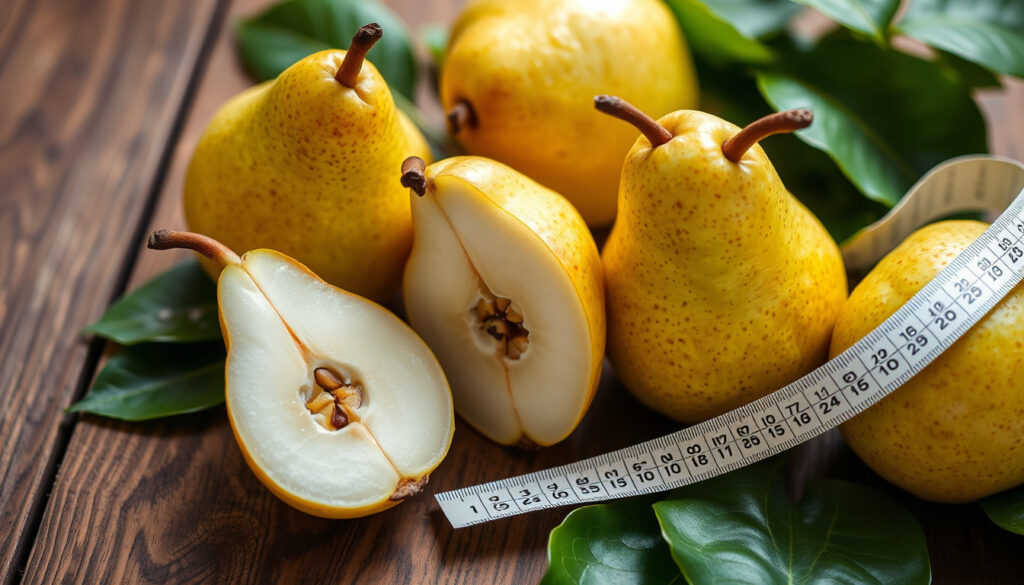
Are Pears Good for You? 7 Benefits, Nutrition Facts & Comparisons
Few fruits manage to be both a sweet treat and a solid nutritional choice, but pears pull it off. With a fiber count that outpaces apples and a sugar load that is gentler than many assume, this everyday fruit deserves a closer look — we examine the evidence behind pear health benefits, compare them against apples and bananas, and answer the practical questions about servings, weight loss, and digestion.
Recommended daily pear intake: 1 medium pear per day (based on fiber and sugar balance) ·
Fiber per medium pear: 6 g (21% DV) ·
Vitamin C per medium pear: 7 mg (12% DV) ·
Pears ranking among fruits for heart health: Top 5 (Cleveland Clinic) ·
Calories per medium pear: 101 kcal
Quick snapshot
- Pears provide 6 g fiber per medium fruit (PMC (peer-reviewed medical research))
- Pears are low in calories – approx 101 kcal per medium pear (Prevention (health media, citing USDA))
- Pears contain pectin fiber, which supports gut health (BBC Good Food (nutrition editorial))
- Whether pears offer unique liver-specific benefits beyond general fruit intake
- Whether eating pears in the morning differs from eating them at other times
- Whether 2 pears per day is too much sugar for individuals with diabetes without adjusting other diet
- 2015 systematic review (Reiland et al.) confirmed pears as excellent fiber and vitamin C source (PMC (peer-reviewed medical research))
- Ongoing institutional guidance from Cleveland Clinic ranks pears among top fruits for heart health (Cleveland Clinic (medical institution))
- More research needed on pears and diabetes-specific blood sugar management
- Growing interest in pears as a low-glycemic fruit alternative among people managing weight
Nutritional breakdown of a medium pear (178 g).
| Characteristic | Pear (medium, 178 g) |
|---|---|
| Fiber | 6 g (21% DV) |
| Vitamin C | 7 mg (12% DV) |
| Calories | 101 kcal |
| Sugar (natural) | 17 g |
| Potassium | 206 mg (4% DV) |
| Water content | ~84% |
Are pears good for you?
What nutrients do pears provide?
As shown in the snapshot above, pears provide 6 g fiber, 7 mg vitamin C, 206 mg potassium, and 101 calories per medium pear.
The 6 g of fiber in a single pear means you get more than a fifth of your daily fiber target from one snack. For most people, that alone makes the pear a stronger everyday choice than ultra-processed snack bars or crackers.
Are pears a healthy fruit overall?
Yes, according to a 2015 systematic review by Reiland et al. published in the Journal of the American College of Nutrition, pears are confirmed as an excellent source of dietary fiber and a good source of vitamin C (PMC (peer-reviewed medical research)). The Cleveland Clinic ranks pears among the top five fruits for heart health, citing their fiber, potassium, and antioxidant content (Cleveland Clinic (medical institution)).
The trade-off: pears are not a vitamin C powerhouse — an orange gives you about seven times more — but they compensate with phytonutrients and an unusually low energy density.
How many pears a day should you eat?
The most common recommendation from dietitians is one medium pear per day. A medium pear delivers roughly 17 g of natural sugar — primarily fructose and glucose — which fits comfortably within the American Heart Association’s added-sugar limits for most adults.
Is 2 pears a day too much sugar?
Two pears provide about 34 g of sugar. For a person without diabetes or blood sugar issues, that remains within the daily added-sugar limit of 36 g for men and 25 g for women set by the American Heart Association — though pears’ sugar is natural, not added. For individuals managing diabetes, it is wise to consider the total carbohydrate load from two pears (approx 48 g of carbs) against your meal plan. A dietitian can help tailor the right portion.
The implication: one pear is a safe, balanced snack for almost everyone. Two pears work for physically active people, but those watching their sugar intake should treat the second pear as an occasional choice, not a daily habit.
What is healthier, a pear or an apple?
How do pears and apples compare nutritionally?
Three data points, one pattern: pears edge out apples on fiber, while apples hold a small lead in vitamin C and polyphenols.
| Nutrient (per 100 g) | Pear | Apple |
|---|---|---|
| Fiber | 3.1 g | 2.4 g |
| Sugar | 9.75 g | 10.4 g |
| Vitamin C | 4.3 mg | 4.6 mg |
| Potassium | 116 mg | 104 mg |
| Water content | ~84% | ~84% |
Data from USDA values quoted by Prevention (health media).
Which fruit is better for weight loss?
Both are low-calorie and high-fiber, but the pear’s extra 0.7 g of fiber per 100 g may offer a slight satiety advantage. The Cleveland Clinic notes that both fruits support heart and gut health, so the choice can rest on taste preference or availability (Cleveland Clinic (medical institution)).
The catch: pears and apples are both higher in FODMAPs, meaning people with irritable bowel syndrome may need to test their tolerance.
Are pears better for you than bananas?
What is better, banana or pear?
Four metrics, one trade-off: pears win on fiber per calorie, bananas on potassium and portability.
| Nutrient (per medium fruit) | Pear (178 g) | Banana (118 g) |
|---|---|---|
| Calories | 101 kcal | 113 kcal |
| Fiber | 6 g | 3 g |
| Sugar | 17 g | ~14 g |
| Potassium | 206 mg | 326 mg |
| Carbohydrates | 27 g | 23 g |
Banana data from Tasting Table (food media). Pear data from USDA via Prevention (health media).
If your priority is fiber and a fuller feeling from fewer calories, a pear is the better pick. If you need potassium for blood pressure or post-workout recovery, a banana is more efficient — it delivers 58% more potassium in a smaller package.
Bananas and pears for athletic performance and recovery
Bananas are a classic pre-workout fruit because of their potassium and quick-digesting carbs. Pears can serve the same purpose — their fiber slows sugar absorption, providing steadier energy during longer sessions (Tasting Table (food media)). For endurance athletes, a pear’s antioxidant content may offer anti-inflammatory benefits that a banana’s simpler profile does not.
The pattern: neither fruit is strictly “better” — the winner depends entirely on the context: recovery, steady energy, or convenience.
Are pears good for your stomach and digestion?
Yes, largely thanks to pectin — a soluble fiber that feeds beneficial gut bacteria and promotes regular bowel movements. BBC Good Food’s nutrition editor highlights pears as a gut-friendly fruit, noting their pectin supports digestive regularity (BBC Good Food (nutrition editorial)).
Are pears good for your liver?
There is no direct evidence that pears specifically benefit the liver more than other fruits. However, the general antioxidant content in pears — particularly flavonoids — may contribute to overall liver health as part of a diet rich in fruits and vegetables. The effect is likely modest and not unique to pears.
Are pears good for your kidneys?
Yes, indirectly. Pears’ potassium content (206 mg per medium fruit) supports healthy blood pressure, which in turn protects kidney function over the long term (Prevention (health media)). That said, people with chronic kidney disease who need to limit potassium should check with their doctor before eating pears daily.
People with IBS may find that pears’ high FODMAP content triggers bloating or gas. A small test serving — half a pear — is a sensible starting point.
The upshot: pears support digestive health for most people, but those with IBS should start small.
Are pears good for you to lose weight?
Pears are a legitimate ally in weight management. With 101 calories per medium fruit and 6 g of fiber, they promote satiety — meaning you feel fuller for longer after eating one. Healthline notes that the fiber in pears can help control appetite and reduce overall calorie intake (Healthline (health media)).
The trick is pairing the fruit with a protein source — like a handful of almonds or a spoonful of Greek yogurt — to stabilize blood sugar and extend the feeling of fullness. Without protein, the natural sugars can cause a quicker drop in energy.
For people trying to lose weight, the pear’s dual advantage is low energy density and high water content (~84%), meaning you can eat a satisfying portion without a large calorie cost.
Are pears good for dogs and other common questions?
Are pears good for you in the morning?
Yes. A pear in the morning provides natural fruit sugars for quick energy and fiber for sustained fullness. Eating it with the skin on maximizes the fiber content — about half the fiber in a pear is in the skin.
Are pears good for you when sick?
Pears’ soft texture, high water content, and natural sweetness make them a soothing choice for sore throats, nausea, or dehydration. The pectin may also help settle an upset stomach, though evidence is anecdotal rather than clinical.
Are pears good for dogs?
Yes, in moderation. Pears are safe for dogs when cut into small pieces and with the seeds and core removed. The seeds contain trace amounts of cyanide, but the risk is minimal in small quantities. Stick to a few small slices — no more than 10% of the dog’s daily diet (American Kennel Club (pet care authority)).
For humans and dogs alike, the pear keeps its promise: a gentle, fiber-rich fruit that fits into almost anyone’s daily routine with minimal fuss. The trade-off is that it is not a vitamin C star and its FODMAP content can trouble sensitive stomachs. But for the vast majority of people, one pear a day is a small, pleasant investment in better fiber intake, heart health, and digestive regularity.
“Pears have a lot of fiber and contain vitamin C, which supports your immune system and your body’s ability to heal. The fiber in pears supports heart and gut health.”
— Cleveland Clinic dietitian, Cleveland Clinic (medical institution)
“The systematic review confirms that pears are an excellent source of dietary fiber and a good source of vitamin C, while also being low in calories.”
— Reiland et al., 2015, PMC (peer-reviewed medical research)
“Pears are one of the best fruits for digestive health because of their high pectin fiber content. They can help with both constipation and diarrhea.”
— BBC Good Food nutrition editor, BBC Good Food (nutrition editorial)
For the average person buying fruit at the grocery, the decision between a pear, an apple, or a banana comes down to a simple trade-off: pears deliver the most fiber per calorie, apples offer slightly more vitamin C, and bananas are the potassium champions. For weight management, the pear’s low energy density and satiety-promoting fiber give it a real edge. For someone managing blood sugar, one medium pear — especially eaten with the skin on — is likely a smarter choice than a banana because of its lower glycemic index. The case for adding pears to your daily diet is grounded in evidence, not marketing.
Frequently asked questions
Are pears good for weight loss?
Yes. A medium pear has only 101 calories and 6 g of fiber, which promotes satiety and can help control appetite, according to Healthline (Healthline (health media)). Pairing it with protein further stabilizes blood sugar.
Can pears cause gas or bloating?
In some people, yes. Pears are higher in FODMAPs, which can cause gas, bloating, or discomfort in individuals with irritable bowel syndrome. A small serving of half a pear is a good way to test tolerance.
Are pears good for people with diabetes?
Pears have a lower glycemic index than bananas and can be part of a diabetes-friendly diet. However, with 17 g of sugar per medium pear, portion control matters. A single pear is generally fine; two may require adjusting other carbohydrates in the meal.
Should you eat pears with or without the skin?
With the skin. About half the fiber in a pear is in the skin, and the peel also contains concentrated antioxidants. Wash thoroughly before eating.
Are pears a good pre-workout snack?
Yes. Pears provide natural sugars for quick energy and fiber for sustained fuel. The lower glycemic index means slower energy release compared to a banana, which can be an advantage for longer workouts.
Are dried pears as healthy as fresh pears?
Dried pears retain fiber and many nutrients but are much more concentrated in sugar and calories. A 40 g serving of dried pears can have as much sugar as a whole fresh pear in a fraction of the volume. Fresh is better for weight management; dried works as an occasional snack.
Can pears help lower cholesterol?
The soluble pectin fiber in pears can help reduce “bad” LDL cholesterol levels by binding to cholesterol molecules in the digestive tract and removing them from the body.
More related posts
 Pay Stansted Drop Off: How to Pay Online & Avoid Fines
 Bugs Bunny: History, Facts, Catchphrases, and Controversies
 Liam Byrne: Politician, Criminal, and Wingsuit Champion
 Virat Kohli: Biography, Net Worth, Retirement, Controversies
 Art Attack: Neil Buchanan, Cancellation, and Legacy
 Kim Taehyung V Relationship Status and Stage Name
 Lindsay Lohan: Downfall, Comeback, Net Worth, and Family Life
 Antony Gormley: The Angel of the North and His Art
