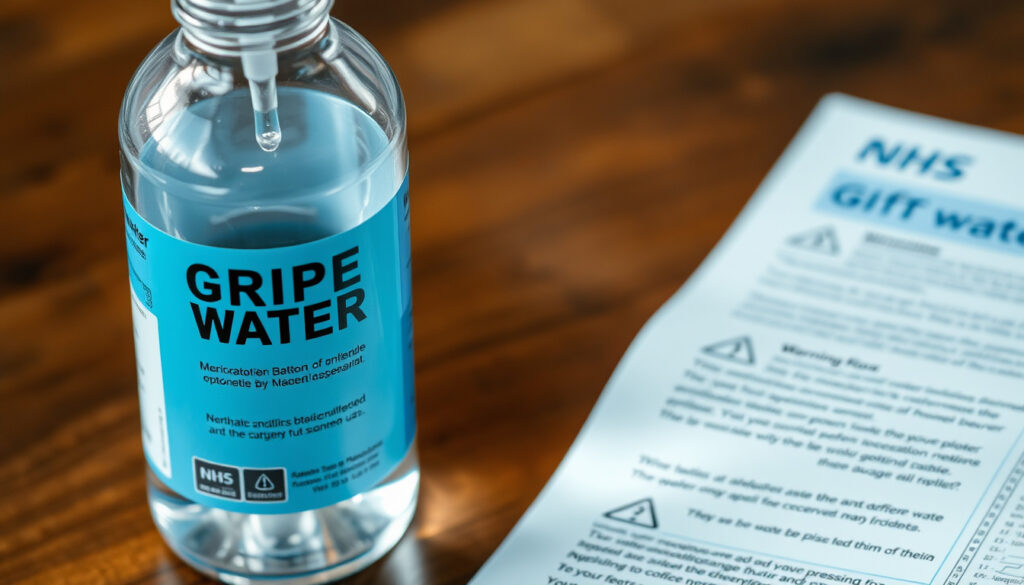
Gripe Water Safety, Side Effects & NHS Advice
Few things test a new parent’s composure quite like the sound of a baby crying through the night. Gripe water has been a go-to remedy for generations, yet its safety and effectiveness remain surprisingly unsettled. This guide examines the evidence behind gripe water, its legal status in the UK and Ireland, what the NHS says, and how it compares to alternatives like Infacol, so you can make an informed choice for your baby.
Infants given gripe water (1-6 months): 55% (non-nutritive substance) ·
Common age range for gripe water use: Newborn to 6 months ·
Countries where gripe water is regulated: UK, Ireland, US, Canada ·
NHS recommendation status: Not recommended ·
Active ingredients in classic formula: Sodium bicarbonate, dill oil
Quick snapshot
- Gripe water contains sodium bicarbonate and dill oil (electronic Medicines Compendium (UK medicines regulator))
- NHS does not recommend gripe water for colic (NHS (UK health authority))
- Some formulations contain honey – risk of infant botulism (PubMed Central (peer-reviewed research))
- Woodwards Gripe Water is sold in Irish pharmacies (electronic Medicines Compendium)
- Exact legal status in Ireland – no official ban, but some conflicting statements (electronic Medicines Compendium)
- Efficacy compared to placebo remains unproven (PrescQIPP (NHS prescribing review body))
- Optimal dosage for infants under 1 month is not established (electronic Medicines Compendium)
- Gripe water use in infants aged 1–6 months reported at 55% (PubMed Central (2012 meta-analysis))
- NHS position statements against gripe water updated 2018, 2021 (South West London ICB NHS (commissioning body))
- Infacol (simeticone) continues to be widely sold for babies from birth (Infacol Official Site (manufacturer))
Here are the core facts every parent should know before reaching for a bottle.
| Attribute | Value |
|---|---|
| Typical age for use | 2 weeks to 6 months |
| Main active ingredients | Sodium bicarbonate, dill oil, sometimes fennel, ginger |
| NHS recommendation | Not recommended |
| Legal in Ireland? | Yes (available in pharmacies) |
| Alcohol content | Alcohol-free in modern formulations |
| Common brand in UK/Ireland | Woodwards Gripe Water |
Is gripe water safe for newborns?
The short answer: not for newborns under one month. The electronic Medicines Compendium (UK medicines regulator) states explicitly that Woodwards Gripe Water must not be used in children under 1 month old. For babies between 1 and 6 weeks, the risks are poorly studied.
Minimum age for gripe water use
The patient leaflet for Woodwards Gripe Water – the dominant brand in the UK and Ireland – approves it from 1 month to 1 year for symptoms of wind. Infacol (manufacturer’s guidance) notes that gripe waters are only suitable for babies of 1 month old or over, while their own product can be used from birth.
Safety of ingredients like sodium bicarbonate
Sodium bicarbonate, a key ingredient, can neutralize stomach acid. In very young infants, altering gastric pH may interfere with digestion and absorption. A PubMed Central review (peer-reviewed research) warns that giving anything other than breast milk in the first six months may increase the risk of allergies, intestinal irritation, and bacterial imbalances.
Risks for very young infants under 1 month
For babies born prematurely or with low birth weight, the risks are even less documented. The NHS (UK health authority) advises consulting a doctor before giving any medicine to a baby under 6 weeks. The PrescQIPP infant colic review (NHS prescribing body) notes that gripe water may be associated with increased vomiting and constipation.
Is gripe water illegal in Ireland?
No – but the confusion is understandable. Several online sources have claimed a “ban”, but the reality is more nuanced.
Legal status in the Republic of Ireland
Gripe water is not banned in Ireland. Major pharmacy chains, including Boots and LloydsPharmacy, stock Woodwards Gripe Water. The electronic Medicines Compendium (UK medicines database) lists Woodwards as a licensed product, and Irish market authorisation is reciprocal under EU rules. However, the product is classified as a herbal medicinal product rather than a medicine, which means it is not subject to the same rigorous clinical trial requirements as a drug.
Difference between banned and restricted
Older formulations of gripe water contained alcohol – up to 9% in some vintage bottles. Those versions are no longer marketed. Modern versions are alcohol-free. The HSE (Irish health service) does not specifically mention gripe water, but its colic advice mirrors the NHS: no strong evidence for any over-the-counter treatment.
Woodwards Gripe Water availability in Ireland
A search on Boots.ie in March 2025 shows Woodwards Gripe Water listed and available. The product carries a Patient Information Leaflet (PL) approved by the UK Medicines and Healthcare products Regulatory Agency (MHRA), which is recognised in Ireland. So parents can buy it, but they should know that official health authorities do not endorse it.
Is gripe water recommended by the NHS?
The answer is a firm no. The NHS (UK health authority) states: “There is not enough evidence to say whether gripe water works for colic” and “it is not recommended for this use.”
NHS stance on gripe water for colic
The NHS colic page does not list gripe water as a treatment option. Instead, it advises parents to try soothing techniques, burping, and safe winding positions. NHS Scotland guidance (national health service) is similarly blunt: “Gripe water is sometimes mentioned by parents, but there is no scientific evidence to support its use.”
Why doctors often advise against it
Beyond the lack of efficacy evidence, there are safety concerns. The South West London ICB NHS position statement (NHS commissioning body) recommends that gripe water should not be prescribed for infant colic because it is not licensed for that condition, and no clinical data support its use. Doctors also worry about untested herbal ingredients like dill oil and ginger in very young babies.
Evidence from the PMC study (2015)
A systematic review published in PubMed Central (peer-reviewed research) found that 55% of parents in the UK gave their infants gripe water between 1 and 6 months, despite the lack of evidence. The same review warned about potential harms: “prelacteal use soon after birth may delay breastfeeding establishment and reduce breast milk supply.”
The NHS is not being cautious for no reason. Without a single high-quality trial confirming that gripe water works, and with real concerns about side effects, the medical establishment’s message is consistent: speak with a health visitor or GP, and skip the gripe water.
What are the negative side effects of gripe water?
Although gripe water is often perceived as “natural”, it can cause side effects, especially in vulnerable infants.
Common side effects
The PrescQIPP infant colic review (NHS prescribing body) reports that gripe water may be associated with increased vomiting, constipation, and allergic reactions such as skin rashes. Some babies experience diarrhoea or breathing difficulties after ingestion.
Rare but serious risks (botulism from honey in some brands)
Several brands of gripe water (including some imported or non-UK brands) contain honey as a sweetener. The PubMed Central review (peer-reviewed research) warns that honey can carry Clostridium botulinum spores, which can cause infant botulism – a rare but life-threatening condition. Honey-based gripe water should never be given to babies under 1 year.
How side effects vary by formulation
Ingredients vary widely. Some brands add gentle ingredients like fennel or ginger, while others include sodium bicarbonate, dill oil, or even traces of alcohol (now removed from UK/Ireland products). Always check the label. Woodwards Gripe Water (medicines compendium) lists sodium bicarbonate, dill oil, and purified water – no alcohol or honey. But not all brands are equal.
Why do doctors not recommend gripe water?
Medical consensus across the UK and Ireland is to avoid gripe water. But why, exactly?
Lack of clinical evidence for efficacy
The NHS (UK health authority) states that even for simeticone (the active ingredient in Infacol), “there is currently no convincing evidence it helps colic.” For gripe water, the evidence is even weaker. No randomised controlled trials have been conducted on modern gripe water formulations.
Potential harm from unnecessary ingredients
Sodium bicarbonate, dill oil, and other herbal extracts have not been safety-tested in infants. The PrescQIPP review (NHS prescribing body) notes that giving any non-nutritive substance to infants may disrupt the developing gut microbiome. The PubMed Central study (peer-reviewed) raises concerns about early introduction of anything other than breast milk.
Preference for evidence-based colic management
Doctors recommend non-pharmacological methods first: responsive settling, gentle winding, skin-to-skin contact, and swaddling. NHS colic guidance (health authority) specifically suggests these before trying any medicine. Probiotic drops containing Lactobacillus reuteri have some trial evidence, though not yet in the UK national guidelines.
Parents often reach for gripe water because it’s cheap and widely available. But the trade-off is real: an unproven product that may cause side effects versus a few extra minutes of burping and cuddling. Doctors view the risk-benefit ratio as unfavourable for gripe water.
What’s better, Infacol or gripe water?
Three differences, one pattern: Infacol is the simpler, better-studied option, while gripe water is a herbal blend with more unknowns. The comparison below highlights the key contrasts.
| Feature | Gripe Water (Woodwards) | Infacol (simeticone) |
|---|---|---|
| Active ingredient | Sodium bicarbonate, dill oil, herbal extracts | Simeticone (gas relief agent) |
| Age approval | From 1 month (eMC) | From birth (Infacol FAQ) |
| Mechanism | Herbal, may neutralise stomach acid | Inert; helps release trapped gas (Boots leaflet) |
| Evidence for colic | None (not recommended by NHS) | None convincing (NHS) |
| Side effects | Vomiting, constipation, allergic reactions (PrescQIPP) | Not known to cause any (Boots leaflet) |
| Regulation | Herbal medicinal product (licensed) | Licensed medicine |
| Cost (approx) | £5–8 per bottle | £8–12 per bottle |
The implication: neither product is proven to cure colic, but their safety profiles differ sharply.
How Infacol (simeticone) works
Simeticone is a defoaming agent that helps small gas bubbles join into larger ones, making them easier to pass. The Boots patient leaflet (pharmacy chain) describes it as “inert and not absorbed into the body”, meaning it travels through the gut unchanged. It is not known to cause any side effects.
Gripe water vs Infacol ingredients
While Infacol contains a single active ingredient, gripe water is a cocktail of bicarbonate, oils, and sometimes herbs with no proven synergy. The NHS (UK health authority) acknowledges simeticone as safe but still says evidence of efficacy for colic is lacking.
When to choose one over the other
Given the safety profile, many doctors would lean towards Infacol if a parent feels they must try something. The Infacol FAQ (manufacturer) states it can be used from birth, making it an option for babies under 1 month, when gripe water is contraindicated. That said, neither is a guaranteed solution. The PrescQIPP review (NHS prescribing body) concludes that “there are no data to confirm that lactase, simeticone, or gripe water are effective for infantile colic.”
The key difference is not efficacy – both are unproven – but safety. Simeticone has a clean side-effect profile and can be used from birth. Gripe water has known side effects and an age restriction. If you choose Infacol, start with the recommended dose. If you choose gripe water, stick to the manufacturer’s age limits.
Pros and cons of gripe water at a glance
Upsides
- Widely available in UK and Ireland without prescription (eMC)
- Low cost per dose (£5–8 per bottle)
- Modern formulations are alcohol-free (eMC)
- Some parents report subjective improvement (anecdotal)
Downsides
- Not recommended by any official health authority (NHS)
- No clinical evidence of effectiveness (PrescQIPP)
- Risk of side effects: vomiting, constipation, allergic reactions (PrescQIPP)
- Cannot be used before 1 month (eMC)
- Some brands contain honey – botulism risk (PubMed Central)
- May interfere with breastfeeding initiation (PubMed Central)
Beyond the noise: what we know and what we don’t
Confirmed facts
- Gripe water contains sodium bicarbonate and dill oil as active ingredients (eMC)
- Woodwards Gripe Water is approved from 1 month to 1 year for symptoms of wind (eMC)
- NHS does not recommend gripe water for colic (NHS)
- NHS Scotland states no scientific evidence supports its use (NHS Scotland)
- Honey-containing gripe water carries botulism risk (PubMed Central)
- Infacol (simeticone) is inert, not absorbed, and can be used from birth (Boots leaflet)
- Gripe water is not banned in Ireland; it is sold in pharmacies (eMC)
What’s unclear
- Whether gripe water is more effective than placebo for colic (PrescQIPP)
- Exact legal nuance in Ireland – no official ban, but some contradictory statements persist (eMC)
- Optimal dosing for babies under 1 month – none recommended (eMC)
- Long-term effects of herbal ingredients on infant gut development (PubMed Central)
What the experts say
“There is not enough evidence to say whether gripe water works for colic. It is not recommended for this use.”
– NHS (UK health authority)
“Gripe water is sometimes mentioned by parents, but there is no scientific evidence to support its use.”
“There are no data to confirm that lactase, simeticone, or gripe water are effective for infantile colic.”
– PrescQIPP (NHS prescribing review body)
Related reading
For more evidence-based guidance on products for your child, see our guides on Activated Charcoal: Benefits, Risks, Irish Guide 2025 and Toy Box Buying Guide: Safety, Materials, and Best Options.
motherandbaby.com, nhs.uk, health.clevelandclinic.org, healthline.com, goodrx.com
Frequently asked questions
Can gripe water cause constipation?
Yes. The PrescQIPP review (NHS prescribing body) notes that gripe water may be associated with increased constipation in some infants.
How much gripe water should I give my 3-month-old?
Follow the manufacturer’s instructions. For Woodwards Gripe Water, the patient leaflet (eMC) recommends 5ml per dose, given up to six times a day for infants aged 1 month and over. Always use the syringe provided.
Is gripe water safe for breastfed babies?
Generally, yes, but only after 1 month. The PubMed Central review (peer-reviewed) warns that giving anything other than breast milk in the first six months may interfere with breastfeeding establishment. Check with a health visitor before starting.
Can I give gripe water with baby formula?
Yes, you can mix gripe water with formula or expressed breast milk, but the patient leaflet (eMC) advises giving it undiluted for best results. Avoid adding it to a full bottle – use a separate spoon or syringe.
Does gripe water expire?
Yes. Always check the expiry date on the bottle. Woodwards Gripe Water (eMC) states a shelf life of 2 years. Discard any leftover mixture after the course of treatment described in the leaflet.
What is the best brand of gripe water for colic?
There is no best brand because no brand has proven efficacy. Woodwards is the most widely available and licensed in the UK and Ireland. Avoid any brand that lists honey or sugar as an ingredient. Whatever you choose, verify the age guideline on the label.
Can gripe water be used for teething pain?
No. Gripe water is not licensed or indicated for teething. The patient leaflet (eMC) states it is for the symptomatic relief of distress associated with wind in infants. For teething, use a chilled teething ring or paracetamol suspension for babies over 2 months (under medical advice).
Is gripe water safe for premature babies?
The risks are higher for premature or low-birth-weight babies. The electronic Medicines Compendium (eMC) does not specifically address prematurity, but the NHS advises consulting a doctor before giving any medicine to babies under 6 weeks or those born prematurely. It is safest to avoid gripe water entirely for premature infants.
Gripe water is a 150-year-old remedy that persists through parental desperation and anecdote, not through evidence. The gap between what parents hope for and what science delivers is wide. For UK and Irish parents, the choice is clear: gripe water is not recommended by any official health body, carries real side effects, and offers no proven benefit over placebo. If you are still considering it, start with the age restriction (1 month minimum) and choose a brand without honey. But the safest move—for your baby’s health and your peace of mind—is to put the bottle back on the shelf and reach for a warm cuddle, a squirt of Infacol (if over 1 month and you want a product), or a phone call to your GP.
More related posts
 Judy Garland Death: Cause, Funeral, and Children’s Ages
 Natasha Lyonne: Health, Sobriety & Relationships Fact Check
 Letitia Dean: Biography, Wigs, Surgery & EastEnders Return
 Jamal Musiala: Age, Injury, Contract, and Transfer Rumors
 Sports Direct NHS Discount: Blue Light Card & Codes
 Ms. Rachel: Net Worth, Husband, Education & Real Life Facts
 Children in Need 2024: £39.2m Raised on Night
 Edward Hopper: Life, Art, Themes & Most Famous Paintings
