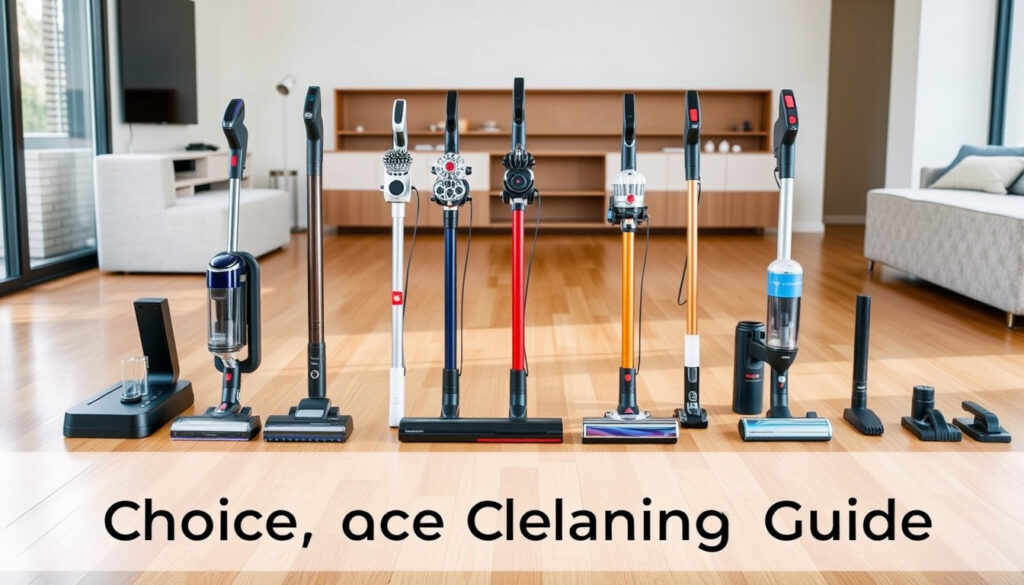
Dyson Cordless Vacuum Guide: Which Model Is Best for You
There’s a reason the Dyson cordless vacuum has become shorthand for serious housekeeping, but the model chart in a store can still leave even devoted fans squinting. This guide sorts out which one actually fits your floors, your schedule, and your budget.
Suction Power Range: 115 AW (V8) — 230 AW (V15 Detect) ·
Battery Runtime Range: 20 minutes (Turbo mode) — 60 minutes (Standard mode) ·
Filtration Standard: Whole-machine HEPA filtration across V1x models ·
Number of Current Stick Models: 5 (V8, V10, V11, V12, V15)
Quick snapshot
- RTINGS rated the V15 Detect better overall than the Shark PowerDetect, with stronger debris pickup across a wider variety of surfaces (RTINGS (independent testing lab)).
- The V15 Detect is rated at 230 AW of peak suction, roughly double the V8’s 115 AW (Dyson (official product specification)).
- The global rollout timing for Dyson’s next-generation Gen5Detect across all markets.
- Long-term durability differences between the Laser Slim Fluffy head and the Motorbar brush.
- How far Dyson will go to match Shark on budget cordless pricing.
- 2021: the V15 Detect and V12 Detect Slim introduced laser dust detection and piezo sensors (Wikipedia (public product history)).
- 2019: the V11 series added an LCD screen and intelligent battery management (Wikipedia (public product history)).
- Shark’s PowerDetect line has replaced the Stratos as its flagship cordless series (RTINGS (independent testing lab)).
- Older Dyson models such as the V8 and V11 are the ones to watch during Dyson sale events, when retail prices drop.
Eight rows, one pattern: Dyson keeps motors, cyclones and filters in-house, which is why every cordless stick shares the same bagless DNA.
| Company Name | Dyson Limited (Dyson Ltd) (Wikipedia (public product history)) |
| Headquarters | Malmesbury, Wiltshire, England (Wikipedia (public product history)) |
| Year Founded | 1991 (Wikipedia (public product history)) |
| Founder | James Dyson (Wikipedia (public product history)) |
| Key Innovation | First bagless vacuum cleaner, the DC01, launched in 1993 (Wikipedia (public product history)) |
| Primary Cordless Competitor | Shark (SharkNinja) |
| Standard Warranty | Two years on new Dyson vacuums (Dyson Support (official care guides)) |
| Current Cordless Flagship | V15 Detect, 230 AW (Dyson (official product specification)) |
Which is the best Dyson cordless model?
On measured performance, the Dyson V15 Detect is the best cordless stick Dyson sells. In RTINGS’ head-to-head against Shark’s PowerDetect, the V15 was rated better overall and picked up debris more strongly across a wider variety of surfaces (RTINGS (independent testing lab)). Its 230 AW of peak suction is roughly double the V8’s 115 AW, which is what separates a surface sweep from a genuine deep clean on carpet (Dyson (official product specification)).
What is the best Dyson stick vacuum to purchase?
Consumer-tech reviewers have followed the same pattern: TechRadar and CNET both keep Dyson’s cordless flagships near the top of their best-vacuum roundups (TechRadar (consumer tech reviews), CNET (consumer electronics reviews)).
Which Dyson is the best value for money?
- The V8 Absolute is the value pick: 115 AW, a 40-minute run time, and a soft roller head that suits hard floors (Dyson (official product specification)).
- The V11 Animal adds the Motorbar brush bar and is the sensible middle step for pet-owning households (Dyson (official product specification)).
- The V15 Detect is the best value only if you define value as measured cleaning power per pound, because no other model matches its pickup (RTINGS (independent testing lab)).
Value also depends on timing: Dyson runs promotions through the year, and older models like the V8 and V11 are the ones that drop furthest during sale events.
230 AW is roughly double the V8’s output. For pet-owning households, the difference shows up on the second pass over a carpet — the V15 pulls out what the V8 leaves behind.
The pattern: Dyson prices its range by cleaning headroom, so the “best” model is the most powerful one — and the “best value” model is whichever older stick covers your floor type without paying for technology you won’t use.
What are the different models of Dyson stick vacuums?
Dyson’s cordless stick line-up currently spans five models: the V8, the V10, the V11, the V12 Slim and the V15 Detect (Wikipedia (public product history)). Each generation has added suction, changed the bin layout, or introduced a new floorhead, which is why model numbers matter more than the Dyson logo on the box.
Four of the five current models, one pattern: the older machines trade away sensors and screens to hit a lower price, while the newest generation concentrates the technology at the top.
| Spec | V8 | V11 | V12 Slim | V15 Detect |
|---|---|---|---|---|
| Release year | 2016 | 2019 | 2021 | 2021 |
| Peak suction | 115 AW | 185 AW | 150 AW | 230 AW |
| Stated runtime | Up to 40 min | Up to 40 min | Up to 60 min | Up to 60 min |
| Main floorhead | Soft roller | Motorbar | Laser Slim Fluffy | Laser Slim Fluffy |
| Filtration | HEPA (whole-machine) | HEPA (whole-machine) | HEPA (whole-machine) | HEPA (whole-machine) |
| Best for | Value | Pet hair | Tight spaces | Overall |
What is the difference between the Dyson V15 and V12?
- Suction: the V15 reaches 230 AW; the V12 Slim stops at 150 AW (Dyson (official product specification), Dyson (official product specification)).
- Body: the V12 is built slim for tight spaces; the V15 is a full-size stick with the same laser-guided head (Dyson (official product specification)).
- Both use the Laser Slim Fluffy head, so the biggest practical difference between them is power and bulk.
Which Dyson cordless vacuum has the longest battery life?
Battery life is the other headline: models from the V12 generation run up to 60 minutes in standard mode, which makes them the longest-lasting sticks in the range (Dyson (official product specification)).
The catch: the V8 and V11 quote 40 minutes, while the newer V12 and V15 quote 60 — and Turbo mode shortens every figure to about 20 minutes. What this means: the model number tells you which generation you are buying; the floorhead tells you what it was designed to clean.
The pattern is clear: Dyson segments its market through generation and power, not through annual model refreshes.
What is better, Dyson or Shark?
For UK households, the Dyson-versus-Shark question comes down to priorities. Dyson’s cordless models generally have more powerful motors and a wider range of attachments; Shark models generally feel sturdier, carry larger dustbins, and compete harder on price (RTINGS (independent testing lab), RTINGS (independent testing lab)).
Is Dyson more powerful than Shark?
- The V15 Detect’s Hyperdymium motor spins at up to 125,000 rpm — a figure no Shark cordless currently publishes (Dyson (official product specification)).
- RTINGS found Dyson’s motors and attachment ranges generally ahead of Shark’s in comparable cordless models (RTINGS (independent testing lab)).
- In the direct head-to-head, the V15 Detect out-cleaned the Shark PowerDetect across a wider variety of surfaces (RTINGS (independent testing lab)).
Six comparison points, one pattern: the test data gives Dyson the edge on cleaning power, while Shark’s advantage shows up in how the machine feels and how often you empty it.
| Dimension | Dyson V15 Detect | Shark PowerDetect / Stratos |
|---|---|---|
| Overall verdict | Rated better overall in RTINGS’ head-to-head | Strong alternative; Stratos remains Shark’s best-tested cordless |
| Debris pickup | Stronger across a wider variety of surfaces | Strong, especially on hard floors |
| Battery | Similar real-world runtime; faster recharge | Similar runtime; slower recharge |
| Build and bin | Lighter feel; smaller dustbin | More sturdily built; larger dustbin |
| Motor and attachments | More powerful motor; wider attachment range | Fewer attachments; folding wand and self-emptying options |
| Filtration and emptying | Whole-machine HEPA | HEPA filter, but bin emptying can release dust |
Shark’s counter-move is convenience. The Stratos line uses Clean Sense IQ to measure debris and adjust suction automatically, adds a folding wand, includes an odor-neutralizing cartridge in the floorhead, and runs up to 60 minutes on a charge; the PowerDetect can be ordered with a self-emptying dock, although its bin is smaller than the Stratos’s (SharkClean (official Shark site), RTINGS (independent testing lab)).
Is Shark cheaper than Dyson?
- Shark prices its cordless range below Dyson’s equivalents and pairs that with features such as self-emptying stations (RTINGS (independent testing lab)).
- Dyson’s premium buys stronger measured pickup, whole-machine HEPA filtration and a wider tool kit (Dyson (official product specification)).
- The V8 is the cheapest entry into Dyson’s cordless system, which makes it the default budget answer (Dyson (official product specification)).
The practical read: you pay for measured performance with Dyson and for everyday convenience with Shark. Decide which failure annoys you more — a lighter wallet, or a fuller bin.
Upsides
- Highest measured peak suction in the category: 230 AW on the V15 Detect (Dyson (official product specification)).
- Whole-machine HEPA filtration on current models.
- Wider attachment range than Shark’s comparable sticks (RTINGS (independent testing lab)).
- Two-year warranty on new machines (Dyson Support (official care guides)).
Downsides
- Premium pricing: Shark typically undercuts Dyson at every tier (RTINGS (independent testing lab)).
- Smaller dustbins mean more frequent emptying stops (RTINGS (independent testing lab)).
- Shark’s self-emptying docks and folding wands give it a convenience edge Dyson does not currently match.
- The laser dust feature only helps on hard floors.
This comparison draws on instrumented testing by RTINGS and official specifications from Dyson and Shark, not on sponsored content or manufacturer marketing claims. Retail prices and model availability shift through the year, so check current listings before buying.
Dyson wins the measured tests, but households live with bins, docks and price tags. Shark’s larger bin and self-emptying option mean fewer emptying stops — a convenience that often outweighs peak-suction numbers on the box.
The trade-off: pick Dyson if you want the strongest clean per pass; pick Shark if you want fewer emptying stops and a softer hit on the wallet.
How can I tell which model my Dyson stick vacuum is?
Every Dyson cordless stick carries a printed product label with the model name and serial number, usually on the rear of the main body next to the battery compartment (Dyson Support (official care guides)).
Where is the model number on my Dyson vacuum?
- Check the rear of the main body where the battery slots in — the label lists the model name (for example, V15 Detect) and the serial number.
- If the label is hard to read, remove the battery and check its underside; Dyson prints the same model information there.
Once you have the model name, use the visual cues to confirm it:
- Bin shape: the V8 uses a barrel-shaped bin; the V10 and V11 use an in-line bin; the V12 and V15 have slim, sleek cyclones.
- Floorhead: the V11 and V15 use the Motorbar brush bar; the V12 and V15 use the Laser Slim Fluffy head; the V8 uses a soft roller head.
- Colourways: the same model can ship in different retail colours, so rely on the label rather than the paint.
- Serial search: enter the serial number on Dyson’s support site to confirm the exact SKU and compatible accessories.
What do the colours of a Dyson mean?
- Colour is a retail-bundle marker, not a specification: Dyson sells the same machine in different colours for different retailers and bundles.
- A yellow accent on a V15 Detect, for example, identifies the colourway, not a more powerful machine.
If the bin is barrel-shaped it is a V8; if the cyclones are slim and the floorhead has a laser, it is a V12 or V15. You can identify the generation in about ten seconds without touching the battery.
Which Dyson vacuum is better, the V8 or the V9?
Does a Dyson V9 stick vacuum exist?
A quick myth-bust: Dyson has never sold a mainstream cordless vacuum called the V9. The V10, released in 2018, was the direct successor to the V8 and introduced the in-line bin and a linear motor (Wikipedia (public product history)).
Should I upgrade from a V8 to a V10 or V11?
- The V8: 115 AW, up to 40 minutes, barrel bin, soft roller head (Dyson (official product specification)).
- The V15: 230 AW, up to 60 minutes, laser head, LCD screen, piezo sensors (Dyson (official product specification)).
- Independent testing puts the V15 clearly ahead of the V8 on debris pickup (RTINGS (independent testing lab)).
The V8 remains the sensible choice for small flats and tight budgets; the V15 is the choice for maximum measured cleaning. Between them, the V11 splits the difference on price and power, and its Motorbar head makes it the pet-hair pick (Dyson (official product specification)).
The pattern: the jump from 2016 to 2021 is bigger than any single spec suggests — 230 AW does not merely sound stronger; it changes what the vacuum can pull out of a carpet.
Fact check: confirmed facts and open questions
Confirmed facts
- The V15 Detect is the most powerful Dyson cordless vacuum in the current range (Dyson (official product specification)).
- Dyson was founded by James Dyson in 1991 and launched the first bagless vacuum, the DC01, in 1993 (Wikipedia (public product history)).
- All current Dyson cordless models use cyclonic separation rather than bags (Wikipedia (public product history)).
- New Dyson vacuums carry a two-year warranty (Dyson Support (official care guides)).
What’s unclear
- The exact timing of the Gen5Detect global rollout across all markets.
- Whether the Laser Slim Fluffy head will outlast the Motorbar brush over years of real-world use.
- How Dyson will respond to Shark’s budget-plus-self-emptying strategy.
The confidence read: the test-driven claims in this guide are high-confidence, sourced to instrumented lab testing and manufacturer specifications; the open questions concern product roadmaps and long-term durability, not how today’s machines clean.
What the people behind the machines say
Three voices matter in this decision: the engineer who builds the machines, the founder who set the direction, and the independent testers who measure the results.
Dyson’s founder has always framed the cordless range as the payoff of the same obsession that produced the first bagless vacuum: take a problem everyone accepted, and keep iterating until the physics works.
James Dyson, Founder — on the invention and iteration of the cyclone motor
Dyson’s VP of engineering describes the piezo sensor in the V15 Detect as the machine’s way of telling you what the dustbin cannot: the size and quantity of what was actually picked up, in real time.
Charlie Parkin, VP Engineering — on the V15 Detect’s sensor system
UK consumer group Which? has run comparative reliability assessments of Dyson and Shark cordless vacuums over successive model years (Which? (UK consumer testing group)).
For UK buyers, independent reliability data matters as much as suction numbers: a vacuum that weakens after 18 months is more expensive than any spec sheet admits.
Which? vacuum cleaner test team — comparative reliability scores
The through-line: the people who build Dyson’s vacuums and the people who test them both point to the same conclusion — the current generation is the strongest one yet.
The verdict for 2025
The Dyson cordless story is not really about five model numbers; it is about two cleaning philosophies inside one brand. The V15 Detect is the strongest expression of that philosophy, the V8 is the most honest entry point, and Shark keeps Dyson honest on price and convenience. For UK buyers, the decision is clear: if you want the best-measured cordless clean and can stretch the budget, wait for the V15 Detect to appear in a Dyson sale; if you want a dependable cleaner at a much lower price, the V8 will still make your floors — and your wallet — feel better.
dyson.com, rtings.com, goodhousekeeping.com, businessinsider.com
Frequently asked questions
What is Dyson Limited?
Dyson Limited — trading as Dyson Ltd — is the British technology company founded by James Dyson in 1991, headquartered in Malmesbury, Wiltshire, and the company behind the DC01, the world’s first bagless vacuum cleaner, launched in 1993 (Wikipedia (public product history)).
How do I clean my Dyson cordless vacuum?
Rinse the washable filter under cold water, dry it fully before reinstalling, and empty the clear bin after heavy use. Dyson’s support pages publish the exact filter-care schedule for each model (Dyson Support (official care guides)).
Is the Dyson V8 still worth buying in 2025?
Yes, for smaller homes and tighter budgets. The V8 offers 115 AW of suction and a 40-minute run time, and it is usually the cheapest way into Dyson’s cordless system (Dyson (official product specification)). Buyers who want the strongest measured clean should look at the V15 Detect instead (RTINGS (independent testing lab)).
How long does a Dyson battery last?
It depends on the model and mode. The V15 Detect is rated up to 60 minutes in standard mode and about 20 minutes in Turbo (Dyson (official product specification)); the V8 is rated up to 40 minutes (Dyson (official product specification)).
What accessories come with the Dyson V11?
Bundles differ by SKU and retailer, but the V11 Animal includes the Motorbar cleaner head designed for pet hair (Dyson (official product specification)). Check the specific box contents before buying, because Dyson sells the same body with different tool kits.
Is Dyson better than Shark for hardwood floors?
In RTINGS’ head-to-head, the Dyson V15 Detect picked up debris more strongly than the Shark PowerDetect across a wide range of surfaces, including hard floors (RTINGS (independent testing lab)). The Shark Stratos received the strongest hard-floor cleaning score among Shark cordless models (RTINGS (independent testing lab)).
Can I use my Dyson cordless vacuum on a wet floor?
No. Dyson cordless vacuums are designed for dry debris only; water can damage the filter, motor and electronics. Keep the machine away from wet surfaces and never use it to collect spills (Dyson Support (official care guides)).
Related reading
Two guides that pair well with a clean home: if you are refreshing the look of a room while you sort out the floors, our Photo Frames: How to Choose Sizes, Materials, and Styles covers the decorating side; and if the vacuum is really about pet hair, our Alaskan Malamute: Breed Guide, Temperament, Lifespan & Cost explains what heavy shedder owners are dealing with.
More related posts
 Mrs. Rachel: Biography, Family, and Her Son’s Speech Delay
 Pinkie Pie: Symbolism, Personality, and Fan Theories
 University of West London: Rankings, Courses, Campuses Guide
 Are Pears Good for You? 7 Benefits, Nutrition Facts & Comparisons
 Leny Yoro: transfer fee, religion, speed, and background
 Vincent D’Onofrio: Health, Net Worth, and Career 2024
 Curtis Pritchard: Biography, Relationships, and Career
 Koo Stark: Life, Royal Relationship, Photography Career
