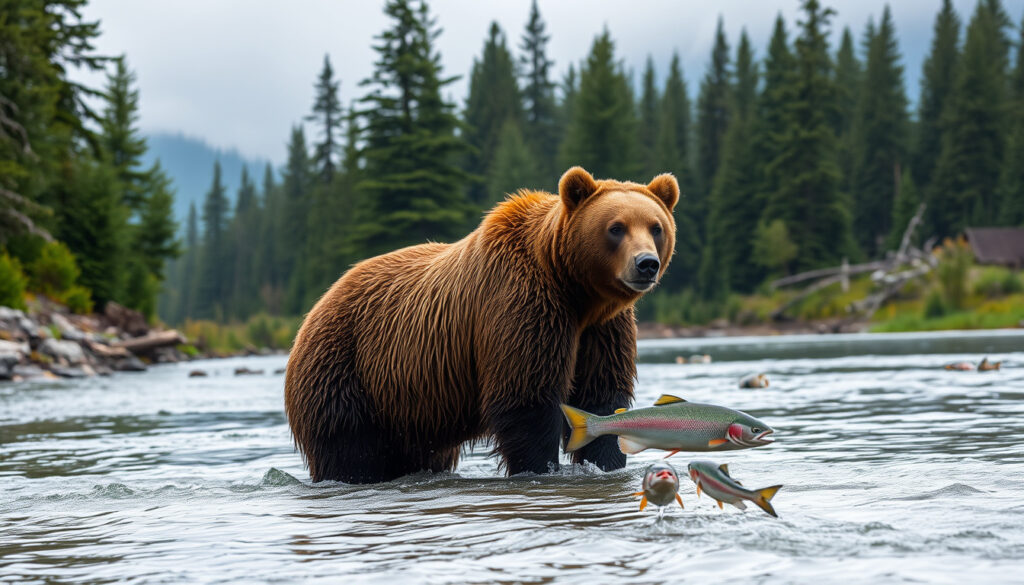
Grizzly Bear: Complete Facts, Behavior, Aggression, and Senses
Most people meet a grizzly bear long before they ever see one — in campfire stories, trailhead warnings, and videos that make you check your tent zipper twice. The real animal is Ursus arctos horibillis, a subspecies of brown bear that mostly wants nothing to do with you. Here’s what official guidance from the U.S. Fish and Wildlife Service, the National Park Service, and Parks Canada says about grizzly aggression, senses, and safety — and what to do if the distance closes to zero.
Scientific name: Ursus arctos horribilis · Average weight (male): 400–700 lbs · Shoulder height: 3–4 feet · Top speed: 30 mph
Quick snapshot
- Grizzlies are a subspecies of brown bear, Ursus arctos (U.S. National Park Service)
- Grizzly attacks are usually defensive in nature (U.S. National Park Service)
- Official guidance: stay at least 100 yards from bears (U.S. Fish & Wildlife Service)
- Grizzly attacks are defensive, not predatory (U.S. National Park Service)
- The name “grizzly” comes from grizzled fur, not grisly behavior (USDA Forest Service)
- Grizzlies usually avoid humans unless surprised (Stanford Environmental Health & Safety)
- Grizzlies are most active at dawn and dusk (Parks Canada)
- Winter means hibernation for most grizzlies (Parks Canada)
- Food concentration drives movement: salmon runs, berry patches, and carcasses attract bears fast (Parks Canada)
- If a grizzly charges and attacks, play dead (U.S. National Park Service)
- Carry bear spray, keep it accessible, and never run from a bear (U.S. Fish & Wildlife Service)
Read those four cards as one idea: the bear is more predictable than its reputation suggests, and the unpredictability is on us — our food, our distance, our decisions.
Six numbers, one pattern: the grizzly is built for power and short bursts, not distance running — worth remembering before you think about outrunning one.
| Grizzly bear | Value |
|---|---|
| Scientific name | Ursus arctos horribilis |
| Weight | 200–700 lbs (90–320 kg) |
| Shoulder height | 3–4 feet (0.9–1.2 m) |
| Top speed | 30 mph (48 km/h) |
| Lifespan | 20–25 years in the wild |
| Diet | Omnivore — berries, fish, small mammals, carrion |
What are 10 facts about grizzly bears?
Some grizzly “knowledge” is actually movie plotting with fur. The ten facts below separate what the agencies tell you from what Hollywood tells you.
- Grizzlies are a subspecies of brown bear, not a separate species.
- A large male can weigh up to 700 pounds.
- Shoulder height runs three to four feet.
- The shoulder hump is a signature grizzly trait — a block of muscle built for digging.
- Front claws are two to four inches long.
- They can sprint up to 30 mph.
- Wild grizzlies typically live 20 to 25 years.
- Grizzly attacks are usually defensive, not predatory.
- Grizzlies are most active at dawn and dusk.
- What you call one depends on where you see it: coastal Alaska bears are usually called brown bears; inland bears are called grizzlies.
That last point matters more than it looks. The National Park Service’s identification guide notes that coastal Alaska bears are commonly called brown bears, while inland bears with limited access to marine food sources are smaller and called grizzlies (U.S. National Park Service). Same species, different menu, different size.
Grizzly bear weight and height
- Full weight range: 200–700 lbs (90–320 kg)
- Large males: 400–700 lbs
- Shoulder height: 3–4 feet (0.9–1.2 m)
The range is wide because the species is adaptable. A coastal bear with steady salmon runs grows heavy; an inland bear living on roots, berries, and small mammals stays leaner. Same species, different dimensions.
Grizzly bear standing up
When a grizzly rises onto its hind legs, it is usually gathering information — a better view, a better scent — not preparing to charge.
The posture to worry about is different: huffing, jaw-snapping, slapping the ground, or lunging forward. Those are the signals that a bear is close to acting, and they all need the same response — more distance, calm movement, no running.
Grizzly bear size
- At the top of the range, a 700-pound grizzly outweighs four average adults.
- A three- to four-foot shoulder height puts the animal’s back at waist-to-chest height for a person.
- On its hind legs, a large grizzly rises well above eye level.
Size sets the terms of any encounter. A bear that outweighs you by hundreds of pounds does not need to win a fight — it only needs to decide there won’t be one.
Which bear is more aggressive, a grizzly or a black bear?
The short answer: grizzlies are generally the more aggressive species toward humans — quicker to stand their ground, quicker to treat surprise as a threat. Black bears are wired differently and more likely to retreat.
- Startled at close range
- Getting between a mother and her cubs
- Approaching a bear defending a kill
Those three scenarios come from Stanford’s Large Predator Fact Sheet, which lays out the triggers for grizzly or brown bear attacks (Stanford Environmental Health & Safety). None of them involve hunting people. The aggression is a boundary reaction, not a food search.
- Huffing
- Snapping jaws
- Slaping the ground
- Lunging and bluff charging
What is the most aggressive bear in the world?
- Polar bear — the species most likely to treat a human as prey
- Grizzly / brown bear — the most likely to react defensively to a surprise encounter
- Black bear — rarely attacks, and usually retreats first
By most measures, the most aggressive bear species is the polar bear — the one most likely to see a human as food rather than as an intruder to avoid. A grizzly attack is usually a boundary dispute. Both end badly, but they start differently.
Which bear is most likely to eat you?
A bear that attacks defensively wants you gone. A bear that attacks for food wants you dead. Polar bears are the species most associated with predatory attacks; grizzlies, in most situations, are defending space.
That distinction drives the survival advice. For a grizzly or brown bear, official guidance is to play dead and protect your neck, and to fight back only if the attack continues. For a black bear, the standard guidance is the opposite — fight back hard. The species matters because the motivation matters.
The trade-off: a grizzly that attacks is usually scared, not hungry. That means your behavior — where you stand, how you move, how much space you give — matters more than your fighting ability.
Why are bears called grizzly?
The name has nothing to do with being grumpy. It describes what the fur looks like in sunlight.
- “Grizzly” comes from “grizzled” — streaked with gray or silver.
- Mature bears often carry silver-tipped guard hairs across the shoulders and back, a frosted effect that gave early naturalists the name.
- The scientific name, Ursus arctos horribilis, means “horrible bear” (USDA Forest Service).
People also mix up “grizzly” with “grisly,” meaning gruesome — a convenient mix-up for movie posters, but it wasn’t the original point. The bear got a name that described the frosted tips on its back, and the nickname outgrew the description. The irony: a name meant to describe silver-tipped fur now works as a warning label, and both readings fit.
What is a grizzly bear’s worst enemy?
The list of animals that can genuinely threaten a grizzly is almost empty. Almost.
- Humans — the only predator that kills grizzlies consistently, through hunting, habitat loss, and vehicles.
- Wolf packs — the one natural adversary that can pressure a bear, especially when the pack is large enough to press an attack.
Beyond humans, the wolf is the most commonly cited natural foe. A pack can force a grizzly off a kill, and the bear usually leaves — not because it is weak, but because a fight over one meal can cost more than the meal is worth.
What is a grizzly bear’s weakness?
- Lone bears versus packs: wolves win by numbers, not by size.
- Cubs: the most vulnerable stage of a grizzly’s life.
- Energy: grizzlies need massive calories, and a bad food year is a real threat.
None of these make the grizzly fragile. They just explain why a bear that can crush a moose will still walk away from a fight it doesn’t need.
What is bear’s biggest fear?
The one thing a grizzly most wants to avoid is a surprise — the same thing every hiker wants to avoid. That’s why making noise is official advice, not folklore.
Parks Canada advises people to make noise in bear country, especially near streams, dense vegetation, and berry patches, and on windy days with low visibility (Parks Canada). The goal isn’t to frighten the bear. It’s to remove the surprise from the equation.
Are grizzlies afraid of dogs?
- A barking dog can deter a bear — sometimes.
- A dog can also provoke a chase and bring the bear straight back to you.
Most wildlife agencies treat dogs as an unpredictable variable in bear country. A confident dog can move a bear along; a scared dog can turn a quiet moment into a sprint — in both directions. The trade-off: the grizzly’s raw power makes it fearless, but its energy needs make it cautious. The bear that avoids a fight isn’t scared — it’s doing the math, and you should too.
What smell do grizzlies hate?
The question sounds practical. The answer is less useful than people hope.
- The lore: strong smells like ammonia, pine, and peppermint send grizzlies running.
- The reality: bears are curious about strong scents, and no household smell works as a reliable deterrent.
What does work is bear spray — a concentrated capsaicin cloud that hits a bear’s eyes, nose, and lungs hard enough to break off a charge. Wildlife agencies list it as essential gear in grizzly country, not optional equipment.
You can’t win a smell contest with a grizzly, and no pine oil or peppermint will reliably mask you. Bear spray is the tool the agencies recommend; everything else is perfume with a plan.
The takeaway: bear spray is the only proven deterrent; other smells are unreliable.
How far can grizzly bears smell you?
- Widely cited range: up to 20 miles.
- Wind changes everything: downwind, a bear may not catch your scent until you are close.
- Food smells travel farther than human scent — which is why food storage rules are strict.
The practical read: in grizzly country, wind and food are the first two things to check. Cook away from your tent, store food properly, and treat your own scent as something a bear can read from a distance it cannot see. Why this matters: the grizzly’s nose is the reason distance is the only real currency. If you can see the bear, it almost certainly knew you were there first.
Are there friendly grizzly bears?
No. A calm bear is not the same thing as a friendly bear.
- Curious: ears up, circling downwind, sniffing — a bear investigating, not approaching for affection.
- Habituated: no longer flees from people, watches them, keeps going about its business.
- Food-conditioned: actively seeks people because people have led to meals.
Habituation explains why a bear near a trailhead can look bored instead of alert. It has lost its fear of people, and losing that fear is what makes it unpredictable.
The U.S. Fish and Wildlife Service is direct about the human side: never feed a bear or make food accessible. A bear that learns people mean food stops keeping its distance.
A habituated bear is not a tame bear. It is a wild animal that has stopped reading people as a reason to leave — and that is exactly when the trouble starts.
The friendliest-looking bear in a park is often the most dangerous one, to itself and to you. Keep the interaction at “a bear you watched from a distance,” not “a bear that watched you back.”
Grizzly vs. Black Bear: Side by Side
One table, one pattern: the two species read threats differently, and the official response guidance follows that difference.
| Trait | Grizzly bear | Black bear |
|---|---|---|
| Shoulder profile | Large muscle hump | Smooth, no hump |
| Front claws | 2–4 inches, built for digging | Shorter and more curved, built for climbing |
| Typical reaction when surprised | Bluff charges and defensive displays | Usually flees |
| Attack motivation | Usually defensive | Usually defensive; predatory attacks are rare |
| Response if attacked | Play dead, protect the neck | Fight back |
The catch: the table makes the difference look obvious, but a young grizzly and a big black bear can be hard to tell apart at 50 yards. The hump and the claw line are the details that settle it.
Grizzly Bear Size at a Glance
Ten measurements, one read: every number here is a reason to keep distance, not a reason to test the animal.
| Spec | Value |
|---|---|
| Common name | Grizzly bear (inland) / brown bear (coastal) |
| Species | Ursus arctos (brown bear) |
| Subspecies | Ursus arctos horribilis |
| Adult weight | 200–700 lbs (90–320 kg) |
| Shoulder height | 3–4 feet (0.9–1.2 m) |
| Top speed | 30 mph (48 km/h) |
| Lifespan | 20–25 years in the wild |
| Diet | Omnivore — berries, fish, small mammals, carrion |
| Peak activity | Dawn and dusk |
| Winter behavior | Hibernation |
The pattern: grizzlies are heavy but fast, big but not slow. Use the table for perspective, and use the distance for survival.
Clarity Check: What’s Confirmed, What’s Not
After sorting through agency guidance, field fact sheets, and trail lore, the split looks like this.
Confirmed
- Grizzly attacks are usually defensive, not predatory.
- Staying at least 100 yards away is the official recommendation.
- If a grizzly attacks, play dead and protect your head and neck.
- Bear spray is recommended equipment in grizzly country.
Still unclear
- Whether grizzlies are more dangerous than polar bears in every scenario.
- The exact size of the remaining wild grizzly population.
- Whether household scents like ammonia, pine, or peppermint reliably deter a determined bear.
- The precise distance a grizzly can detect a human scent — widely repeated, hard to measure.
The pattern: the safety guidance is settled, but the animal’s mind isn’t. Treat the confirmed list as rules and the unclear list as reasons to stay humble.
What the Experts Say
The agencies that run bear country give the same advice in three different voices.
If a grizzly or brown bear charges and attacks you, play dead. Leave your pack on, lie flat on your stomach, and protect your head and neck with your hands and arms. If the attack continues, fight back vigorously.
— U.S. National Park Service, bear safety guidance
Bears are more active at dawn and dusk, so travel during daylight and stay on marked trails. Make noise in bear country, especially near streams, dense vegetation, and berry patches, and on windy days with low visibility. If a bear makes contact, fall to the ground and play dead, lying on your stomach with your hands behind your neck.
— Parks Canada, bear safety guidance
Bears may attack if they are startled, if a person gets between a mother and her cubs, or if the bear is defending a kill. Watch for huffing, snapping jaws, slapping the ground, lunging, and charging — these are the defensive behaviors that precede an attack.
— Stanford Environmental Health & Safety, Large Predator Fact Sheet
What this means: three agencies, three geographies, one identical message — don’t surprise a bear, and if it comes anyway, play dead and protect the neck.
Grizzly bears hold up better under facts than under folklore. They are powerful, fast, and capable of killing a person, and every official guidance sheet treats them with the same respect — because the attack that ends badly is almost always the one that should have been avoided at 100 yards. For anyone walking in grizzly country, the choice is practical, not philosophical: travel in groups, make noise, keep food locked down, and carry bear spray you actually know how to use. The cost of guessing wrong is measured in seconds, not statistics.
fws.gov, www2.gov.bc.ca, nps.gov, fs.usda.gov, en.wikipedia.org, fws.gov, nps.gov
Frequently asked questions
What do grizzly bears eat?
Grizzlies are omnivores. Their diet swings with the season: berries, roots, fish — especially salmon — small mammals, and carrion. A bear’s menu depends heavily on where it lives and what the season is offering.
Where do grizzly bears live?
Grizzlies live in North America — Alaska, western Canada, and the northern Rockies of the United States. Coastal Alaska bears are often called brown bears, while inland populations are called grizzlies.
How fast can a grizzly bear run?
Up to 30 mph in short bursts — faster than most humans can sprint.
How long do grizzly bears live?
Roughly 20 to 25 years in the wild.
Are grizzly bears endangered?
In the lower 48 states, grizzlies are listed as threatened under the Endangered Species Act. Populations in Alaska and Canada are generally more stable.
How can I avoid a grizzly bear attack?
Stay at least 100 yards away, hike in groups, make noise, carry bear spray, store food properly, and never run from a bear.
What is the difference between a grizzly and a brown bear?
Mostly geography. Coastal Alaska bears eat salmon, grow larger, and are usually called brown bears; inland bears live on a leaner menu, stay smaller, and are called grizzlies. They are the same species.
More related posts
 Jason Bateman: Biography, Sobriety, Family & Net Worth
 Argos Ninja Air Fryer: Best Models, Reviews & Deals
 Matthew Garber Cause of Death: What Happened to the Child Actor
 America Ferrera: Ethnicity, Kids, Net Worth, and Career Journey
 Varun Dhawan: Age, Wife, Movies, Family, Religion Facts
 Peter Parker: Complete Guide to Spider-Man’s Age and Death
 What Are the 10 Commandments – Full KJV List, Catholic Version, Bible Verses
 Mila Kunis: Age, Height, Marriage, Children, Net Worth
