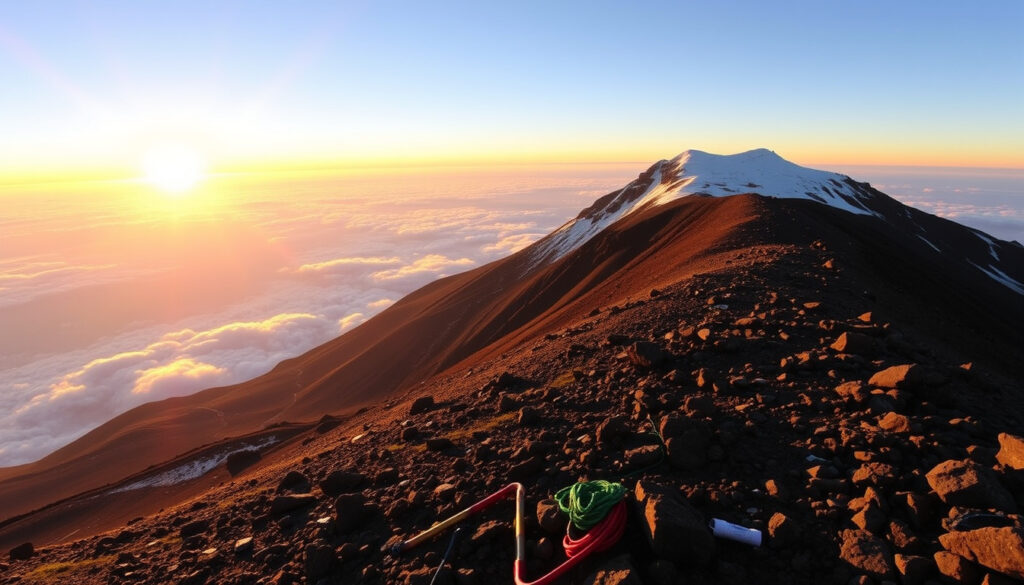
Kilimanjaro Peak: Climbing Guide, Cost, Difficulty & Tips
Kilimanjaro’s summit doesn’t require technical climbing skills, but altitude makes it a serious endurance test for beginners. What makes it so magnetic isn’t just the summit—it’s the fact that a determined beginner with the right preparation can actually reach it.
Height: 5,895 m (19,341 ft) ·
First ascent: 1889 ·
Overall success rate: ~65% ·
Annual deaths: 10-20 estimated
Quick Snapshot
- Uhuru Peak is the highest point at 5,895 m (Kilimanjaro Local Trips)
- First ascent in 1889 by Hans Meyer and Ludwig Purtscheller (Tanzania Tourism)
- No technical climbing required (Much Better Adventures)
- Exact annual death count varies due to underreporting (Much Better Adventures)
- Success rates differ by route and operator (Tanzania Tourism)
- Best climbing seasons: June–October and January–March (Tanzania Tourism)
- Routes range from 5–9 days, with longer routes showing higher success rates (Much Better Adventures)
- Expect continued growth in climber numbers, especially post-pandemic (Tanzania Tourism)
Six objective facts about Kilimanjaro, one pattern: the mountain rewards preparation but punishes haste. The stats that matter most for planning—height, routes, and difficulty—all point to the same truth.
| Attribute | Value |
|---|---|
| Height | 5,895 m (19,341 ft) |
| Location | Tanzania, near Kenyan border |
| First ascent | 1889 – Hans Meyer and Ludwig Purtscheller |
| Summit name | Uhuru Peak |
| Overall success rate | Approximately 65% |
| Annual deaths | Estimated 10–20 per year |
What is the peak of Kilimanjaro called?
The highest point on Kilimanjaro is Uhuru Peak, a name that means “freedom” in Swahili. It sits on the mountain’s Kibo volcanic cone, one of three distinct volcanic centers that formed the massif.
Uhuru Peak
- Uhuru Peak reaches 5,895 m (19,341 ft) above sea level (Kilimanjaro Local Trips)
- The summit is a broad, snow-covered plateau rather than a sharp point
- It’s one of the “Seven Summits”—the highest peaks on each continent
Height and location
- Kilimanjaro is a free-standing volcano in Tanzania, not part of a mountain range (Tanzania Tourism)
- The mountain spans about 80 km east-west and 65 km north-south
- It’s located just 330 km south of the equator
For beginners, the peak’s most important trait isn’t its name—it’s the fact that reaching it doesn’t require technical climbing gear, only grit and acclimatization.
The implication: the peak’s name reflects the reward of freedom that comes with successful acclimatization.
Can a beginner climb Kilimanjaro?
Yes, but “beginner” needs a definition. Kilimanjaro doesn’t demand rock-climbing skills, but it does require physical fitness, mental stamina, and a healthy respect for altitude.
Physical preparation
- Most operators recommend 2–3 months of training, including 3–4 days of aerobic exercise weekly (Much Better Adventures)
- Hiking with a loaded daypack on hills builds the specific muscles you’ll need
- Success rates for first-timers hover around 65% overall, but drop significantly on shorter routes (Tanzania Tourism)
Choosing the right route
- Marangu is the easiest route and the only one with hut accommodations, but also the busiest (Much Better Adventures)
- Machame offers better views and scenery, though it’s steeper (Tanzania Tourism)
- Lemosho is longer and quieter, giving your body more time to adjust (Tanzania Tourism)
Guided vs independent
- Independent climbing is technically possible but strongly discouraged; the park requires a certified guide (Tanzania Tourism)
- Guided treks include porters, cooks, and emergency support
- Cost typically includes park fees, guiding, and rescue services
Beginner-friendly doesn’t mean easy. The success-rate gap between 5-day and 8-day itineraries can be as wide as 30%, which is why your route choice matters more than your training.
The implication for first-timers is clear: pick a route with more days (Lemosho or Rongai) even if it costs more, because the extra time at altitude is what gets you to the top.
“With proper acclimatization and a good guide, most motivated beginners can reach the summit.”
How difficult is the Kilimanjaro climb?
Kilimanjaro is a trek, not a technical climb. The difficulty comes from altitude, not terrain. Most of the climb follows well-trodden paths with switchbacks, so it’s more endurance than skill.
Altitude and acclimatization
- Altitude sickness is the main obstacle; over half of climbers experience some symptoms (Tanzania Tourism)
- The “pole-pole” method—Swahili for slowly—is the standard approach: walk slowly, drink water, sleep low
- Routes that follow a “climb high, sleep low” pattern have notably higher success rates (Much Better Adventures)
Route difficulty comparison
- Marangu (5–6 days, 72 km) is the easiest but lacks proper acclimatization (Tanzania Tourism)
- Machame (6–7 days, 49 km) offers a balance of challenge and scenery (Tanzania Tourism)
- Lemosho (7–8 days, 56 km) has the best success-to-difficulty ratio (Tanzania Tourism)
- Rongai (6–7 days, 65 km) is quieter and starts from the north (Tanzania Tourism)
Duration of climbs
- The shortest route, Umbwe (48 km), takes 5–6 days but is brutally steep and has the lowest success rate (Much Better Adventures)
- Longer routes like Lemosho (7–8 days, 56 km) give your body more time to adapt (Tanzania Tourism)
- The Northern Circuit is the longest at 9 days and 90 km, with very low traffic (Tanzania Tourism)
What this means: if you want the summit, give yourself the gift of time. The mountain can’t be rushed without consequences.
“We recommend at least a six-day route for proper altitude adaptation.”
Do you need oxygen to climb Kilimanjaro?
Most climbers do not use supplemental oxygen on Kilimanjaro. Unlike Everest or Aconcagua, which are above 8,000 meters, Kilimanjaro’s summit sits below that threshold.
Altitude sickness risks
- Acute Mountain Sickness (AMS) affects up to 50% of climbers at minimum (Tanzania Tourism)
- Symptoms include headache, fatigue, and nausea
- Severe cases can progress to life-threatening HAPE or HACE
When oxygen is used
- Some operators offer supplemental oxygen on summit night as a safety net
- Most trekkers rely on the “pole-pole” method and medication like acetazolamide
- The guideline is “climb high, sleep low”—the summit push is the only time you’re above your sleeping altitude
Acclimatization strategies
- Routes with built-in acclimatization days (like Lemosho or Northern Circuit) have higher success rates (Tanzania Tourism)
- Hydration is key—aim for 3-5 liters per day
- Sharp descent to lower altitude for sleep reduces AMS risk
Oxygen is a tool, not a magic bullet. Skipping acclimatization and using O2 can actually increase your risk of missing the summit, because you feel fine but your body hasn’t built the necessary red blood cells.
The strategic takeaway for climbers: treat Kilimanjaro like a high-altitude trek, not a summit assault. Your body needs time to produce erythropoietin (EPO) and acclimatize; no amount of bottled oxygen substitutes for that.
Why is Kilimanjaro so famous?
Kilimanjaro’s fame is built on contrast: it’s a snow-capped giant near the equator, visible from hundreds of kilometers away, and it’s the world’s tallest free-standing mountain.
Highest peak in Africa
- At 5,895 m, Uhuru Peak is Africa’s highest point (Tanzania Tourism)
- It’s one of the Seven Summits, a goal for peak-baggers worldwide
- Its snow cap and glaciers are iconic, though shrinking (Tanzania Tourism)
Accessibility
- It’s near trade routes, with good air access via Kilimanjaro International Airport
- The climb doesn’t require technical gear, unlike most other high peaks
- Weather, though cold, is more predictable than monsoon-driven mountains
Cultural significance
- The Chagga people living on the slopes have rich traditions around the mountain
- It’s a UNESCO World Heritage Site
- Local guides and porters—who the trekking industry depends on—have made tourism their livelihood
Kilimanjaro’s fame isn’t just about its height—it’s a source of national identity for Tanzania and a key economic engine. Your climb supports thousands of local jobs, but it also puts pressure on fragile alpine ecosystems.
The deeper pattern: Kilimanjaro became a bucket-list icon exactly because it offered almost everyone a shot at a summit, but the mountain’s accessibility is also its environmental tightrope. The park limits daily climbers to preserve the experience and the ecology.
Route Comparison Table
Seven main routes, one takeaway: the longer you climb, the better your odds—and the more you’ll pay.
| Route | Length (days) | Distance (km) | Difficulty | Success Rate |
|---|---|---|---|---|
| Marangu | 5-6 | 72 | Easiest, but busiest | ~65% |
| Machame | 6-7 | 49 | Moderate, scenic | ~75% |
| Lemosho | 7-8 | 56 | Moderate, quiet | ~80% |
| Rongai | 6-7 | 65 | Moderate, remote | ~70% |
| Northern Circuit | 9 | 90 | Hardest, fewest climbers | ~85% |
| Umbwe | 5-6 | 48 | Very hard, steep | ~50% |
The catch: the “easiest” route (Marangu) has about the same success rate as the “hardest” acclimatization route (Lemosho) when you account for days on the mountain. Short and steep (Umbwe) is statistically the riskiest bet for first-timers.
Kilimanjaro Pros & Cons
Upsides
- No technical climbing skills needed
- Seven main routes with varying difficulty
- High overall success rate (~65%) vs. other peaks
- Accessible year-round; limited weather windows
- Life-changing bucket-list achievement
Downsides
- Altitude sickness is a real risk; ~50% experience symptoms
- Cost is high: $2,000–$5,000+ depending on route and operator
- Overcrowding on some routes impacts the wilderness experience
- Glaciers are retreating, which could alter the landscape
- Deaths (10-20/year) underscore the seriousness of the climb
Related reading: Loch Lomond vs Loch Ness: Which is the Better Scottish Trip · Grizzly Bear: Complete Facts, Behavior, Aggression, and Senses
globalsummitguide.com, mountkilimanjaroclimb.com, mountkilimanjaro.guide, muchbetteradventures.com, en.wikipedia.org, kilipeak.com, kilipeak.com, olympusadventure.com, iantaylortrekking.com
Frequently Asked Questions
How many climbers died on Kilimanjaro?
Kilimanjaro is not a death trap, but it’s not a walk in the park either. Data from the Tanzania National Parks Authority indicates the annual fatality rate is in the low double digits—typically 10-20 climbers per year
How cold does it get on Kilimanjaro?
At night, temperatures at the summit can drop to around -5°C to -20°C (23°F to -4°F). Depending on the season, you’ll need a warm sleeping bag and layers for the final summit push.
Are there lions on Kilimanjaro?
No. You’ll see elephants, buffalo, and antelope, but the arid, high-altitude zone lacks the prey to sustain lions.
What animals live on Kilimanjaro?
The mountain hosts diverse wildlife, including black-and-white colobus monkeys, olive baboons, and various birds like the white-necked raven. The southern slopes receive more rain, supporting lush rainforest habitat.
Is it harder to climb, Everest or Kilimanjaro?
Everest Camp 1 sits at 6,000m, so acclimatization and oxygen matters. Kilimanjaro’s altitude is lower, but you’re still vulnerable to altitude sickness. The 5,895m altitude is comparable to Everest Base Camp, which most consider a tough trek.
How much does Kilimanjaro cost to climb?
Budget operators start around $2,200 per person, but a typical tour from a reputable outfitter costs $3,500–$5,000 per person including all fees.
What is the best time to climb Kilimanjaro?
The best times are the dry seasons: June to October and January to March.
Summary: Kilimanjaro rewards smart climbers. The mountain is forgiving (no technical skills needed) but unforgiving (altitude), making your route choice and timeline the real determinants of success. For a novice trekkers, the most reliable recipe is 7+ days, a route with built-in acclimatization, and the mental preparation that it’s the altitude, not the distance, that will test you. The peak will be there—make sure you are too.
More related posts
 Danielle Brooks Movies and TV Shows: Full Filmography
 Missy Peregrym: FBI Departure, Family, and What She’s Doing Now
 Kieran Tierney’s Celtic Return: Salary, Religion & Net Worth
 Napoleon Dynamite: Autism Debate & Cult Classic Status
 Oscar Branning: Age, Actor, and 2025 Return
 Sam Elliott Biography: Age, Wife, Health & Net Worth
 Sam and Billie Sister Act – TOWIE Fame to 2025 ITV Return
 Matthew Gray Gubler: Biography, Health & Career Facts
