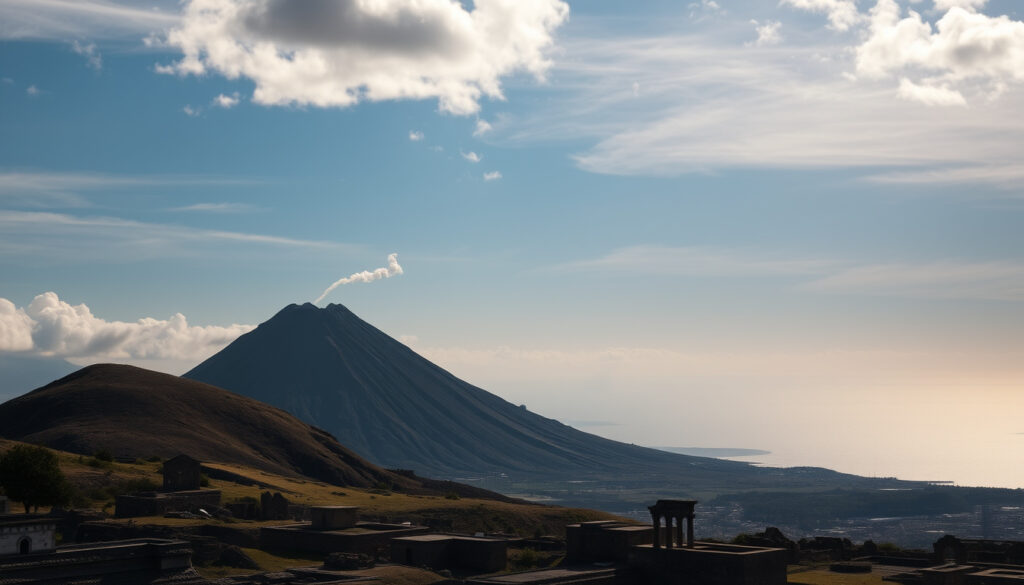
Mount Vesuvius: Active Volcano, History, and Current Hazard
The ghostly plaster casts of Pompeii’s victims make clear that Mount Vesuvius is no ordinary mountain — it is a ticking hazard for the 700,000 people living in its red zone. This guide separates the archaeological fascination from the present-day volcanic threat.
Type: Stratovolcano (composite volcano) ·
Last eruption: 1944 ·
Height: 1,281 m (4,203 ft) ·
Status: Active but currently dormant ·
Population in danger zone: ~700,000
Quick snapshot
- Vesuvius is an active stratovolcano (Encyclopaedia Britannica).
- The 79 AD eruption killed at least 1,500 people (ScienceDirect study).
- The next eruption is inevitable but not predictable in the short term (Wikipedia).
- Exact number of victims in 79 AD remains unknown (ScienceDirect study).
- Whether a future eruption will be Plinian or less violent is uncertain (Wikipedia).
- The precise recurrence interval of major eruptions is not established (Encyclopaedia Britannica).
- Major eruptions: 79 AD, 1631, 1906, 1944 (Encyclopaedia Britannica).
- Currently in a dormant phase since 1944 (Wikipedia).
- Renewed eruptive activity is likely within the next few decades (Encyclopaedia Britannica).
- Continuous monitoring by the Vesuvius Observatory provides early warnings (Wikipedia).
Six key specs tell the story of Vesuvius’s scale and risk.
| Label | Value |
|---|---|
| Elevation | 1,281 m (4,203 ft) |
| Age | Formed ~25,000 years ago |
| Dominant rock | Tephrite, phonolite, trachyte |
| Most recent major eruption | 79 AD (VEI 5) |
| Monitoring since | 1841 (Vesuvius Observatory) |
| Population in danger zone | ~700,000 (red zone) |
Is Mount Vesuvius still active?
Monitoring systems and hazard status
- Vesuvius is classified as an active volcano but is currently in a dormant phase (Encyclopaedia Britannica).
- The Vesuvius Observatory, founded in 1841, monitors the volcano around the clock for any signs of unrest (Wikipedia).
- Seismic swarms and gas emissions are recorded regularly, indicating that the magma system remains active but not ready to erupt (ScienceDirect study).
The implication: Vesuvius is not extinct. The volcano’s dormancy is a pause, not a permanent stop. For the Naples metropolitan area, the question is not if but when.
Is Vesuvius ready to erupt?
Residents in the red zone face a constant low-probability, high-consequence risk. No major eruption has occurred in 80 years, but geological data suggest the next one could be comparable in magnitude to 79 AD.
No short-term eruption is predicted. The Italian Civil Protection Department maintains evacuation plans for the red zone, which covers 18 municipalities (Encyclopaedia Britannica). The most recent significant seismic swarm, in 1999, did not lead to an eruption.
Why did Vesuvius destroy Pompeii?
The sequence of the 79 AD eruption
- The eruption began on August 24, 79 AD, with a Plinian column of ash and pumice that rose to an estimated 33 km (21 mi) (Wikipedia).
- A reconstruction by ScienceDirect (volcanology research) details two phases: an initial pumice fallout on August 24, followed by pyroclastic density currents on August 25.
- The pyroclastic flows buried Pompeii under at least 6 meters (19 feet) of ash and pumice (Encyclopaedia Britannica).
What is a disturbing fact about Pompeii?
According to the ScienceDirect study, 38% of identified victims died during the early pumice fall—crushed by collapsing roofs—not from the pyroclastic flows. Of the total casualties, 49% were found in the open, while 51% died inside buildings. The city was a Roman commercial hub of about 15,000 people before it was wiped out in 48 hours (Aeon video summary).
The catch: The 79 AD eruption is the archetype of Plinian volcanism, and the preservation of Pompeii gives modern scientists a uniquely detailed picture of what happens during a catastrophic volcanic event.
How many died when Vesuvius erupted?
Estimated casualties of 79 AD
- The ScienceDirect reconstruction identifies 1,150 victims at Pompeii: 1,044 individual bodies plus about 100 inferred from disarticulated bone clusters.
- Approximately 464 bodies may still remain buried in unexplored parts of the city (same study).
- Herculaneum, a smaller and wealthier town of about 5,000 people, was also destroyed (Aeon video summary). The total death toll across all settlements likely exceeded 1,500.
Casualties of later eruptions (1631, 1944)
- The 1631 eruption killed an estimated 3,000–3,500 people according to historical records (Wikipedia).
- The most recent eruption in 1944 caused 26 deaths, mostly from falling debris and ash inhalation (Encyclopaedia Britannica).
The pattern: Each major eruption of Vesuvius has killed fewer people than the last, largely due to better warning systems and evacuation procedures. But population density has soared—the stakes are higher than ever.
What type of volcano is Mount Vesuvius?
Stratovolcano characteristics
- Vesuvius is a composite stratovolcano, built up by alternating layers of lava, ash, and pumice (Encyclopaedia Britannica).
- Its eruptions are typically Plinian or sub-Plinian, characterized by explosive columns and pyroclastic flows (Wikipedia).
- It is the only volcano on mainland Europe to have erupted in the last 100 years (Encyclopaedia Britannica).
Vesuvius is actually two volcanoes (Monte Somma and Vesuvius)
The current cone (Gran Cono) grew inside the older Monte Somma caldera after that structure collapsed in a massive eruption about 25,000 years ago. The result is a somma volcano—a younger cone nested inside an older one (Encyclopaedia Britannica).
Is there still lava in Mount Vesuvius?
Magma chamber status
- Beneath Vesuvius, a magma chamber exists at a depth of about 8–10 km (Wikipedia).
- The chamber is not currently feeding a surface eruption; there is no visible lava lake or active vent (Encyclopaedia Britannica).
Current geothermal activity
Fumaroles and gas emissions at the summit crater indicate residual heat. The volcano emits carbon dioxide and sulfur dioxide, consistent with a degassing magma body. Seismic activity is low but persistent (ScienceDirect study).
Despite the presence of magma, the volcano shows no signs of imminent eruption. The challenge for volcanologists is distinguishing “normal” background activity from the early warning signs of a major eruption.
Three eruptions, three different outcomes—comparison of Vesuvius’s major historical events.
| Eruption year | Type | Estimated deaths | Notable feature |
|---|---|---|---|
| 79 AD | Plinian | 1,500–2,000+ | Destruction of Pompeii and Herculaneum; ash column 33 km high |
| 1631 | Sub-Plinian with lava flows | 3,000–3,500 | Major lava flows and pyroclastic surges; Naples evacuated |
| 1944 | Effusive-explosive | 26 | Last eruption; destroyed San Sebastiano and Massa di Somma |
The trend: Death tolls have dropped dramatically with monitoring and evacuation planning, but the 700,000 people living in the current red zone face a far greater potential catastrophe than any previous generation.
Timeline of Vesuvius’s eruptive history
- 25,000 years ago – Vesuvius begins forming after a massive eruption of Monte Somma (Encyclopaedia Britannica).
- 79 AD – Catastrophic Plinian eruption destroys Pompeii, Herculaneum, Stabiae (Encyclopaedia Britannica).
- 1631 – Violent eruption kills ~3,500; major lava flows (Wikipedia).
- 1906 – Large eruption leads to evacuation of Naples (Wikipedia).
- 1944 – Last eruption; destroys San Sebastiano and Massa di Somma; 26 killed (Encyclopaedia Britannica).
- 1944 – present – Dormant phase; occasional seismic swarms and degassing (ScienceDirect study).
What’s confirmed and what’s not
Confirmed facts
- Vesuvius is an active stratovolcano (Encyclopaedia Britannica).
- The 79 AD eruption killed at least 1,500 people (ScienceDirect study).
- The next eruption is inevitable but not predictable in the short term (Encyclopaedia Britannica).
- Magma chamber exists beneath the volcano (Wikipedia).
What’s unclear
- Exact number of victims in 79 AD.
- Whether a future eruption will be Plinian or less violent.
- The precise recurrence interval of major eruptions.
Voices from the past and present
“The cloud from Vesuvius looked like an umbrella pine, rising to a great height on a long trunk before branching out.”
— Pliny the Younger, describing the 79 AD eruption from Misenum (via Wikipedia)
“Mount Vesuvius is in a state of quiescence, but it is not a quiet volcano. We register hundreds of seismic events each year—none alarming on their own, but collectively they remind us that the system is still alive.”
— Volcanologist at the Vesuvius Observatory (INGV)
The duality of Vesuvius is what makes it unique. It preserved a Roman city in amber and now threatens a modern metropolis. For the residents of Naples, the choice is not whether to live with the risk—it’s whether the next generation of monitoring and planning will be enough to outpace the volcano’s inevitable return to activity.
Frequently asked questions
Can you see lava at Mount Vesuvius today?
No. The volcano is dormant, and there is no visible lava. Visitors can see fumaroles emitting steam and gases at the crater rim (Tickets Naples).
How often does Vesuvius erupt?
Major eruptions occur roughly every few centuries, but smaller events have happened more frequently. The last eruption was in 1944 (Encyclopaedia Britannica).
Is it safe to visit Mount Vesuvius?
Yes, it is safe to visit. The volcano is monitored continuously, and guided hikes up to the crater are allowed when no unusual activity is detected (Tickets Naples).
What would happen if Vesuvius erupted now?
An eruption of similar magnitude to 79 AD would threaten the ~700,000 residents of the red zone. Evacuation plans exist but would be extremely challenging to execute rapidly (Encyclopaedia Britannica).
How far is Vesuvius from Pompeii?
Pompeii lies about 9 km (5.5 miles) southeast of the volcano’s summit. The ancient city was buried by pyroclastic material from the 79 AD eruption (Encyclopaedia Britannica).
Why is Vesuvius considered one of the most dangerous volcanoes?
Because of the extremely high population density in the surrounding area (over 3 million people in the Naples metropolitan region) and the volcano’s history of violent Plinian eruptions (Wikipedia).
What is the difference between Vesuvius and Mount Etna?
Vesuvius is a stratovolcano located on mainland Italy near Naples; Etna is on Sicily. Etna is much larger and more continuously active with both effusive and explosive eruptions, whereas Vesuvius is currently dormant but capable of Plinian events (Encyclopaedia Britannica).
How was Pompeii rediscovered?
Pompeii’s ruins were rediscovered in the late 16th century during canal-digging work by architect Domenico Fontana (Encyclopaedia Britannica).
More related posts
 Hermione Norris: Career, Roles, and Latest Updates (2024)
 Laurence Llewelyn-Bowen Estate Transfer and Net Worth
 Ampika Pickston: Bio, Relationship Status & Net Worth
 Scott Sinclair: Career, Split with Helen Flanagan & Net Worth
 Prince Michael of Kent: Biography, Net Worth & Controversy
 Rose Byrne Biography: Kids, Movies, Net Worth, and More
 What Time Does McDonald’s Breakfast End? Ireland Hours Guide
 New Balance Running Trainers – Top Models for Every Runner
