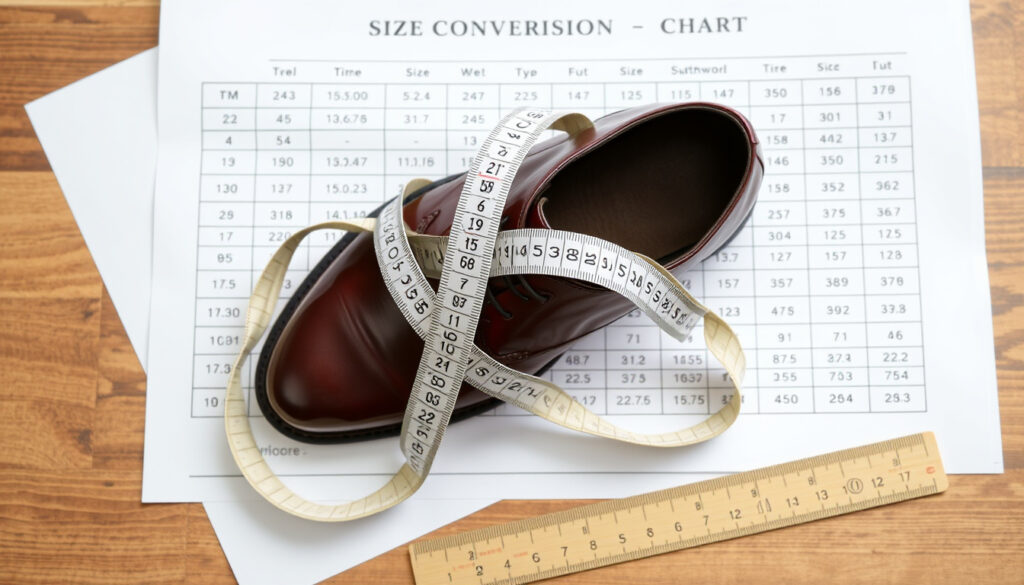
EU Shoe Size to UK: Complete Conversion & Size Charts
Few things are as frustrating as ordering shoes online and discovering they don’t fit. If you’ve ever stared at a European size 42 and wondered what that means in UK sizing, this guide cuts through the confusion with concrete charts and explains why the numbers never line up perfectly.
UK size 6 (women): EU 39 · UK size 7 (women): EU 40 · UK size 8 (men): EU 42 · EU 40 foot length: approx 25 cm · EU 43 foot length: approx 27 cm
Quick snapshot
- EU shoe size increases by 2/3 cm per whole size (Calculator.net shoe-size conversion tool)
- UK shoe size increases by 1/3 inch per half size (Calculator.net shoe-size conversion tool)
- Women’s UK 6 typically equals EU 39 (Clarks Women’s Size Guide)
- Men’s UK 8 typically equals EU 42 (Clarks Men’s Size Guide)
- Exact conversion for half sizes (e.g. UK 7.5) varies by brand (Morgans Shoes size charts)
- Brand-specific deviations (Nike vs Adidas vs Clarks) can shift half a size (Morgans Shoes size charts)
- Children’s size conversions across different age groups lack a single standard (Clarks Kids’ Size Guide)
- No major changes to EU or UK sizing standards in recent years — but no authoritative source confirms this (Calculator.net shoe-size conversion tool)
- Retailers update charts periodically — always check the brand’s latest guide (Famous Footwear conversion charts)
- No major changes to EU or UK sizing standards in recent years (Calculator.net shoe-size conversion tool)
- Retailers update charts periodically — always check the brand’s latest guide (Famous Footwear conversion charts)
- Measure your foot in cm, then compare directly to EU and UK charts (Zappos conversion guide)
- Try shoes with the socks you plan to wear — thickness affects fit (Calculator.net shoe-size conversion tool)
Key facts at a glance
Here are the key conversions at a glance.
| Label | Value |
|---|---|
| UK size 6 (women) = | EU 39 |
| UK size 8 (men) = | EU 42 |
| EU 40 foot length | 25.1 cm |
| EU 43 foot length | 27.0 cm |
| UK size 9 (men) = | EU 43 |
| UK size 10 (men) = | EU 44 |
What is EU shoe size in the UK?
European shoe sizes follow the Paris point system: each full size corresponds to 2/3 cm of foot length. UK sizes, on the other hand, are based on the barleycorn — one third of an inch per half size. This difference in base measurement is why a direct one-to-one conversion doesn’t exist. Instead, retailers and brands publish approximation charts that group sizes into ranges.
- EU sizes increase by 2/3 cm per whole size
- UK sizes increase by 1/3 inch (approx 0.85 cm) per half size
- Women’s UK 6 generally maps to EU 39 (Clarks Women’s Size Guide)
- Men’s UK 8 generally maps to EU 42 (Clarks Men’s Size Guide)
EU to UK conversion formula
While no universal formula exists, a rough approximation can be derived from foot length in centimetres. The Calculator.net shoe-size conversion tool (based on international measurement formulas) gives the general principle: US and Canada women’s sizes ≈ 3L – 21 (L in inches), while men’s sizes ≈ 3L – 22. UK sizes are then typically one size smaller than US men’s sizes and two sizes smaller than US women’s sizes. This layered logic is why a simple EU number to UK number table can only ever be a guide.
Difference between EU and UK sizing systems
The EU system (Mondopoint) measures foot length in millimetres and is linear. The UK system is historical, based on the barleycorn (1/3 inch) and a starting point of size 0 (3.66 inches for children). Because the increments are different — 0.67 cm for EU vs 0.85 cm for UK per full size — the alignment shifts as sizes go up. This is why a UK 6 (women’s) is EU 39, but UK 7 (women’s) jumps to EU 40, while men’s UK 9 lands at EU 43 — the gap widens at larger sizes.
Is UK size 9 a 43 or 44?
For men, a UK size 9 almost always corresponds to EU 43, not 44. The confusion typically arises because EU 44 fits a UK 10 foot. Let’s break it down with specific brand evidence.
Men’s UK size 9 conversion
- Clarks Men’s Size Guide lists UK 9 as EU 43
- Famous Footwear conversion charts show men’s UK 9 maps to EU 43
- A foot length of approx 27 cm matches both UK 9 and EU 43
Why confusion between 43 and 44
The uncertainty stems from half-size jumps and brand-specific last shapes. A shoe that runs small — for instance, some Nike models — might feel tight in EU 43, pushing someone to EU 44. But the measurement standard says 43 fits a 27 cm foot, which is exactly UK 9. The Grivet Outdoors size chart confirms that EU 43 is the correct pairing, though it also notes that a US men’s 10 (UK 9) can span EU 42.5–43.5 depending on brand.
The pattern: when in doubt, measure your foot length in cm and match it to the EU scale — that removes the brand-to-brand noise.
Is EU 39 a UK size 6?
For women, yes — EU 39 is generally the same as UK size 6. Most retailers’ charts agree on this pairing, but there are nuances worth noting.
Women’s EU 39 to UK conversion
- Clarks women’s size guide: UK 6 = EU 39
- Zappos conversion guide shows women’s UK 6 = EU 39
- Foot length for EU 39 is approximately 24.5 cm
EU 39 vs UK 6.5
Some brands make a UK 6.5, which usually falls between EU 39 and 40. The Laughing Hens conversion table suggests that UK 6.5 is closest to EU 39.5, but since the EU scale rarely includes half sizes, a 6.5 wearer may need to try both 39 and 40. The ShoeCity chart confirms that women’s size 7 maps to EU 38, while size 8 maps to EU 39, showing the variability.
The takeaway: if you’re a UK 6.5, treat EU 39 as your baseline but expect to experiment.
Do socks affect your shoe size?
Yes — but only indirectly. Socks don’t change your foot’s measurement, but they can alter how a shoe fits, which might lead you to choose a different size.
How sock thickness affects fit
- Thick winter socks can require going up half a size or choosing a wider shoe
- Thin dress socks barely change the fit
- Always try on shoes with the sock type you plan to wear most often
Choosing the right sock for accurate sizing
For the most reliable conversion, measure your foot while wearing the socks you intend to use with the new shoes. The Calculator.net guide recommends taking measurements in the afternoon when feet are slightly swollen, and doing so without socks first, then adding 0.5–1 cm for sock allowance. This way your EU-to-UK conversion will account for the extra layer.
The trade-off: going up half a size for thick socks is safer than squeezing into your normal size. A too-tight shoe causes more discomfort than a slightly roomy one.
Is UK size 7 a 40 or 41?
This depends whether the shoe is for men or women. UK size 7 has different EU equivalents across genders.
UK size 7 for men and women
- Women’s UK 7: EU 40 (confirmed by Clarks and Famous Footwear)
- Men’s UK 7: EU 40.5 to 41 — brands like Clarks map to EU 40.5, while others use EU 41
EU 40 vs 41 for UK 7
The Grivet Outdoors chart lists men’s UK 7 as EU 40.5, but a US men’s size (which is one larger) can be EU 41. The inconsistency arises because UK 7 sits near the break point between two EU sizes. Your best bet is to check the brand’s chart — Morgans Shoes publishes separate brand-specific conversions for Clarks and Umi, showing that even within the same retailer, mapping can differ.
The catch: if you’re a UK 7 man, you’re in a grey zone. Measure your foot length; if it’s close to 25 cm, choose EU 40.5; if closer to 25.5 cm, go with EU 41.
Comparison table: UK, EU, and US sizing side by side
The variations across categories matter most for cross-border shopping. Here’s a snapshot of how the three major systems align for typical sizes.
| UK Size | EU Size (Women’s) | EU Size (Men’s) | US Women’s | US Men’s | Foot Length (cm) |
|---|---|---|---|---|---|
| 3 (W) | 36 | — | 5.5 | — | 22.5 |
| 4 (W) | 37 | — | 6.5 | — | 23.2 |
| 5 (W) | 38 | — | 7.5 | — | 24.1 |
| 6 (W) | 39 | — | 8.5 | — | 24.8 |
| 7 (W) | 40 | — | 9.5 | — | 25.4 |
| 8 (W) | 42 | — | 10.5 | — | 26.0 |
| 6 (M) | — | 39.5 | — | 7 | 25.1 |
| 7 (M) | — | 40.5–41 | — | 8 | 25.9 |
| 8 (M) | — | 42 | — | 9 | 26.7 |
| 9 (M) | — | 43 | — | 10 | 27.3 |
| 10 (M) | — | 44 | — | 11 | 28.0 |
| 11 (M) | — | 45 | — | 12 | 28.6 |
The implication: always cross-reference your foot length with the brand’s own chart, because the numbers above are averages, not guarantees.
Specification table: foot length to EU and UK sizes
Knowing your exact foot length in centimetres is the most reliable way to convert between EU and UK systems, because it sidesteps brand-specific tables.
| Foot length (cm) | EU size | UK size (women’s) | UK size (men’s) |
|---|---|---|---|
| 22.5 | 36 | 3 | — |
| 23.2 | 37 | 4 | — |
| 24.1 | 38 | 5 | — |
| 24.8 | 39 | 6 | — |
| 25.4 | 40 | 7 | — |
| 26.0 | 41 | 8 | — |
| 25.1 | 39.5 | — | 6 |
| 25.9 | 40.5–41 | — | 7 |
| 26.7 | 42 | — | 8 |
| 27.3 | 43 | — | 9 |
| 28.0 | 44 | — | 10 |
| 28.6 | 45 | — | 11 |
The pattern: once you know your foot length, the EU column is your anchor — the UK size follows from that row.
How to measure your feet and find the right size
A few minutes with a ruler can save you hours of returns. Follow these steps to get an accurate measurement, then use the tables above for conversion.
- Place a sheet of paper on a hard floor against a wall.
- Stand with your heel touching the wall and your weight evenly distributed.
- Mark the longest toe on the paper.
- Measure the distance from the edge of the paper (where the wall was) to the mark — that’s your foot length in cm.
- Repeat for the other foot; use the larger measurement.
- Add 0.5–1 cm for movement and sock allowance, then match to the EU column in the spec table.
- Find the corresponding UK size from the same row.
If you’re between sizes, the Zappos conversion guide recommends going up half a size for a comfortable fit. For children, Clarks Kids’ Size Guide uses a separate scale — never directly apply adult conversions to kids’ shoes.
Clarity: what’s confirmed and what’s still uncertain
Based on the available data from major retailers and conversion tools, here’s the current state of knowledge.
Confirmed facts
- EU sizes increase by 2/3 cm per whole size
- UK sizes increase by 1/3 inch per half size
- Women’s UK 6 typically equals EU 39 (Clarks Women’s Size Guide)
- Men’s UK 8 typically equals EU 42 (Clarks Men’s Size Guide)
- UK size 9 (men) = EU 43 (Famous Footwear conversion charts)
- Women’s UK 7 = EU 40 (multiple retailers agree)
What’s unclear
- Exact conversion for half sizes (e.g. UK 7.5) — may be EU 40.5 or 41
- Brand-specific deviations: Nike vs Adidas vs Clarks can shift half a size
- Children’s size conversions across different age groups — no single standard
- Whether a “US men’s” size label on a European shoe follows the same conversion logic
The implication: when in doubt, measure your foot length — it cuts through all the brand noise.
Quotes from the experts
Contrary to common understanding, EU sizes do not translate directly to UK sizes. Typically they jump around 5/6 of a UK size for every EU size.
US women’s shoe sizes can be approximated by size ≈ 3L − 21, where L is foot length in inches. This formula-based approach explains why a direct EU-UK table is always approximate.
— Calculator.net shoe-size conversion tool (mathematical sizing reference)
The pattern: both experts agree that conversion is approximate — foot length is the only reliable anchor.
Brands like Nike use slightly different lasts, meaning a EU 43 in one brand can feel as tight as a EU 42.5 in another. The best conversion is the one that accounts for the specific shoe’s construction — always check the brand’s own chart before buying.
A half-size up in UK (0.85 cm) isn’t the same as a half-size up in EU (0.33 cm). Going up one EU size is a smaller jump than going up one UK size. So if you’re between EU sizes, you can often stay in your UK size; but if you’re between UK sizes, try the next EU whole size.
For anyone shopping across borders, the safest play is to measure your foot length in centimetres, add 0.5–1 cm for wiggle room, and match to the EU chart from a brand you trust. For UK shoppers buying from European retailers: women, a UK 6 is EU 39; men, a UK 8 is EU 42, and UK 9 is EU 43. The choice between 40 and 41 for UK 7 men comes down to your exact foot length — measure it, don’t guess it. For British consumers ordering shoes from EU-based brands, the implication is clear: skip the mental arithmetic, use a centimetre ruler, and your next online order will fit the first time.
Related reading: **Best New Balance Running Trainers – Top Models for Every Runner** · **Pain in Heel of Foot: Causes, Home Care & When to See a Doctor**
For a quick reference, our European shoe size to UK conversion charts help match sizes across men’s, women’s, and kids’ footwear reliably.
Frequently asked questions
How do I measure my foot length for shoe size?
Place a piece of paper against a wall, stand with your heel touching the wall, mark the longest toe, measure the distance in cm. Repeat for the other foot and use the larger number. Then add 0.5–1 cm for comfort and check the EU column in the spec table above.
What is the difference between US and UK shoe sizes?
US men’s sizes are typically one number larger than UK men’s sizes (US 9 = UK 8). US women’s sizes are roughly two numbers larger than UK women’s sizes (US 8 = UK 6). These differences are standard in conversion charts from retailers like Nordstrom.
Are EU shoe sizes the same as French sizes?
Yes — EU shoe sizes are often called French sizes because the Paris point system originated in France. A EU 39 is the same as a French 39.
Do I need to size up for wide feet?
Wide feet may need a half size up in length or a specific wide (E/2E) width option. Famous Footwear’s size charts include width guides. The EU conversion doesn’t account for width, so try shoes designed for wide feet.
What is the standard foot length for EU 39?
EU 39 corresponds to a foot length of approximately 24.5–24.8 cm. The Grivet Outdoors chart lists 24.8 cm, while other sources cite 24.5 cm — the slight variation comes from brand-specific lasts.
Can I convert UK shoe size to EU using a formula?
Not precisely, but a rough rule: for women, add 33 to UK size (UK 6 +33 = EU 39). For men, add 34 (UK 8 +34 = EU 42). The formula works for whole sizes but fails for half sizes and brand differences. Use foot length for accuracy.
More related posts
 Gone in 60 Seconds – 2000 Film Complete Guide
 Vanessa Kirby: Relationships, Career & Personal Life
 David Boreanaz in 2026: Still Acting, Career, & Personal Life
 Kelly Jones Biography: Answers to Top Fan Questions
 Cat Burns: Biography, Music, and Personal Life Profile
 Paul Nicholas Now: Career, Hit Song & Latest News
 Kaye Adams: BBC Suspension, Allegations & Current Life
 Mr Tumble: Justin Fletcher’s Net Worth and Career
